
Top 10 Benefits of Warehouse Automation
Ask any warehouse manager what keeps them up at night, and you will hear the same short list: shipping errors, rising labour costs, and the constant pressure to move orders out faster. Every peak season the manual approach strains a little more, and hiring extra hands only stretches so far before the aisles simply cannot keep up.
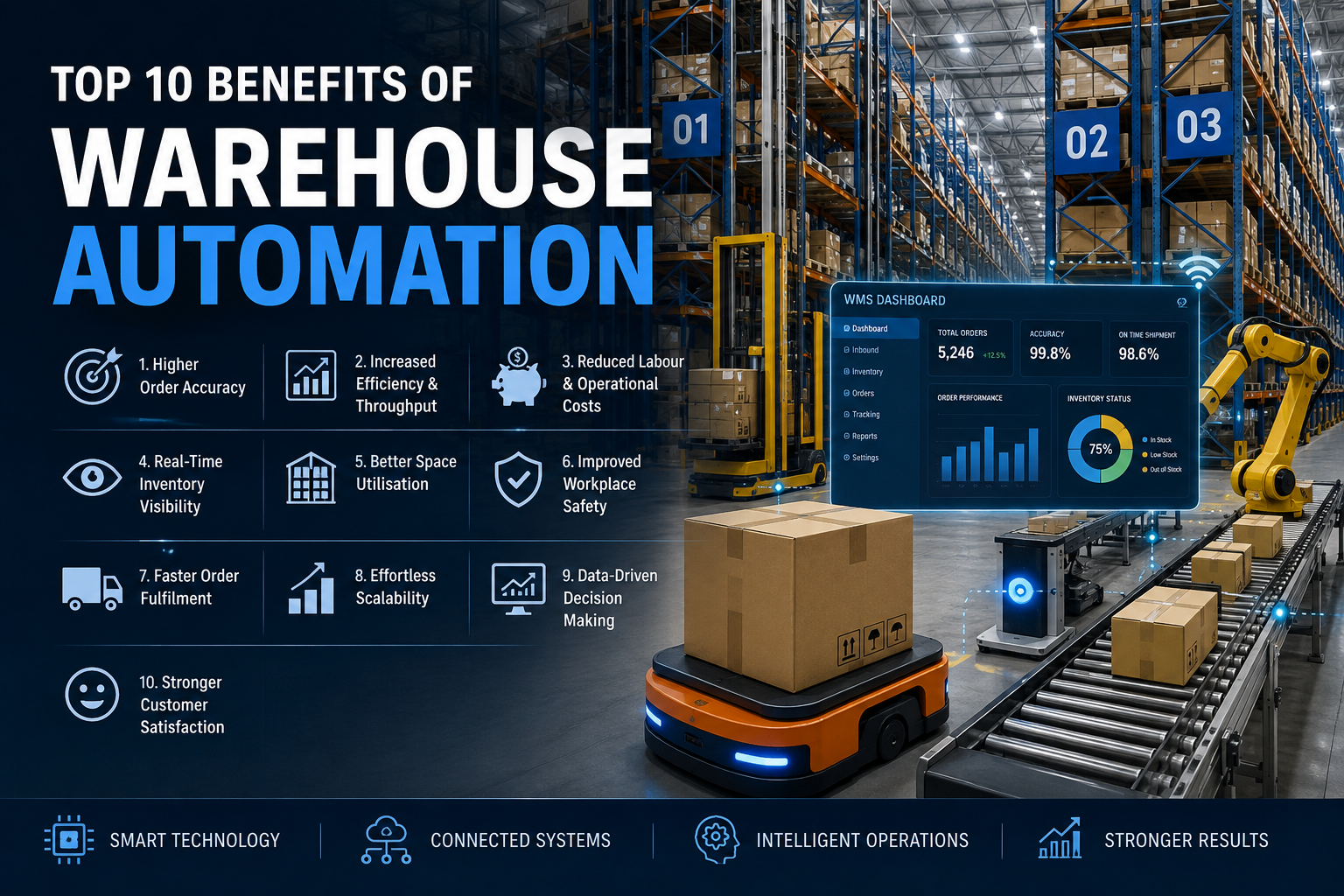
That is why so many operations are turning to automation. But the real question is not whether to automate — it is understanding exactly what you gain when you do. Below are the top 10 benefits of warehouse automation, and why each one matters to your bottom line.
▶ Watch: Smart Warehouse Solutions
What Is Warehouse Automation?
Warehouse automation is the use of technology — software, robotics, and connected equipment — to handle tasks that people once did by hand. It ranges from a warehouse management system that directs every move, to physical warehouse automation systems like conveyors, robots, and storage cranes. The goal is simple: take the repetitive tasks off your team and let data run the warehouse process. Here is what that delivers.
1. Higher Order Accuracy
Few things damage customer trust faster than the wrong item arriving at the door. Automation removes much of the human guesswork from picking, packing, and shipping by using scans and system-directed workflows to confirm every item. The result is near-perfect order accuracy, far fewer returns, and a reputation your customers can rely on. Every avoided error also saves the hidden costs of re-picking, re-shipping, and handling complaints, which quietly add up across thousands of orders.
2. Increased Efficiency and Throughput
Automated systems do not take breaks, and they do not waste time walking empty aisles. By handling the repetitive tasks and routing work intelligently, automation increases efficiency across the whole warehouse operation — letting you process far more orders per hour without adding floor space or people. Machines also keep a steady pace through the night shift and peak periods, so throughput stays high when it matters most.
3. Reduced Labour and Operational Costs
Labour is the single biggest cost in most warehouses, and it keeps rising. Automation delivers reduced labour costs by taking over the high-volume manual work, and reduced operational costs by cutting errors, overtime, and wasted movement. The savings compound year after year, which is what makes the investment pay for itself. Just as importantly, automation reduces your dependence on hard-to-find seasonal labour, giving you predictable costs even when the job market is tight.
4. Real-Time Inventory Visibility
When stock is tracked by hand, your numbers are always a little out of date. Automation — powered by RFID and barcode solutions — gives you real-time data on inventory levels and locations. This live view is the key to optimizing inventory management, avoiding both stockouts and dead stock, and tracking inventory with confidence. With accurate inventory levels at your fingertips, you can hold less safety stock and free up cash that would otherwise sit on the shelf.
5. Better Space Utilisation
Floor space is expensive, and most warehouses waste more of it than they realise. Automated storage and retrieval systems (ASRS) store goods densely and go vertical, often doubling capacity in the same footprint. Better space utilisation can delay or even eliminate the need for a costly move to a larger building. Reclaiming that space also creates room for value-adding activities like kitting or returns processing, without expanding your footprint.
6. Improved Workplace Safety
Manual handling, heavy lifting, and busy forklift traffic are the biggest sources of warehouse injuries. By using autonomous mobile robots (AMRs) and conveyor systems to move goods, automation takes people out of harm’s way. Improved safety means fewer injuries, lower insurance costs, and a workforce that feels looked after. A safer environment also reduces costly downtime and the disruption that follows a serious incident on the floor.
7. Faster Order Fulfilment
Customers now expect next-day, sometimes same-day, delivery. Automation compresses the time between an order landing and a parcel leaving the dock by streamlining picking, packing, and shipping into one smooth flow. Faster fulfilment directly lifts customer satisfaction and helps you compete with the biggest players in your market. Shorter cycle times also give you more flexibility to handle last-minute orders and tight carrier cut-offs.
8. Effortless Scalability
Demand is rarely steady. Peak seasons, promotions, and sudden growth can overwhelm a manual operation, forcing frantic hiring and training. Automated warehouse systems scale far more gracefully — absorbing volume spikes across your supply chains without the operation grinding to a halt, then flexing back down when things quieten. This means you can say yes to big customers and busy seasons without gambling on whether you can physically fulfil the orders.
9. Data-Driven Decision Making
Every automated action generates data. Over time that becomes a powerful, data-driven picture of how your warehouse really performs — where the bottlenecks are, which products move fastest, and where to improve next. It also makes forecasting far more reliable, so you plan staffing and stock around evidence rather than guesswork. Combined with Industrial IoT sensors, this real-time data turns gut-feel decisions into confident, evidence-based ones.
10. Higher Customer Satisfaction and Competitive Edge
Every benefit above rolls up into this one. Accurate orders, fast delivery, and reliable stock all add up to happier customers who come back and recommend you. In a market where service is the differentiator, the benefits of warehouse automation give you a genuine, lasting competitive edge that manual operations simply cannot match. Over time, that reputation for reliability becomes one of your strongest sales advantages.
Conclusion
Warehouse automation is no longer a luxury reserved for the giants — it is becoming the baseline for any operation that wants to stay competitive. From accuracy and safety to lower costs and happier customers, the benefits reinforce one another and grow over time. The best part is that you do not have to automate everything at once; even a single well-chosen automation solution can start delivering returns quickly.
Ready to Unlock These Benefits?
Brilliant Info Systems designs warehouse automation that fits your operation — from WMS and RFID to ASRS, conveyors, and autonomous robots. Talk to our team to find out which automation solution will deliver the biggest impact for your warehouse.
Frequently Asked Questions
What is the biggest benefit of warehouse automation?
It varies by operation, but most businesses see the greatest impact from higher order accuracy and reduced labour costs. Together they cut errors and expenses while freeing your team for higher-value work.
Does warehouse automation replace workers?
No. Automation takes over repetitive, physical tasks so your people can focus on judgment, problem-solving, and customer service. The goal is a safer, more productive team — not an empty warehouse.
Is warehouse automation only for large companies?
Not at all. Because you can automate in stages — starting with a WMS or a single conveyor line — small and mid-sized warehouses can adopt automation affordably and scale it as they grow.
How quickly does warehouse automation pay off?
Many operations see returns within one to three years, driven by reduced labour costs, fewer errors, and higher throughput. Starting with the biggest bottleneck usually delivers the fastest payback.
What technologies are used in warehouse automation?
Common technologies include warehouse management systems, RFID and barcode tracking, conveyors, automated storage and retrieval systems (ASRS), and autonomous mobile robots (AMRs), all tied together by real-time data.