
Ground Vibration Monitoring: Why It Matters During Blasting Operations
When explosives break rock, only part of their energy does the intended work. The rest travels outward as ground vibration — waves that ripple through the earth and can be felt in buildings hundreds of metres away. Left unchecked, these blast induced ground vibrations can crack walls, spark community complaints, and breach regulations. Ground vibration monitoring is how mining and quarrying operations keep that energy in check.
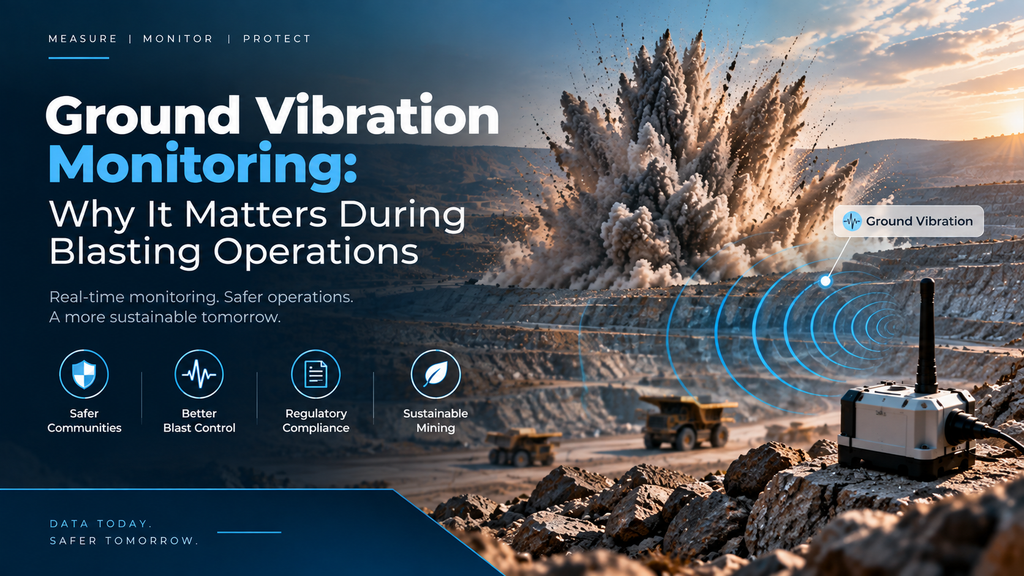
Monitoring is not just a regulatory box to tick; it protects structures, people, and the future of the operation itself. This guide explains what ground vibration monitoring is, why it matters during blasting operations, the parameters and limits involved, and how a modern blast vibration monitoring solution makes it reliable.
Table of Contents
- What is ground vibration monitoring?
- What causes blast-induced vibrations?
- Why it matters
- Key parameters
- Ground vibration limits
- How monitoring works
- Beyond blasting: condition monitoring
- FAQs and conclusion
What Is Ground Vibration Monitoring?
Ground vibration monitoring is the practice of measuring the vibrations that travel through the ground when a blast is detonated. Using vibration sensors placed at key locations, a vibration monitoring system records how strongly and how often the ground moves, then compares those readings against safe limits.
The purpose is simple: allow productive blasting while ensuring the resulting vibration stays within levels that will not damage nearby structures. It turns each blast event from an unknown into a clear, measurable set of vibration data.
What Causes Blast-Induced Ground Vibrations?
When explosives detonate, they create intense pressure that shatters the surrounding rock. Not all of that energy is used to break rock — a portion radiates outward as seismic waves, travelling through the ground in every direction. These blast-induced ground vibrations lose energy as they travel, but near the source they can be strong enough to shake structures noticeably.
How far and how strongly they travel depends on the explosive charge, the rock and soil conditions, the distance to the structure, and the blast design. Because so many factors are involved, the only reliable way to know a blast’s true impact is to measure it directly.
Why Ground Vibration Monitoring Matters
The stakes are high, which is why monitoring is essential rather than optional. It matters for several connected reasons:
- Preventing structural damage: excessive vibration can crack plaster, damage walls, and, at extreme levels, affect foundations.
- Protecting communities: mines increasingly operate near homes and infrastructure that feel every blast.
- Meeting regulations: operations must prove that vibration stays within legal ground vibration limits.
- Maintaining trust: objective vibration data resolves complaints fairly and keeps the operation running.
- Improving operational efficiency: monitoring data helps refine blasts, improving fragmentation and reducing waste.
Without monitoring, a single dispute or an unnoticed exceedance can halt an entire operation. With it, blasting stays both safe and productive.
Key Parameters in Ground Vibration Monitoring
Effective monitoring focuses on a few well-defined measurements. The most important is peak particle velocity (PPV), but it is always read alongside frequency and other factors:
| Parameter | Why it matters |
| Peak particle velocity (PPV) | The key measure of vibration intensity and damage potential |
| Frequency range | Low frequencies are closer to a building’s natural frequency and more damaging |
| Duration | How long the structure is shaken by the blast event |
| Three-axis movement | Ground moves vertically and horizontally; all axes are recorded |
The reason frequency matters so much is resonance: vibration in a low frequency range sits closer to the natural frequency at which buildings flex, making the same PPV potentially more damaging. Good monitoring always captures both PPV and vibration frequencies together.
Ground Vibration Limits and Standards
Because damage depends on both velocity and frequency, ground vibration limits are set by standards and regulations rather than a single universal figure. International and national standards define permissible vibration levels for different building types, with lower limits for older or more sensitive structures.
The table below gives a general, illustrative sense of vibration levels. The exact limits that apply to your site depend on local regulations and the standard in force, so always work to the specific figures set for your operation.
| General vibration level | What it typically means |
| Very low | Barely perceptible; no effect on structures |
| Low | Felt by people indoors; well within safe limits |
| Moderate | Clearly felt; may prompt complaints but usually below damage thresholds |
| High | Approaching or exceeding limits; risk of structural damage |
How Ground Vibration Monitoring Works
A ground vibration monitoring system follows a clear chain from the blast to a compliance record:
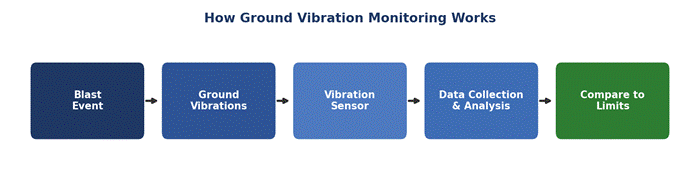
A blast event sends vibrations through the ground; a vibration sensor — typically a geophone in a seismograph — detects them; the monitoring equipment handles data collection, recording velocity on three axes; and the system analyses the readings, comparing them against limits. Modern IoT sensors and smart sensors stream this data in real time, so any exceedance is flagged instantly rather than discovered later — as covered in our guide to real-time blast monitoring.
Beyond Blasting: Condition Monitoring and Predictive Maintenance
The same vibration expertise that protects structures also protects equipment. Vibration analysis is the foundation of condition monitoring, where sensors watch rotating machinery for the tell-tale vibration signatures of a developing bearing and gear fault. Feeding this into predictive maintenance lets teams fix machines before they fail.
For a mining operation, this means the investment in vibration monitoring can serve double duty — safeguarding nearby structures from blast vibration while also protecting crushers, conveyors, and other critical equipment through condition monitoring. Both rely on the same core skill: turning vibration into actionable insight.
Best Practices
To get reliable results, place monitoring equipment at the nearest and most sensitive structures, not just at the blast. Know the ground vibration limits that apply in your area, keep sensors calibrated, and record every blast rather than only the large ones. Wherever possible, use real-time monitoring so exceedances are caught immediately — and review the accumulated vibration data over time to improve blast design and operational efficiency.
When Is Ground Vibration Monitoring Required?
Monitoring is most critical whenever a blast could affect something of value nearby. That includes mines and quarries operating close to residential areas, roads, railways, pipelines, or heritage buildings, and any site where regulators require proof of compliance. It is equally important on projects near hospitals, schools, or sensitive equipment, where even moderate vibration can cause disruption.
In practice, most modern operations monitor continuously rather than blast by blast. Continuous coverage builds a complete record of vibration levels over time, makes it easier to demonstrate compliance, and provides the accumulated data needed to steadily improve blast design. The closer a site is to sensitive structures, the stronger the case for permanent, real-time monitoring.
Conclusion
Ground vibration monitoring is what allows modern blasting to be both powerful and responsible. By measuring blast-induced ground vibrations and keeping them within safe limits, operations protect structures, satisfy regulators, and maintain the trust of the communities around them.
The same vibration data also drives better blast design and even equipment health through condition monitoring. Captured reliably — ideally in real time — a blast vibration monitoring solution turns ground vibration from a hidden risk into a well-managed, measurable part of every blast.
Monitor Ground Vibration with Brilliant Info Systems
Brilliant Info Systems provides a complete blast vibration monitoring solution — powered by IoT and smart sensors with real-time data, analysis, and predictive maintenance. Contact our team to monitor ground vibration accurately across your operation.
Frequently Asked Questions
What is ground vibration monitoring?
It is the measurement of vibrations travelling through the ground during blasting, using vibration sensors, to ensure the vibration stays within safe and legal limits for nearby structures.
Why is ground vibration monitoring important during blasting?
It prevents structural damage, protects nearby communities, proves regulatory compliance, and provides data to refine blasts — allowing blasting operations to continue safely and efficiently.
What is PPV in ground vibration monitoring?
PPV, or peak particle velocity, is the maximum speed at which the ground moves during a blast, measured in mm/s. It is the key indicator of vibration intensity and the basis of most vibration limits.
What are typical ground vibration limits?
There is no single universal limit — permissible vibration levels depend on the standard in force, local regulations, and the type of structure nearby, with sensitive buildings having lower limits than robust industrial ones.
How is ground vibration measured?
A vibration sensor, usually a geophone in a seismograph, records ground velocity on three axes throughout a blast. Monitoring systems then identify the peak values and compare them against limits.
Can vibration monitoring also help with equipment maintenance?
Yes. The same vibration analysis underpins condition monitoring, detecting bearing and gear faults in machinery and feeding predictive maintenance — so equipment is serviced before it fails.