
Understanding PPV: The Key Parameter in Blast Vibration Monitoring
If you work anywhere near blasting, one three-letter term comes up more than any other: PPV. It appears in regulations, monitoring reports, and every conversation about whether a blast was safe. Yet many people use it without fully understanding what it measures or why it matters so much. Get PPV right and you can blast productively while protecting nearby structures; misunderstand it and you risk damage, disputes, and downtime.
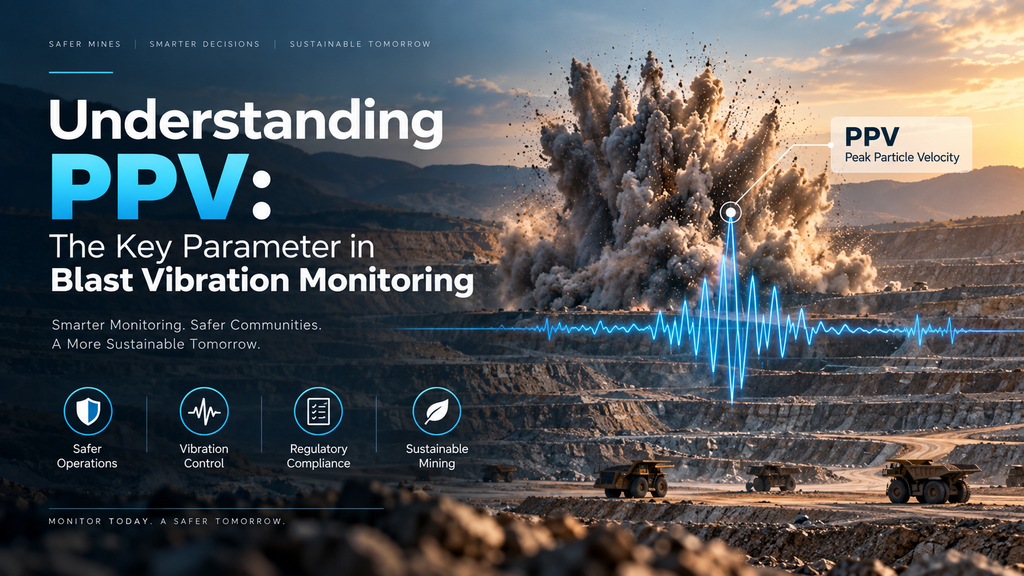
Peak particle velocity (PPV) is the single most important number in blast vibration monitoring. This technical guide explains what PPV is, how PPV measurement works, why it matters for structures, and how it is used within a modern blast vibration monitoring solution.
Table of Contents
- What is PPV?
- How PPV is measured
- Why PPV matters for structures
- PPV and frequency
- Vibration limits and standards
- How PPV is used in monitoring
- FAQs and conclusion
What Is PPV (Peak Particle Velocity)?
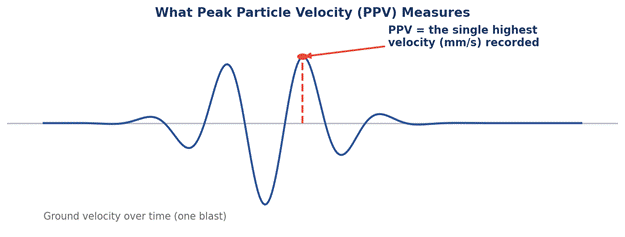
Peak particle velocity is the maximum speed at which a particle of ground moves as a vibration wave passes through it. When explosives detonate, they send shock waves and ground vibrations outward through the rock masses and soil. As those waves travel, they make the ground oscillate back and forth — and PPV captures the fastest that movement gets at a given point.
It is measured in millimetres per second (mm/s). Importantly, PPV is a velocity, not a distance — it describes how fast the ground moves, not how far. That distinction matters, because it is the speed of ground movement that correlates most closely with the potential to damage structures.
How PPV Is Measured
PPV is captured by a geophone — a sensor that measures ground velocity — usually as part of a seismograph within a blast vibration monitoring solution. Because ground moves in three directions at once, monitoring equipment records velocity on three axes: vertical, and two horizontal (longitudinal and transverse).
The system records the velocity waveform for each axis throughout the blasting event, then identifies the single highest value — that peak is the PPV. Modern IoT sensors and smart sensors capture this collected data automatically and stream it for analysis, so the PPV of every blast is logged without manual effort.
Why PPV Matters for Structures
The reason PPV dominates blast monitoring is simple: it is the best single predictor of whether ground vibrations might damage a building. Too much velocity can crack plaster, damage walls, or, at extreme levels, affect foundations. The effects of vibration depend on the structure, but PPV gives a consistent, measurable way to judge the risk.
This is why limits are set around sensitive structures — homes, schools, churches, and older or heritage buildings that are more vulnerable than modern industrial ones. Monitoring PPV at these locations, rather than just at the blast, is what keeps blasting safe for the community around a site.
PPV and Frequency: Why Both Matter
PPV rarely tells the whole story on its own. The frequency of the blasting vibration — how rapidly the ground oscillates, measured in hertz — matters just as much. The same PPV can be more or less damaging depending on its frequency.
Low-frequency vibrations are generally more damaging to structures, because they are closer to the natural frequency at which buildings tend to resonate. Higher-frequency vibrations, though sometimes more noticeable to people, usually pose less structural risk. That is why good monitoring records both PPV and the associated vibration frequencies, and why many standards define limits as a combination of the two rather than PPV alone.
Vibration Limits and Standards
Because the risk depends on both velocity and frequency, PPV limits are defined by standards and regulations rather than a single universal number. International standards such as ISO 4866 provide the framework for measuring and evaluating structural vibration, and individual countries and regions set their own permissible vibration levels for different building types.
The table below gives a general, illustrative sense of vibration levels — but the exact limits that apply to your site depend on local regulations, the standard in force, and the type of structure nearby. Always work to the specific limits set for your operation.
| General vibration level | What it typically means |
| Very low | Barely perceptible; no effect on structures |
| Low | Perceptible to people indoors; well within safe limits |
| Moderate | Clearly felt; may prompt complaints but usually below damage thresholds |
| High | Approaching or exceeding limits; risk to sensitive structures |
How PPV Is Used in Blast Monitoring
In practice, PPV turns each blast into a clear pass-or-fail result. A blast vibration monitoring solution records the PPV at sensitive locations, compares it to the applicable limit, and flags any exceedance. Over time, this collected data does more than prove compliance — it helps engineers refine blasting operations, adjusting charge sizes and timing to keep vibration levels down while maintaining productivity.
This is where real-time monitoring adds real value: instead of discovering a high PPV the next day, teams are alerted immediately. Our guides on real-time blast monitoring and how blast vibration monitoring works explore that side in more detail.
Conclusion
PPV is the heartbeat of blast vibration monitoring — the one measurement that best captures whether a blast is safe for the structures around it. Understanding that it measures peak ground velocity in mm/s, that it must be read alongside frequency, and that safe limits depend on standards and structure type is essential for anyone involved in blasting.
Measured properly and monitored in real time, PPV lets operations blast productively while protecting people and property. A modern blast vibration monitoring solution makes capturing and acting on PPV straightforward — turning a critical technical parameter into everyday, defensible practice.
Monitor PPV with Brilliant Info Systems
Brilliant Info Systems provides a complete blast vibration monitoring solution — powered by IoT and smart sensors with real-time PPV capture and analysis. Contact our team to monitor peak particle velocity accurately across your operation.
Frequently Asked Questions
What is PPV in blast monitoring?
PPV, or peak particle velocity, is the maximum speed at which the ground moves as a blast vibration passes, measured in millimetres per second. It is the key parameter used to judge whether a blast risks damaging nearby structures.
How is PPV measured?
PPV is measured with a geophone in a seismograph, which records ground velocity on three axes throughout a blast. The single highest velocity value recorded is the PPV, captured automatically by modern monitoring systems.
What is a safe PPV level?
There is no single universal figure — safe PPV limits depend on the standard in force, local regulations, and the type of structure nearby. Sensitive buildings have lower limits than robust industrial ones.
Why does frequency matter alongside PPV?
The same PPV can be more or less damaging depending on frequency. Low-frequency vibrations are generally more harmful to structures, so many standards set limits based on both PPV and the frequency of the blast.
What units is PPV measured in?
PPV is measured in millimetres per second (mm/s), describing how fast the ground moves — not how far it moves — which is what correlates most closely with the potential for structural damage.
How is PPV data used?
PPV data proves compliance with vibration limits and helps engineers refine blast design over time, adjusting charges and timing to reduce vibration while keeping blasting operations productive.