
What Is a Warehouse Management System (WMS)? Features, Benefits & Implementation Guide
Running a warehouse on spreadsheets and memory works — until it doesn’t. As order volumes grow, manual tracking leads to lost stock, picking errors, and slow dispatch, and every one of those mistakes costs money and customers. A Warehouse Management System (WMS) replaces that guesswork with software that controls and records every movement of inventory, from the moment goods arrive to the moment they ship.
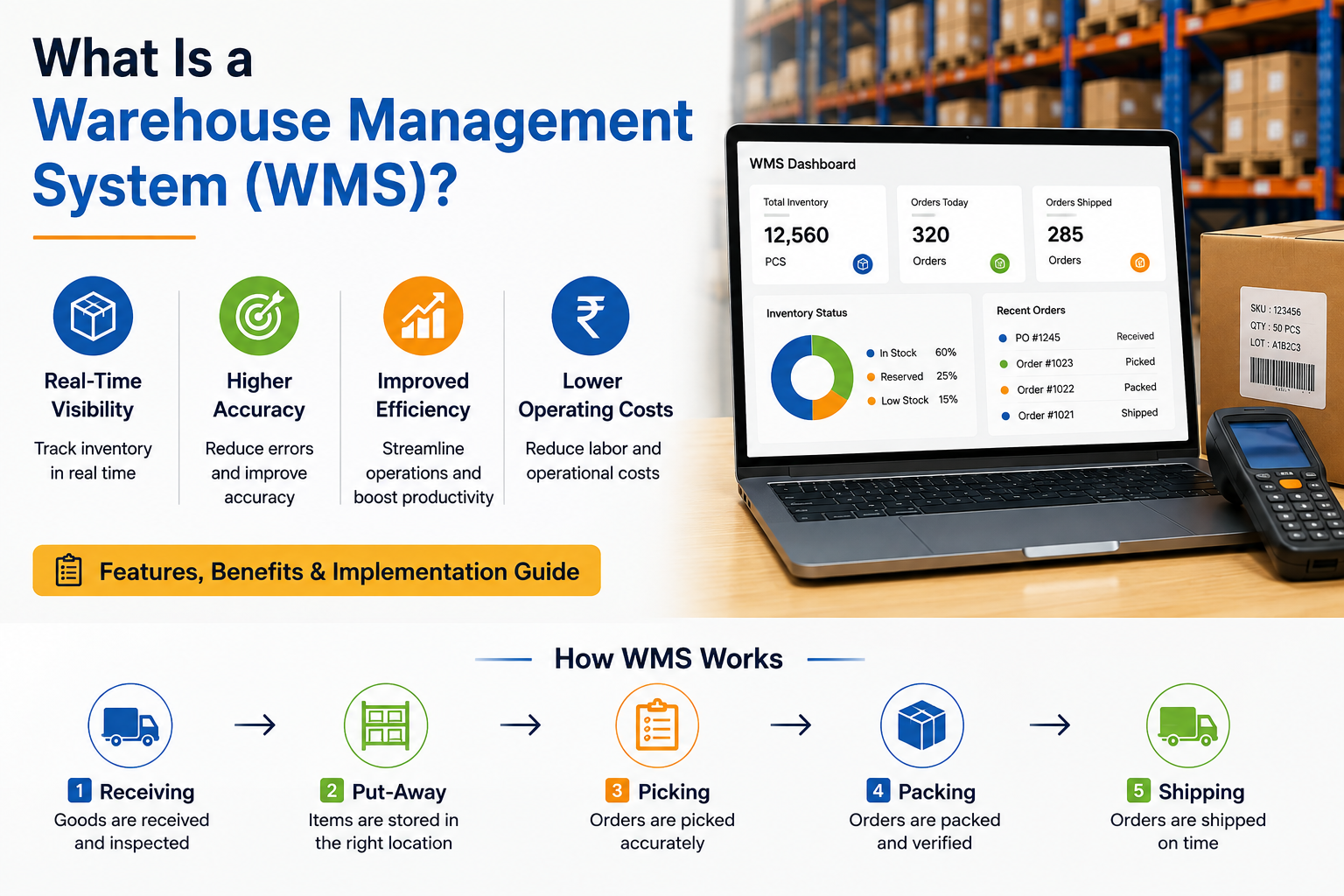
This guide explains what a WMS actually is, the core features that matter, the benefits of upgrading, and how it differs from an ERP — so you can decide what your operation needs.
▶ Watch our video: Warehouse Management System (WMS)
What Is a Warehouse Management System?
A Warehouse Management System is software that directs and records how inventory moves and is stored inside a warehouse. It tells staff where to put stock, where to find it, the most efficient way to pick it, and when to reorder — while keeping a live, accurate record of what you have and exactly where it is.
Where a basic inventory list simply counts stock, a Warehouse Management System actively controls it: assigning tasks, guiding workers through handheld scanners or voice, and connecting to your ERP, e-commerce, and shipping tools so the whole operation runs as one.
Core Features to Look For
When you choose a new platform, it helps to know which features matter most. The best systems do far more than basic inventory management — here are the ones that make a real difference.
Comprehensive Inventory Management
At the heart of any solution is strong tracking. A good WMS keeps up with every unit, carton, and pallet, and can track expiry dates for perishable goods and serial numbers for high-value electronics — so nothing gets lost. This level of detail is what makes advanced inventory tracking pay off as a business grows.
Inbound and Outbound Optimization
A top system guides receiving, put-away, and smart slotting. It improves your warehouse layout by suggesting the best storage location for each new item: fast-moving goods stay near packing stations, while slower stock is stored higher or further back. That cuts worker walking time and speeds up daily operations.
Advanced Tracking Technologies
Modern sites rely on barcoding and RFID integration rather than counting boxes by hand and typing SKU numbers. Workers simply scan items as they move through the building. Accurate data capture is the foundation of warehouse automation — without reliable barcodes or RFID tags, robotic retrieval systems and automated conveyors have nothing to work with.
Streamlined Fulfillment
To meet customer demand and tight shipping deadlines, modern sites need fast, accurate picking and packing. Advanced systems generate optimised pick lists and batch orders, then guide workers along the best routes through the aisles — reducing backtracking and physical fatigue. For busy teams, this is one of the biggest advantages a WMS delivers.
Labor and External Integrations
Managing people matters as much as managing stock. Built-in labor management tools help supervisors monitor performance, track key metrics, and spot where extra training can improve safety and speed. And if you work with outside partners, smooth third-party logistics (3PL) integration lets your system connect cleanly with carriers, suppliers, and fulfilment partners.
Major Benefits of Upgrading Your Technology
Why should a company invest time and money in better warehouse technology? Because the benefits reach every team.
- Enhanced stock visibility: Real-time inventory visibility shows exactly what is in stock at any moment, helping you avoid overselling online and spot dead stock early.
- Higher accuracy: Scan-verified counts replace manual data entry, cutting the mispicks and stock discrepancies that trigger returns and complaints.
- Faster fulfilment: Optimised put-away and picking shorten order turnaround, so you meet delivery promises even during peak demand.
- Better labour productivity: Task direction and performance data let the same team handle more volume without the chaos.
- Scalability: A structured system absorbs growth — more SKUs, more orders, more channels — without breaking your process.
- Seamless integration: Clean data flows automatically to your ERP, e-commerce store, and shipping carriers, removing double entry and errors.
- Improved customer satisfaction: Accurate stock and on-time, correct orders build the reputation that wins repeat B2B business.
WMS vs ERP: How Are They Different?
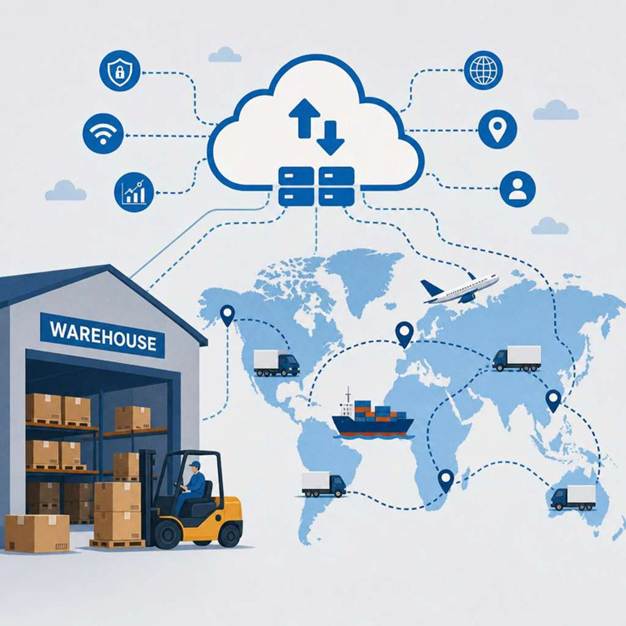
This is one of the most common questions buyers ask. An ERP manages broad company functions — accounting, HR, payroll, and high-level CRM. A WMS controls what happens on the warehouse floor — receiving, storage, picking, packing, and dispatch. Think of the ERP as the business’s central nervous system and the WMS as the hands-on muscle doing the physical work. Used together, and properly integrated, they give you a complete view of business health. If you also run production or automated equipment, a Warehouse Control System sits between the WMS and your machines to coordinate them in real time.
Conclusion
Managing a distribution centre does not have to feel like a guessing game of lost clipboards and late spreadsheets. With a modern WMS, businesses of every size can turn their sites into efficient, low-error operations. Whether you start with basic tracking or move to a fully automated setup, the core idea stays the same: a strong digital platform gives you clear control, faster fulfilment, and greater long-term profit. Upgrading your logistics backbone is one of the smartest moves a growing business can make.
Ready to see what a WMS could do for your warehouse? Explore Brilliant Info Systems Warehouse Management System or talk to our team for a walkthrough tailored to your operation.
Frequently Asked Questions
What is a Warehouse Management System (WMS), and how is it different from an ERP?
A WMS is software that directs and improves the movement and storage of goods from receiving to shipping, tracking each unit, location, and task on the warehouse floor. An ERP manages broad company functions like accounting, HR, payroll, and CRM. The ERP is the business’s central nervous system; the WMS is the hands-on muscle on the warehouse floor. Together they give a full view of business health.
Which core features should I prioritise when selecting a WMS?
Start with comprehensive inventory tracking (units, cartons, pallets, expiry and serial numbers), inbound/outbound optimisation with smart slotting, barcode and RFID data capture, optimised picking and packing, and built-in labor management. Also confirm it integrates cleanly with your ERP, e-commerce platform, and 3PL partners.
Does a small business really need a WMS?
Yes — often more than it realises. Even at modest volumes, a WMS removes manual errors and creates a scalable process, so growth doesn’t turn into chaos. Many systems scale with you, so you pay for what you need today and expand later.
How does RFID improve a WMS?
RFID lets workers capture stock data by scanning tags automatically instead of typing SKUs, which speeds up receiving, picking, and stock counts while sharply improving accuracy. It is also the foundation for warehouse automation.
good information