
WMS vs WCS vs ERP: Differences and How They Work Together in a Modern Warehouse
Picture a fast-growing distribution centre on its busiest morning of the year. Orders are flooding in, the conveyors are running, and the team is picking as fast as they can. Then two trucks arrive at once, an online promotion doubles the order queue, and suddenly nobody is sure which system is supposed to be in charge of what. The ERP shows orders. The warehouse software shows stock. The conveyor controller is doing its own thing. Work slows, mistakes creep in, and the finger-pointing starts.
This is the exact moment most companies realise they never fully understood the difference between their ERP, their WMS, and their WCS — and how those systems are supposed to hand work to each other. It is one of the most common sources of confusion in warehouse technology, and it leads to expensive mistakes: buying the wrong platform, automating on a shaky foundation, or expecting one system to do a job it was never built for.
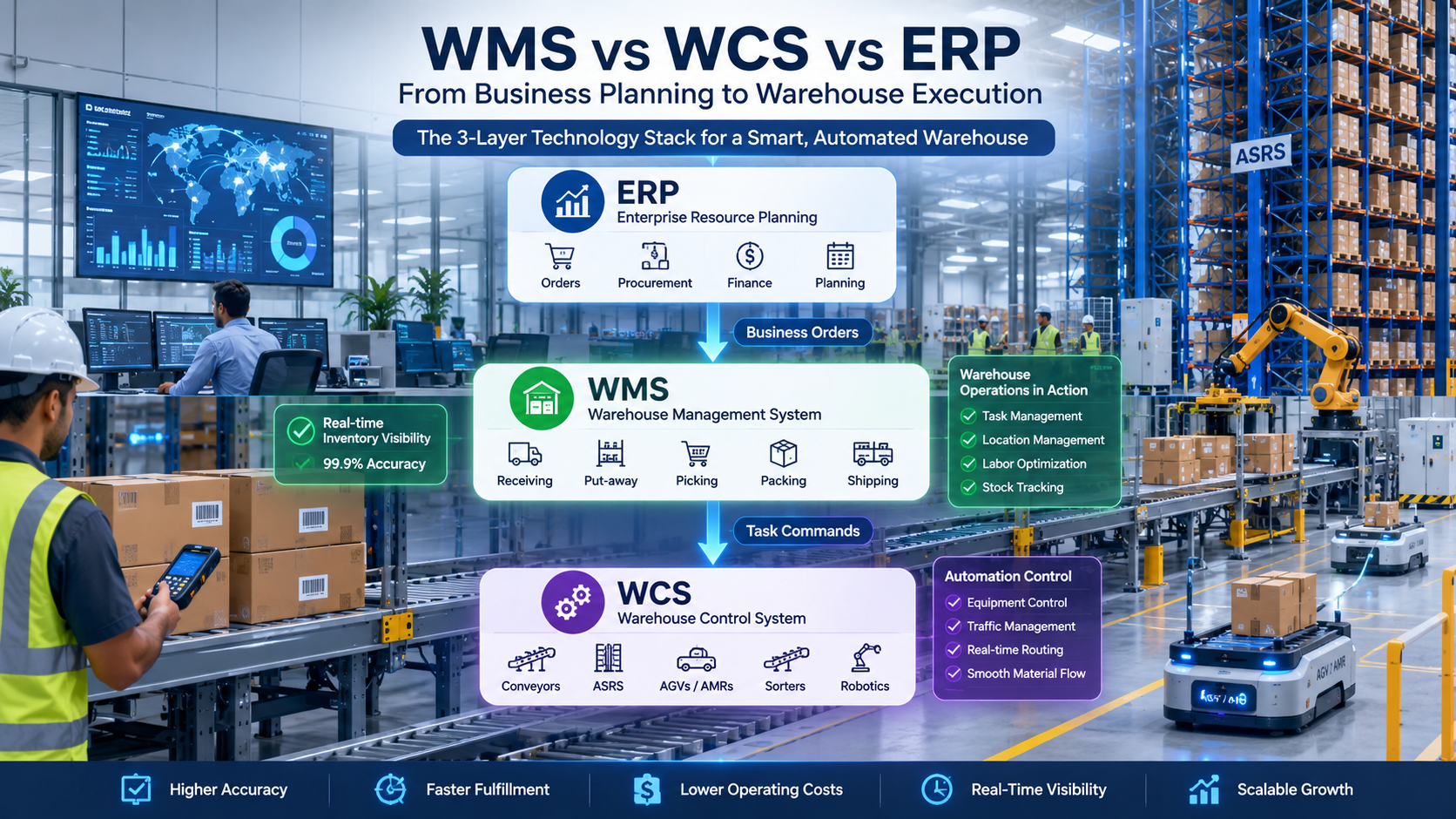
In this guide we clear that up for good. You will learn what ERP, WMS, and WCS each actually do, how they differ, how they work together as a single stack, and how to decide which ones your operation needs as it grows. We will use real warehouse examples throughout, so the concepts stick.
▶ Watch our video: Warehouse Control System (WCS)
What Is an ERP (Enterprise Resource Planning System)?
An ERP is the system that runs the whole business. It is the financial and commercial brain of the company — the place where a customer order officially exists, where inventory is valued, and where purchasing, accounting, and sales all meet. When someone in the business asks “what did we sell and what did it cost us,” the answer lives in the ERP.
In a warehouse context, the ERP’s role is to own the order and the money around it, not the physical work. It receives the sales order, checks credit and pricing, reserves stock at a high level, and later records the shipment and the invoice. What it does not do well is direct the second-by-second activity on the warehouse floor — that is simply not what it was designed for. Understanding that boundary is the key to the whole ERP vs WMS vs WCS question.
Its key functions typically include:
- Finance and accounting: general ledger, payables, receivables, and inventory valuation.
- Order and customer management: sales orders, pricing, and the customer record.
- Procurement and supply chain: purchase orders and supplier management across the wider supply chain.
- Business reporting: company-wide dashboards for leadership and finance.
What Is a WMS (Warehouse Management System)?
If the ERP owns the order, a Warehouse Management System owns everything that happens to that order inside the building. The WMS is the operational heart of the warehouse. It knows what stock you hold, exactly where each item sits, and the smartest way to receive, store, pick, and ship it.
Where the ERP thinks in orders and money, the WMS thinks in locations, tasks, and movements. It turns a sales order into a series of physical instructions: go to aisle 12, pick six units, confirm the scan, move to packing. It also manages the people doing that work, tracking productivity and guiding them along efficient routes. This is why a strong WMS is the single biggest lever for accuracy and speed in most warehouses.
A capable WMS handles:
- Inventory management: real-time stock levels, locations, and full traceability.
- Receiving and put-away: directed storage based on size, weight, and demand.
- Order picking and packing: optimised pick paths, batch picking, and scan verification.
- Labor management: task assignment and performance tracking across the team.
A WMS is also the natural hub for capture technologies such as barcode and RFID solutions, which feed it the accurate, real-time data it needs to keep inventory correct.
What Is a WCS (Warehouse Control System)?
A Warehouse Control System lives closest to the machines. If the WMS is the brain deciding what should happen, the WCS is the nervous system that makes the physical equipment actually move. It works in milliseconds, not minutes, coordinating hardware in real time so that goods flow smoothly through an automated facility.
The WCS speaks the language of the floor. It communicates directly with PLCs (the industrial controllers inside machines), and orchestrates equipment control across the whole automation fleet — diverting cartons on a conveyor, releasing a tote from an ASRS crane, or dispatching a robot to the right aisle. Without a WCS, that equipment cannot act on the WMS’s instructions in a coordinated way.
In a smart warehouse, the WCS typically controls or coordinates conveyor automation, sortation systems, ASRS, and mobile robots such as AGVs and AMRs. It is the layer that turns a WMS instruction into synchronised machine movement.
Core WCS functions include:
- Real-time equipment control: direct communication with PLCs, conveyors, and sorters.
- Automation coordination: synchronising ASRS, AGVs, and AMRs so they don’t collide or idle.
- Flow management: routing and diverting product across the material-handling network.
- Exception handling: detecting jams or faults and rerouting work instantly.
WMS vs WCS vs ERP: A Side-by-Side Comparison
The three systems overlap in conversation but rarely in function. Each was built for a different level of the operation and a different time horizon — from the boardroom down to the conveyor motor. The table below shows how they line up.
| ERP | WMS | WCS | |
| What it is | Enterprise Resource Planning | Warehouse Management System | Warehouse Control System |
| Primary job | Runs the whole business | Runs warehouse operations | Runs the automated equipment |
| Scope | Company-wide | The four walls of the warehouse | The machines on the floor |
| Decides | What the business needs | What to do and where | How the machines execute it |
| Manages | Finance, HR, procurement, sales | Inventory, put-away, picking, labor | Conveyors, sorters, ASRS, AGVs, AMRs |
| Time horizon | Days to months | Hours to days | Milliseconds to seconds |
| Typical users | Executives, finance, planners | Warehouse & ops managers | Controls & automation engineers |
The pattern is clear: the ERP plans, the WMS directs, and the WCS executes. Problems appear only when a company expects one of them to cover another’s job — asking an ERP to run picking, or a WMS to control a high-speed sorter.
How ERP, WMS, and WCS Work Together
The magic is not in any single system — it is in how cleanly they hand work to one another. Think of it as a relay race where the baton is a customer order, passing down through the stack and back up again.
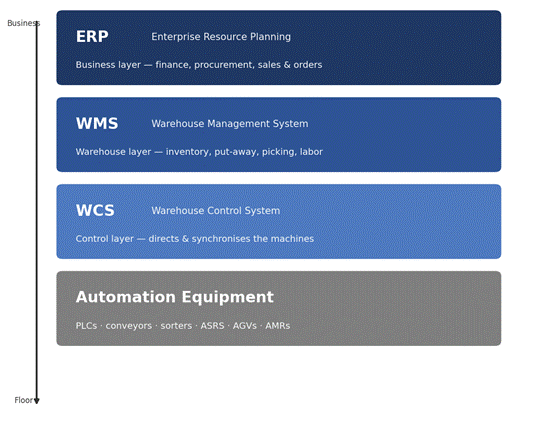
Here is the typical order-to-ship flow. A customer places an order, which the ERP captures along with pricing and stock reservation. The ERP passes the order to the WMS, which decides what to pick, where it lives, and in what sequence. The WMS then releases that work to the WCS, which drives the conveyors, ASRS, and robots to move the goods. Once the order is packed and shipped, confirmation flows back up the stack so the WMS updates inventory and the ERP updates the books.
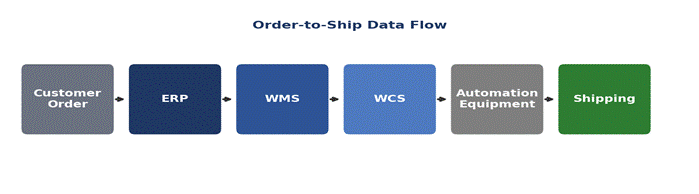
This layered model is the foundation of every smart warehouse. Get the ERP integration and the WMS-to-WCS link right, and information flows without anyone re-keying data — which is exactly what keeps a busy site from grinding to a halt on that peak-season morning.
Real Warehouse Example: An E-commerce Fulfilment Centre
Imagine an online retailer shipping thousands of parcels a day. A shopper checks out at 9 a.m. That order lands in the ERP, which confirms payment and reserves the stock. Within seconds the ERP hands it to the WMS.
The WMS groups that order with hundreds of others into an efficient picking wave, then decides the fastest route through the building. It releases the work to the WCS, which starts the conveyors and directs an ASRS crane to present the right totes to the picker. As cartons travel downstream, the WCS diverts each one to the correct packing lane. The moment the parcel is scanned out, confirmation flows back: the WMS decrements inventory, and the ERP marks the order shipped and raises the invoice.
No single system did all of that. Each played its part, and the hand-offs were invisible to the customer — who simply got a fast, accurate delivery.
Real Warehouse Example: A Manufacturing Plant
The same relationship holds on the factory side, with one addition. Here the ERP plans production and raw-material purchasing. The WMS manages the raw-material and finished-goods stores — receiving components, storing them, and feeding them to the line at the right moment.
On the line itself, the WCS coordinates the automated material handling that moves components between stations and whisks finished goods into storage. In plants pursuing Industrial IoT and Industry 4.0, sensor data from that equipment also flows upward, giving managers live visibility into throughput and bottlenecks. The result is a tightly synchronized operation where planning, storage, and automation all speak the same language.
The Benefits of Integrating ERP, WMS, and WCS
When these three systems are properly connected, the whole operation gets faster, leaner, and far more reliable. The benefits are not abstract — they show up directly in accuracy, cost, and customer satisfaction.
The biggest win is a single source of truth. When the ERP, WMS, and WCS share data in real time, everyone from the CFO to the forklift operator is working from the same numbers. That alone removes a huge class of errors. Beyond that, integration delivers:
- Higher accuracy: scan-verified, automated data flow eliminates the mistakes that manual re-keying creates.
- Faster fulfilment: orders move from click to dispatch with no waiting between systems.
- Lower operating cost: less manual work, less safety stock, and better use of expensive automation.
- Real-time visibility: live inventory and order status across the business, not day-old snapshots.
- Scalability: the same integrated stack absorbs peak volumes and new automation without breaking.
Common Integration Challenges
Connecting these systems is worth it, but it is rarely plug-and-play. Knowing the common pitfalls up front saves months of frustration.
The first challenge is unclear ownership of data. When it is not obvious whether the ERP or the WMS is the master for a given piece of information — say, inventory counts — the two can drift out of sync and undermine trust in both. The second is legacy equipment: older machines may not expose clean interfaces for a WCS to control, requiring middleware or upgrades. The third is timing mismatches, because an ERP thinking in hours has to interface with a WCS thinking in milliseconds, and the integration has to buffer that gap gracefully. Finally, many projects underestimate change management — the people on the floor need training and trust in the new flow, or they will quietly revert to spreadsheets.
Best Practices for a Successful Integration
A smooth ERP-WMS-WCS rollout comes down to a few disciplined choices. Each of these matters because it removes a specific risk that derails projects.
- Define a single master for each data type. Decide clearly whether the ERP or WMS owns inventory, orders, and item data — this prevents the sync conflicts that erode confidence.
- Integrate through proven, standard interfaces. APIs and middleware built for these systems age far better than custom point-to-point code.
- Start with the process, not the software. Map your real workflow first; configure the systems around it, so you automate a good process rather than a bad one.
- Phase the automation. Get ERP and WMS talking cleanly before layering in WCS-controlled equipment, so each layer is stable before the next is added.
- Invest in training. The best integration fails if the team does not trust it; bring the floor along from day one.
The KPIs That Improve After Integration
How do you know the integration is working? You watch the numbers. A well-connected ERP-WMS-WCS stack moves the metrics that operations and finance both care about. The typical improvements look like this:
| KPI | Before integration | After integration | Typical gain |
| Order accuracy | 95–97% | 99.5%+ | Fewer returns |
| Picking productivity | Baseline | +25–40% | More orders per hour |
| Inventory accuracy | 90–95% | 99%+ | Less safety stock |
| Order cycle time | Baseline | -30–50% | Faster dispatch |
| Equipment utilisation | 60–70% | 85%+ | More throughput |
| Manual data entry | High | Near zero | Lower labor cost |
The exact figures vary by site, but the direction is consistent: fewer errors, more throughput, and less wasted labour and stock.
Where This Is All Heading: The Future of Warehouse Technology
The line between these systems is blurring as warehouses get smarter. Several trends are reshaping how the stack works together.
AI-Driven Warehouses
Artificial intelligence is moving from pilot projects into daily operations, optimising pick paths, forecasting demand, and slotting inventory automatically. Increasingly, the WMS and WES use AI to make decisions that once needed an experienced manager.
Digital Twins
A digital twin is a live virtual model of the warehouse, fed by real-time data from the WCS and IoT sensors. Managers can test changes, spot bottlenecks, and simulate peak days before they happen — without touching the real operation.
Industry 4.0 and Predictive Analytics
As Industry 4.0 matures, connected equipment streams data that predictive analytics turns into foresight — flagging a conveyor motor that is about to fail, or a slotting change that will save hours next month. Maintenance shifts from reactive to predictive, and downtime drops.
Autonomous Warehouses
The end state many operators are working toward is the largely autonomous warehouse, where AMRs, robotic picking, and self-optimising software handle the routine work while people focus on exceptions and improvement. The ERP-WMS-WCS stack is the backbone that makes that future possible.
Conclusion
ERP, WMS, and WCS are not competing products to choose between — they are three layers of one well-run warehouse. The ERP plans the business, the WMS directs the work, and the WCS drives the machines. The companies that win are the ones that understand those roles clearly and connect the systems so information flows without friction.
Get that foundation right and everything downstream gets easier: automation pays off faster, peak seasons stop being firefights, and the whole operation becomes something you can scale with confidence.
Ready to Connect Your Warehouse Systems?
Brilliant Info Systems designs and integrates ERP-connected warehouse management and warehouse control systems — from smart warehousing and RFID to ASRS, conveyors, and robotics — built around your operation. Talk to our team for a walkthrough tailored to your site, and see how the right stack can lift accuracy, speed, and throughput across your warehouse.
Frequently Asked Questions
What is the difference between WMS, WCS, and ERP?
An ERP runs the whole business — finance, orders, and procurement. A WMS runs warehouse operations, deciding what to pick and where. A WCS runs the automated equipment, directing conveyors, ASRS, AGVs, and AMRs in real time. They operate at different levels and work best together.
Can a WMS replace an ERP?
No. A WMS manages the physical warehouse, while an ERP manages company-wide finance, procurement, and orders. They serve different purposes and are usually integrated so data flows between them rather than one replacing the other.
Do I need a WCS if I already have a WMS?
Only if you run automated equipment. A WCS is what lets a WMS control conveyors, sortation, ASRS, and robots in real time. A largely manual warehouse can run on a WMS alone; an automated one needs a WCS to coordinate the machines.
How do ERP, WMS, and WCS communicate?
They connect through integrations — typically APIs or middleware. The ERP passes orders to the WMS, the WMS releases work to the WCS, and confirmations flow back up so inventory and financial records stay accurate in real time.
Is a WES the same as a WCS?
No. A Warehouse Execution System (WES) orchestrates and prioritises work across the WMS and WCS, while a WCS focuses on directly controlling the equipment. Some modern platforms blend WMS, WES, and WCS features, but the roles remain distinct.
Which system should a growing warehouse invest in first?
Most start with an ERP and a WMS, since accurate orders and inventory come first. A WCS is added when the site introduces automation such as conveyors or ASRS, and a WES follows in high-volume, heavily automated operations.