
How to Build a Smart Warehouse: A Complete Automation Roadmap
Every warehouse manager knows the feeling. Orders are climbing, customers expect next-day delivery, and the team is already stretched thin. Hiring more people helps for a while, but at some point the aisles simply cannot move any faster on manpower alone. That is the moment most businesses start asking how to build a smart warehouse — and quickly discover there is no single switch to flip.
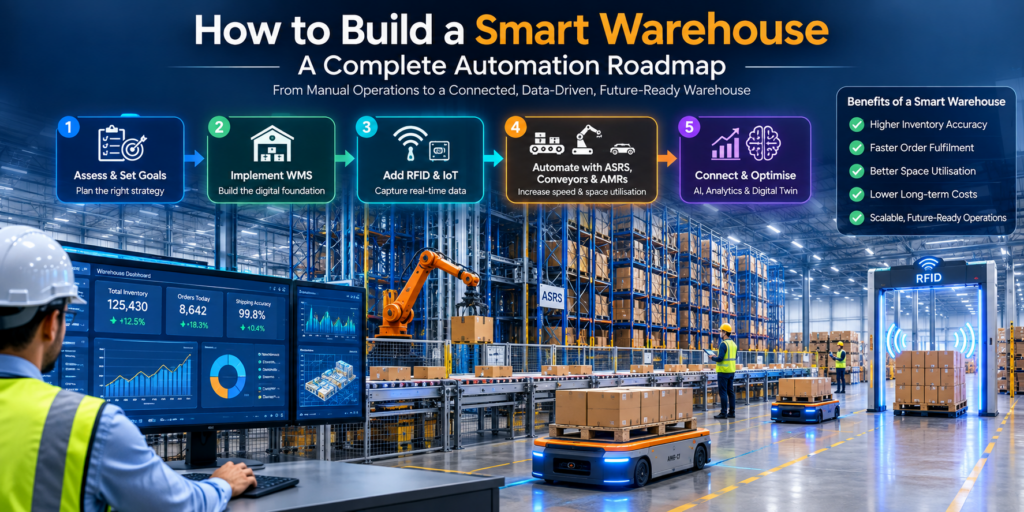
Building a smart warehouse is a journey, not a purchase. It works best as a step-by-step roadmap that moves you from manual, paper-driven work to a connected, data-driven operation — at a pace your business and budget can handle. This guide lays out that complete automation roadmap, stage by stage, so you can modernise with confidence instead of guesswork.
▶ Watch: Smart Warehouse Solutions
What a Smart Warehouse Really Means
A smart warehouse is one where software, sensors, and automated systems work together to move goods with minimal manual effort and maximum visibility. Instead of workers hunting for stock and updating spreadsheets, the systems know what is where in real time and direct both people and machines to the next best task.
The goal is not to remove human workers. It is to let them focus on judgment and exceptions while automation handles the repetitive lifting, transporting goods, and counting. Done well, a smart warehouse gives you faster fulfilment, better accuracy, and a real competitive advantage as your supply chain grows.
The Automation Roadmap at a Glance
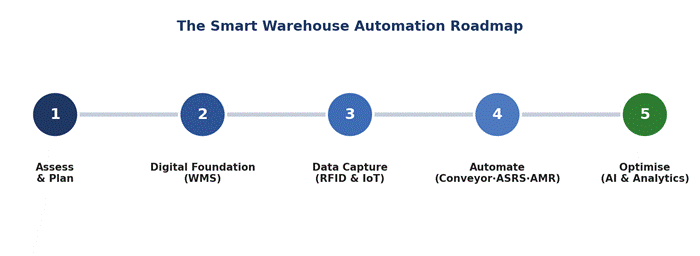
Modernising a warehouse follows five natural stages. Each one builds on the last, so you get value at every step rather than waiting for a single, risky “big bang” project.
Step 1: Assess Your Operations and Set Clear Goals
Before buying any technology, understand how work actually happens today. Walk the floor and map every workflow — receiving, storage, order picking, packing, and shipping — and note where delays, errors, and manual workarounds appear. Talk to the people doing each job, because they see problems that never show up in a report.
Then set measurable goals. Do you need to raise picking speed, improve inventory accuracy, or make better use of your space? Capture baseline numbers for these now. Without a clear starting point, you cannot prove the return on your investment later, and you risk automating a broken process instead of fixing it first.
Step 2: Build the Digital Foundation with a WMS
Automation is only as good as the data behind it, which is why warehouse management systems (WMS) are the true foundation of any smart warehouse. A WMS gives you real-time visibility of inventory levels and locations, directs put-away and order picking, and replaces guesswork with a single source of truth.
Get this layer right before adding machines. When your inventory management is accurate and every movement is tracked digitally, you have the reliable data that every later stage of automation depends on. Skipping this step is the most common — and most expensive — mistake companies make.
Step 3: Add Real-Time Data Capture with RFID and IoT
With a WMS in place, the next step is to feed it faster, cleaner data. RFID solutions and Industrial IoT sensors let stock update itself as it moves, instead of relying on manual scans and counts.
This is where a warehouse becomes genuinely data-driven. RFID gives you near-instant, accurate stock counts; IoT sensors track conditions, equipment health, and movement in real time. Together they deliver the real-time data that powers automated decisions — and lay the groundwork for predictive maintenance, so you fix equipment before it fails rather than after.
Step 4: Automate the Right Tasks — Conveyors, ASRS, and AMRs
Now you are ready for physical automation. The key is to automate where the payback is clearest, not everywhere at once. Conveyor automation speeds up transporting goods across the site, while automated storage and retrieval systems (ASRS) reclaim floor space and improve space utilization by going vertical.
For flexible movement, autonomous mobile robots (AMRs) and AGVs carry goods between zones without fixed tracks, adapting as your layout changes. These storage and retrieval systems and mobile robots take over the repetitive, high-volume work — freeing your team for tasks that need judgment. Start with the one bottleneck that hurts most, prove the results, then expand.
Step 5: Connect, Orchestrate, and Optimise
The final stage turns a collection of automated systems into one intelligent operation. A warehouse control system coordinates the conveyors, ASRS, and robots in real time, so they work together instead of in isolation.
From here, optimisation never really stops. Analytics and AI study your real-time data to fine-tune slotting, staffing, and pick paths, while a digital twin lets you test changes virtually before touching the real floor. This is what separates a merely automated warehouse from a truly smart one — it keeps getting better with every order it processes.
The Benefits of Building a Smart Warehouse
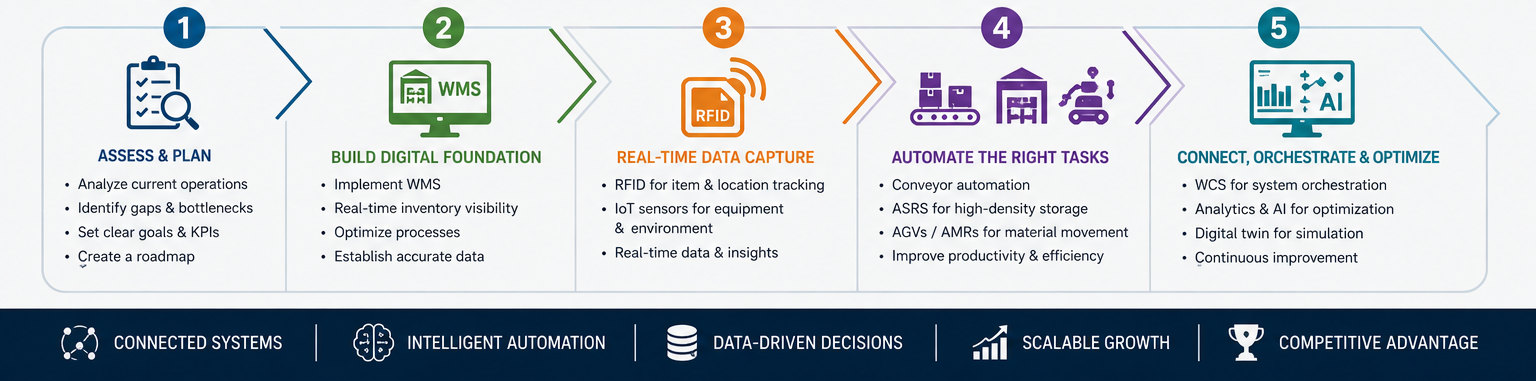
Following this roadmap does more than add technology — it changes how the whole operation performs. The gains compound as you move through each stage:
- Higher accuracy and fewer returns from real-time, scan-verified inventory.
- Faster order fulfilment as automated systems cut walking and waiting time.
- Better space utilisation through vertical storage solutions like ASRS.
- Lower long-term costs from reduced manual work and predictive maintenance.
- A lasting competitive advantage built on a scalable, data-driven supply chain.
Conclusion
Building a smart warehouse is not about buying the flashiest robots — it is about following a clear roadmap in the right order. Assess honestly, build a solid digital foundation, capture accurate data, automate where it pays, and never stop optimising. Take it one stage at a time and each step funds the next, turning a daunting transformation into a series of manageable wins.
The warehouses that thrive over the next decade will be the ones that started this journey early and built it on strong foundations. Wherever you are today, there is a sensible next step on the roadmap.
Ready to Start Your Smart Warehouse Journey?
Brilliant Info Systems helps businesses design and build smart warehouses end to end — from WMS and smart warehouse solutions to RFID, ASRS, conveyors, and autonomous robots. Talk to our team to map the right automation roadmap for your operation.
Frequently Asked Questions
How much does it cost to build a smart warehouse?
Costs vary widely depending on size and how much you automate. Because a smart warehouse is built in stages, you can start with a WMS and data capture for a modest investment, then add automation as each phase proves its return — spreading the cost over time.
How long does warehouse automation take to implement?
A full roadmap typically unfolds over months to a few years, but you see benefits at every stage. The first steps — assessing operations and deploying a WMS — can be completed relatively quickly, with automation layered in afterward.
Do smart warehouses replace human workers?
No. Automation handles repetitive, physical tasks, while human workers focus on judgment, exceptions, and improvement. The goal is a more productive team, not an empty building.
What is the first step to building a smart warehouse?
Assess your current operations and set measurable goals. Understanding your real workflows and baseline numbers ensures you automate the right things and can prove the return later.
What technologies make a warehouse “smart”?
A WMS provides the digital foundation, RFID and IoT deliver real-time data, and conveyors, ASRS, and AMRs handle physical movement. A warehouse control system and analytics tie them together into one coordinated, data-driven operation.