
How to Calculate Warehouse Automation ROI
A warehouse manager walks into the CFO’s office with a proposal to automate. The technology is impressive, the demo went well, and the team is excited. Then comes the only question that really matters: “What’s the return, and when do we get our money back?” Without a clear answer, even the best automation project stalls.
Warehouse automation is a major capital investment, and no serious business commits to it on a hunch. Before a single conveyor is installed, decision-makers need to know what the project will cost, what it will save, and how long it will take to pay for itself. That is exactly what this guide covers. You will learn what warehouse automation ROI really means, which costs and benefits to include, the formulas to use, and a full worked example you can adapt to your own operation.
▶ Watch: Smart Warehouse Solutions
Why ROI Matters in Warehouse Automation
Automation is not a small purchase. Between equipment, software, and installation, a serious project can run into crores, and that capital has to be justified against every other investment the business could make. A clear ROI analysis turns an emotional “this looks great” pitch into a financial case the CFO can approve with confidence.
ROI also protects you after the purchase. By defining the expected return up front, you set the benchmark you will measure against — so you know whether the project delivered, and where to improve. In an era of digital transformation, automation is rarely a one-time buy; it is a long-term platform, and ROI thinking keeps that platform aligned with real business value rather than shiny technology.
What Is Warehouse Automation ROI?
Return on investment simply measures what you get back compared to what you put in. For warehouse automation, that means weighing the total cost of the project against the savings and gains it produces over its life. But a good analysis looks wider than the obvious numbers.
Direct ROI comes from tangible, easy-to-measure benefits such as reduced labour costs and fewer errors. Indirect ROI comes from intangible benefits — happier customers, safer staff, better decisions — that are harder to put a figure on but often just as valuable. The best ROI cases capture both, because ignoring the intangible side almost always undersells the true return.
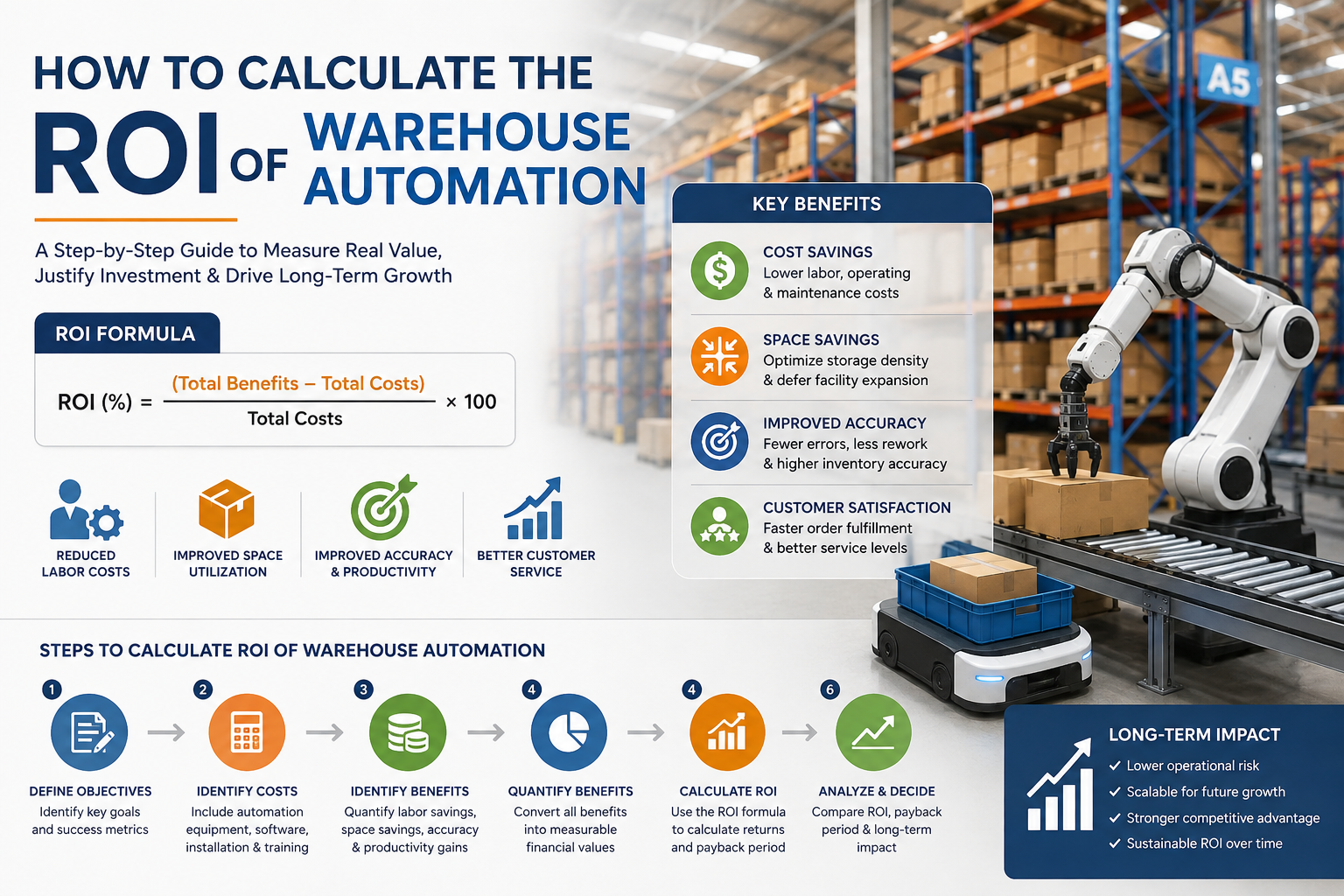
Warehouse Automation Costs to Consider
An honest ROI calculation starts with honest costs. Many projects look great on paper because they only count the equipment and forget everything around it. To avoid nasty surprises, include every line below:
- Automation equipment: conveyors, ASRS, AGVs, AMRs, and pick-to-light hardware.
- Software systems: the WMS, WCS, and any RFID or IoT platforms that run the operation.
- Installation and integration: physical setup plus connecting new systems to your ERP and existing tools.
- Training: getting your team confident and productive on the new systems.
- Maintenance and support: the ongoing annual cost of keeping everything running.
Grouping these into a one-time investment (equipment, software, installation, training) and a recurring annual cost (maintenance, support, subscriptions) makes the later calculations much cleaner.
The Benefits That Generate ROI
On the other side of the ledger are the returns. A warehouse management system and connected automation deliver value in several ways, and each should be quantified where possible:
- Reduced labour costs: automation absorbs repetitive tasks, so the same team handles far more volume.
- Improved accuracy: fewer picking and shipping errors mean fewer costly returns and re-shipments.
- Faster order fulfilment: shorter cycle times lift throughput and customer satisfaction.
- Space savings: dense storage avoids or delays an expensive facility expansion.
- Risk reduction: fewer injuries and less dependence on hard-to-find seasonal labor.
Together these turn into measurable cost savings — the raw material of your ROI calculation.
The ROI Formulas You Need
Four simple measures cover almost every automation business case. You do not need to be an accountant to use them.
Return on Investment (ROI): ROI (%) = (Net Benefit ÷ Total Investment) × 100.
Example: invest ₹1,00,000 and gain ₹40,000 in net savings a year, and your annual ROI is 40%.
Payback Period: Payback = Total Investment ÷ Annual Net Savings.
Example: a ₹2 crore project saving ₹75 lakh a year pays back in about 2.7 years.
Net Present Value (NPV): NPV = the sum of future savings, discounted to today’s value, minus the investment.
NPV accounts for the fact that money saved in five years is worth less than money saved today. If the NPV is positive, the project adds real value.
Internal Rate of Return (IRR): IRR = the discount rate at which NPV equals zero.
In plain terms, IRR is the project’s annual growth rate. If it comfortably exceeds your cost of capital, the investment is worth making. A spreadsheet or ROI calculator does the heavy lifting here.
Step-by-Step ROI Calculation: A ₹2 Crore Example
Let’s put it together with a realistic mid-sized project. Imagine a distribution centre investing ₹2 crore in a WMS, conveyors, RFID, and some AGVs.
- Total investment: ₹2,00,00,000 (equipment, software, installation, integration, and training).
Now the annual savings the project generates:
- Labour savings: ₹60,00,000 — automation covers work that previously needed extra staff and overtime.
- Inventory accuracy savings: ₹15,00,000 — less shrinkage, fewer write-offs, and lower safety stock.
- Space savings: ₹10,00,000 — denser storage avoids renting additional space.
- Error and returns reduction: ₹8,00,000 — fewer mis-ships and the costs that follow them.
That is ₹93,00,000 in gross annual savings. From this we subtract the recurring cost of maintenance, support, and software — say ₹18,00,000 a year — leaving net annual savings of ₹75,00,000.
Now the two headline numbers. The payback period is ₹2,00,00,000 ÷ ₹75,00,000, which is about 2.7 years. The simple annual ROI is (₹75,00,000 ÷ ₹2,00,00,000) × 100, or roughly 37% a year. Over a typical seven-year equipment life, the project returns several times its cost — which is exactly the kind of case a CFO approves.
Hidden Benefits That Improve ROI
The numbers above are the ones you can bank, but they are not the whole story. Several less obvious benefits quietly strengthen the return over time.
Automation improves employee safety by taking people away from heavy lifting and busy forklift lanes, which lowers injury and insurance costs. It removes soul-destroying repetitive tasks, improving workforce satisfaction and retention. It makes scaling far easier, so you can win bigger customers without a hiring scramble. And with Industrial IoT feeding real-time data into your systems, you gain the data-driven decision making and competitive advantage that manual operations simply cannot match.
Common Mistakes When Calculating ROI
A weak ROI case usually fails for predictable reasons. The most common is ignoring ongoing maintenance and support costs, which makes the payback look better than it really is. Another is forgetting software and integration costs and counting only the hardware. Many teams also focus solely on labour savings while ignoring the value of accuracy, space, and customer satisfaction — which understates the real return. Finally, some analyses underestimate long-term business value, judging a multi-year platform on its first year alone. Avoid these five traps and your business case will hold up under scrutiny.
A Real Warehouse Example
Consider an e-commerce distribution centre shipping 5,000 orders a day. Before automation, it relied on manual picking and paper checks; accuracy hovered around 96%, peak seasons meant expensive temporary staff, and the building was nearly out of space. After deploying a WMS, RFID, and conveyor automation, the picture changed sharply.
Order accuracy climbed above 99.5%, picking productivity rose by roughly a third, and denser storage removed the need for a costly move. Returns fell, customers were happier, and the operation absorbed the next festive peak without a hiring panic. The project paid for itself in under three years and continues to compound value every quarter — the classic shape of a strong automation ROI.
ROI by Automation Technology
Not every technology pays back at the same rate. Some deliver quick wins; others are longer-term plays that transform capacity. This comparison helps you sequence your investment sensibly.
| Technology | Typical payback | Primary ROI driver | Best suited for |
| WMS | 6–18 months | Accuracy + labour efficiency | Every warehouse — the foundation |
| RFID | 12–24 months | Inventory accuracy, instant counts | High-SKU or high-value stock |
| Pick-to-Light | 1–2 years | Picking speed and accuracy | Fast, dense picking zones |
| Conveyors | 2–4 years | Throughput, less manual handling | High-volume, fixed product flows |
| AGVs / AMRs | 2–4 years | Reduced labour in transport | Repetitive long-distance moves |
| ASRS | 3–5 years | Space savings + high throughput | High-density, high-volume storage |
As a rule, most operations start with a WMS for its fast, broad payback, then add targeted hardware such as pick-to-light, AGVs, or ASRS where the numbers justify it.
KPI Improvements to Track
ROI is proven in the KPIs. Set a baseline before you start, then watch these metrics move — they translate directly into money and customer loyalty.
| KPI | Before automation | After automation | Business impact |
| Inventory accuracy | 90–95% | 99%+ | Less safety stock, less shrink |
| Order accuracy | 95–97% | 99.5%+ | Fewer returns & complaints |
| Picking productivity | Baseline | +25–40% | More orders per hour |
| Labour cost per order | Baseline | -20–30% | Lower operating cost |
| Space utilisation | Baseline | +40–60% (ASRS) | Avoids facility expansion |
| Customer satisfaction | Baseline | Higher & steadier | Repeat business & referrals |
Best Practices for Measuring ROI
Getting an accurate, defensible ROI comes down to discipline. First, set clear business objectives so you know what success looks like. Second, measure baseline KPIs before automating, because you cannot prove improvement without a starting point. Third, track ROI continuously rather than once, so you catch drift early and keep optimising. Fourth, choose scalable automation solutions that grow with you, avoiding a costly rip-and-replace later. Finally, plan for future growth, sizing the investment for where the business is heading, not just where it is today.
Where Warehouse Automation ROI Is Heading
The return on automation is only getting stronger as the technology matures. AI-powered warehouses now optimise slotting and staffing automatically, squeezing out more savings. Predictive analytics flags equipment problems before they cause downtime, protecting throughput. Digital twins let managers test changes virtually before spending a rupee on the floor. And as Industry 4.0 and autonomous warehouses advance, the gap between automated and manual operations — in both cost and capability — will only widen.
Conclusion
Calculating the ROI of warehouse automation is not just an accounting exercise — it is how you turn a promising idea into a confident, approved investment. Count every cost honestly, quantify both the tangible and intangible benefits, and use simple formulas like payback and ROI to make the case clear.
Most importantly, remember that automation ROI is about far more than cutting labour. It is about building long-term operational efficiency, unlocking growth, and creating a competitive advantage that compounds year after year. Judged over its full life, a well-planned automation project is one of the strongest investments a warehouse can make.
Build an Automation Case That Pays Off
Brilliant Info Systems helps businesses plan, justify, and deploy warehouse automation that delivers real returns — from WMS and WCS to RFID, ASRS, conveyors, AGVs, and Industry 4.0 solutions. Talk to our team and we will help you model the ROI for your specific operation before you invest a rupee.
Frequently Asked Questions
How do you calculate warehouse automation ROI?
Add up the total investment (equipment, software, installation, and training), calculate the net annual savings it produces, then apply ROI (%) = (Net Benefit ÷ Total Investment) × 100 and Payback = Investment ÷ Annual Net Savings.
What is a good payback period for warehouse automation?
It varies by technology, but two to four years is common and considered healthy. A WMS often pays back faster, while large ASRS projects may take longer but deliver bigger long-term value.
Does warehouse automation really reduce labour costs?
Yes. By handling repetitive tasks, automation lets the same team process far more volume, cutting reliance on overtime and seasonal hiring. Labour is usually the single largest saving in an ROI case.
Does a WMS improve ROI?
Significantly. A WMS is the foundation that makes other automation effective, and on its own it improves accuracy and labour efficiency — which is why it typically has the fastest payback of any warehouse technology.
How long does warehouse automation take to pay for itself?
Most projects pay back within two to four years, depending on the technology and how heavily the warehouse is used. Higher order volumes generally shorten the payback period.
What factors most affect automation ROI?
Order volume, labour costs, accuracy improvements, space savings, and ongoing maintenance costs are the biggest levers. Capturing intangible benefits like customer satisfaction and safety improves the case further.