
ASRS (Automated Storage & Retrieval System): A Complete Guide
There comes a point in almost every growing warehouse when the building simply runs out of room. Racks are full, aisles are crowded, and the obvious answer — leasing a bigger facility — comes with a frightening price tag. Meanwhile, workers spend hours each day walking to shelves and hunting for stock. It is at this moment that most operations discover automated storage and retrieval systems.
An ASRS lets you store far more in the same footprint while machines do the fetching and carrying. But the term covers a whole family of technologies, from towering pallet cranes to compact units that sit beside a desk. This complete guide explains what an ASRS is, how it works, the main types, the benefits, and how to decide whether one is right for your operation.
▶ Watch: ASRS
What Is an ASRS?
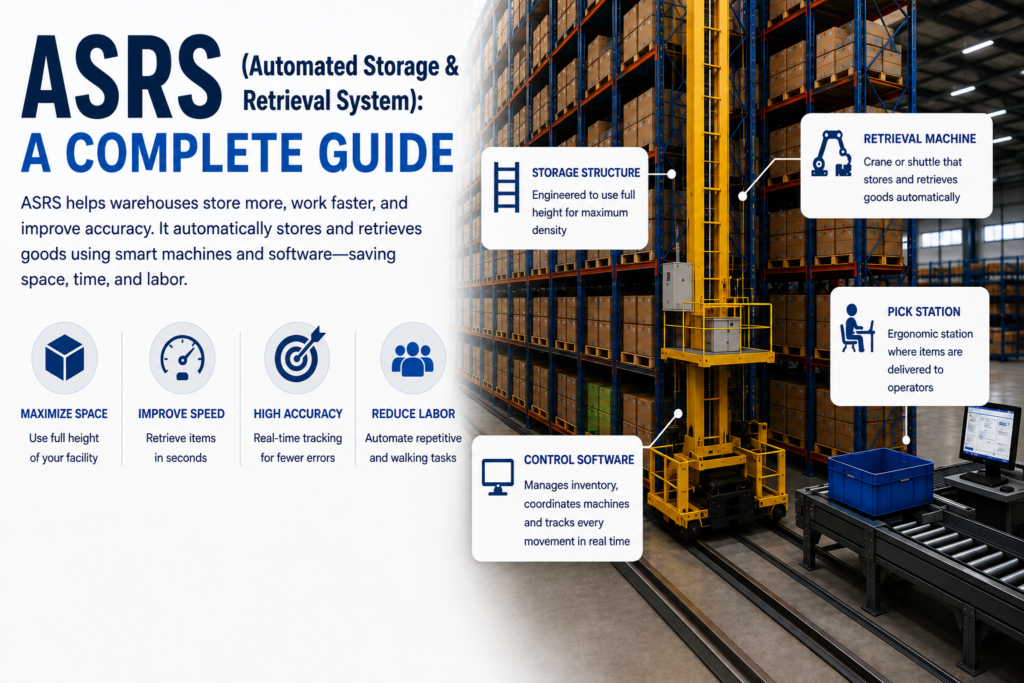
An automated storage and retrieval system (ASRS) is a combination of machines and software that automatically places goods into storage and retrieves them on demand, with little or no manual handling. Instead of a worker walking to a shelf, the ASRS brings the right item to the worker — a principle often called “goods-to-person.”
At its simplest, an ASRS is a storage solution that removes the walking, climbing, and searching from the job. Under computer control, it knows exactly where every item lives and can store and retrieve it in seconds. That precision is what makes an ASRS so much denser and more accurate than conventional shelving.
How Does an ASRS Work?
Every ASRS follows the same basic idea, whatever its size. Goods are held in fixed storage locations, and a machine moves to those locations to store or retrieve items on request. The intelligence sits in the software that ties it all together.
When an order arrives, the warehouse management software tells the ASRS which items to fetch. A mechanism — often an inserter/extractor or a crane — travels to the location, collects the load, and delivers it to a pick station. Because the system can move vertically as easily as horizontally, it uses the full height of the building, not just the reachable lower shelves. A warehouse control system coordinates the machine movements in real time so nothing collides or waits unnecessarily.
The result is fast, accurate storing and retrieving with almost no human effort — and a live, always-current record of inventory because every movement is logged automatically.
The Key Components of an ASRS
However large or small, most ASRS installations share four core building blocks. Understanding them helps you compare systems and ask suppliers the right questions.
- The storage structure: the racking, grid, or column of trays that holds the goods, engineered to use the full height available.
- The retrieval machine: the crane, shuttle, or inserter/extractor that travels to a location and moves the load — the moving muscle of the system.
- Pick stations: the ergonomic points where goods are presented to operators, designed to keep picking fast and comfortable.
- Control software: the management software and warehouse control system that decide what to fetch, track every item, and coordinate the machines in real time.
It is the software layer that turns a pile of hardware into an intelligent system. Without it, a crane is just a crane; with it, the ASRS becomes a self-directing storage engine that always knows where everything is.
The Main Types of ASRS
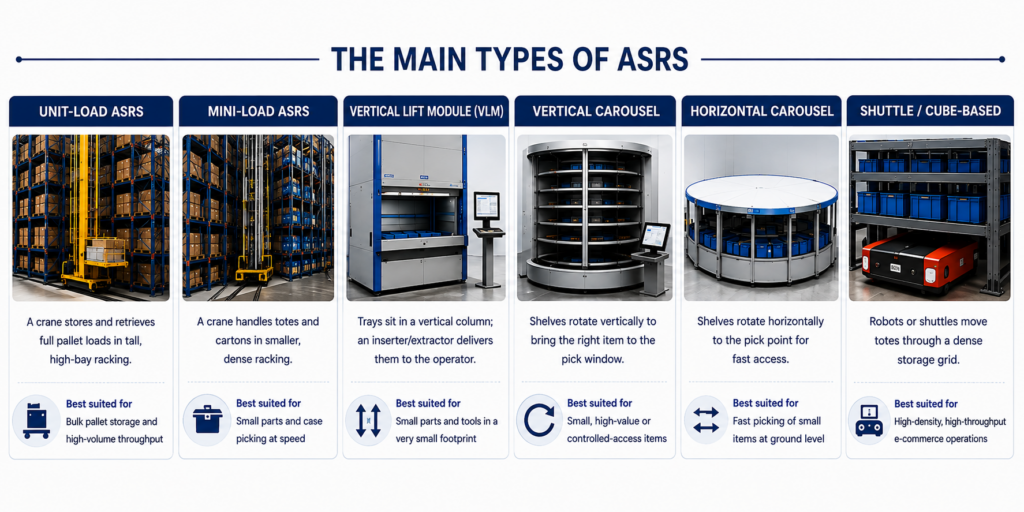
“ASRS” is really an umbrella term. The right type depends on what you store, how fast you need it, and how much space you have. Here are the most common options.
| ASRS type | How it works | Best suited for |
| Unit-Load ASRS | A crane stores and retrieves full pallet loads in tall, high-bay racking | Bulk pallet storage and high-volume throughput |
| Mini-Load ASRS | A crane handles totes and cartons in smaller, dense racking | Small parts and case picking at speed |
| Vertical Lift Module (VLM) | Trays sit in a vertical column; an inserter/extractor delivers them to the operator | Small parts and tools in a very small footprint |
| Vertical Carousel | Shelves rotate vertically to bring the right item to the pick window | Small, high-value or controlled-access items |
| Horizontal Carousel | Shelves rotate horizontally to the pick point for fast access | Fast picking of small items at ground level |
| Shuttle / Cube-based | Robots or shuttles move totes through a dense storage grid | High-density, high-throughput e-commerce |
Broadly, unit-load and mini-load crane systems handle pallets and cartons in large facilities, while vertical lift modules and carousels bring dense small-parts storage into a compact footprint. Newer shuttle and cube-based systems, sometimes using robots similar to an autonomous mobile robot, deliver very high throughput for e-commerce.
Vertical Lift Modules and Carousels Explained
For smaller items, three formats dominate, and it is worth understanding the difference. A vertical lift module (VLM) is an enclosed column of trays; an inserter/extractor retrieves the requested tray and presents it at an ergonomic window. A vertical carousel works like a giant Ferris wheel of shelves that rotate to bring the right shelf to the operator. A horizontal carousel does the same but spins on a horizontal plane, ideal for rapid, repeated picks.
All three share the same advantage: they store a large amount in a small floor area and cut the walking and searching that slow down manual picking. For tools, spare parts, or high-value goods, they are often the fastest ASRS to justify.
The Benefits of an Automated Storage and Retrieval System
The benefits of an automated storage and retrieval system reach well beyond simply holding more stock. Each one translates into measurable operational gains.
- Maximised floor space: by going vertical and eliminating wide aisles, an ASRS can store the same goods in a fraction of the area — often avoiding a costly facility expansion.
- Fewer picking errors: the system delivers the exact item to the operator under computer control, so mis-picks and the returns they cause drop sharply.
- Lower labour on repetitive tasks: machines handle the walking and lifting, freeing staff from repetitive tasks for higher-value work and improving order fulfillment speed.
- Higher throughput: goods-to-person delivery keeps operators picking continuously instead of travelling the warehouse.
- Better inventory accuracy: every movement is tracked automatically, giving real-time, reliable inventory management.
- Improved safety: fewer people on ladders and forklifts in narrow aisles means fewer accidents.
ASRS vs Traditional Storage
Conventional racking is cheap to install but expensive to run at scale. It needs wide aisles for forklifts, limits usable height to what a person or truck can safely reach, and relies on workers walking long distances to pick. An ASRS flips that equation: it uses narrow aisles or none at all, exploits the full ceiling height, and brings goods to the operator.
The trade-off is up-front cost and complexity. An ASRS is a bigger investment and a more involved project than adding shelving. But for operations fighting space constraints, high labour costs, or accuracy problems, the long-term savings usually outweigh the initial outlay — often within a few years.
Industries That Rely on ASRS
ASRS technology has spread far beyond traditional distribution. Any operation that values space, speed, or accuracy can benefit, and several sectors now treat it as essential.
- E-commerce and retail: high order volumes and tight delivery windows make goods-to-person picking invaluable for fast, accurate order fulfillment.
- Pharmaceuticals and healthcare: precise tracking, controlled access, and full traceability protect high-value and regulated stock.
- Cold storage and food: dense automated storage limits the time people spend in freezing environments and keeps goods moving under strict conditions.
- Manufacturing and automotive: ASRS feeds components to the production line just in time and buffers finished goods, keeping the line running smoothly.
What these industries share is a need to do more in less space, with fewer errors — exactly what an ASRS is built to deliver.
Where ASRS Fits in the Modern Warehouse
An ASRS rarely works alone. It is one part of a connected operation, taking direction from the WMS and often working alongside conveyor automation and mobile robots that carry goods to and from the pick stations. In a smart warehouse, the ASRS handles dense storage while other material handling automation moves product between zones.
This integration is the key to getting the full return. When the ASRS, WMS, and transport systems share data in real time, goods flow smoothly from storage to dispatch with minimal handling — which is exactly what a high-performing modern warehouse looks like.
Is an ASRS Right for Your Warehouse?
An ASRS is not the answer for every site, and honesty here saves money. It makes the strongest case when you are running out of floor space, when labour is expensive or hard to hire, when accuracy problems are hurting customers, or when you handle a high volume of consistent, well-defined items such as pallet loads or small parts.
It is a weaker fit for very low volumes, highly irregular products, or operations that expect major, unpredictable change in the near term. The best approach is to start from your goals and constraints, measure your current performance, and model the return before committing — ideally with a partner who can match the right ASRS type to your operation.
The Future of ASRS
ASRS technology is advancing quickly. Software is getting smarter, using AI to optimise where items are stored and how orders are sequenced. Robotic shuttle and cube-based systems are making very high density affordable for mid-sized businesses, not just giants. And as these systems connect more tightly with the wider warehouse, the line between storage, picking, and transport continues to blur — pointing toward increasingly autonomous operations.
Conclusion
An automated storage and retrieval system is one of the most powerful ways to solve the twin problems of limited space and rising labour costs. By storing goods densely and bringing them to your people automatically, an ASRS lifts capacity, accuracy, and throughput all at once — often turning a looming facility expansion into an unnecessary expense.
The key is choosing the right type for your goods and volumes, and integrating it properly with the rest of your warehouse. Done well, an ASRS is not just a storage upgrade; it is a foundation for a faster, smarter, and more scalable operation.
Explore ASRS Solutions with Brilliant Info Systems
Brilliant Info Systems designs and integrates ASRS solutions — from unit-load and mini-load cranes to VLMs and shuttle systems — connected to your WMS, WCS, and wider automation. Talk to our team to find the right storage and retrieval system for your space, your goods, and your growth plans.
Frequently Asked Questions
What is an ASRS in simple terms?
An ASRS is a system of machines and software that automatically stores goods and retrieves them on demand, delivering items to workers instead of workers walking to shelves. It saves space, cuts errors, and speeds up order fulfilment.
What are the main types of ASRS?
The common types are unit-load and mini-load crane systems, vertical lift modules (VLMs), vertical and horizontal carousels, and shuttle or cube-based robotic systems. Each suits different products, volumes, and space constraints.
How much floor space can an ASRS save?
By using full building height and eliminating wide aisles, an ASRS can reclaim a large share of floor space — often enough to avoid moving to a larger facility. The exact saving depends on the system type and your current layout.
Is an ASRS worth the investment?
For operations facing space limits, high labour costs, or accuracy problems, yes. An ASRS is a bigger up-front investment than shelving, but the savings in space, labour, and errors typically deliver a strong return within a few years.
Does an ASRS integrate with a WMS?
Yes. An ASRS is directed by warehouse management software and coordinated by a warehouse control system, so it works as part of the wider operation rather than in isolation. Good integration is essential to realising its full value.