
What Is RFID and How Does It Work?
Walk into most traditional warehouses and you will still see people with clipboards and handheld scanners, counting stock one item at a time. It is slow, it is error-prone, and by the time the count is finished, it is already out of date. For operations under pressure to be faster and more accurate, that approach has quietly become a liability.
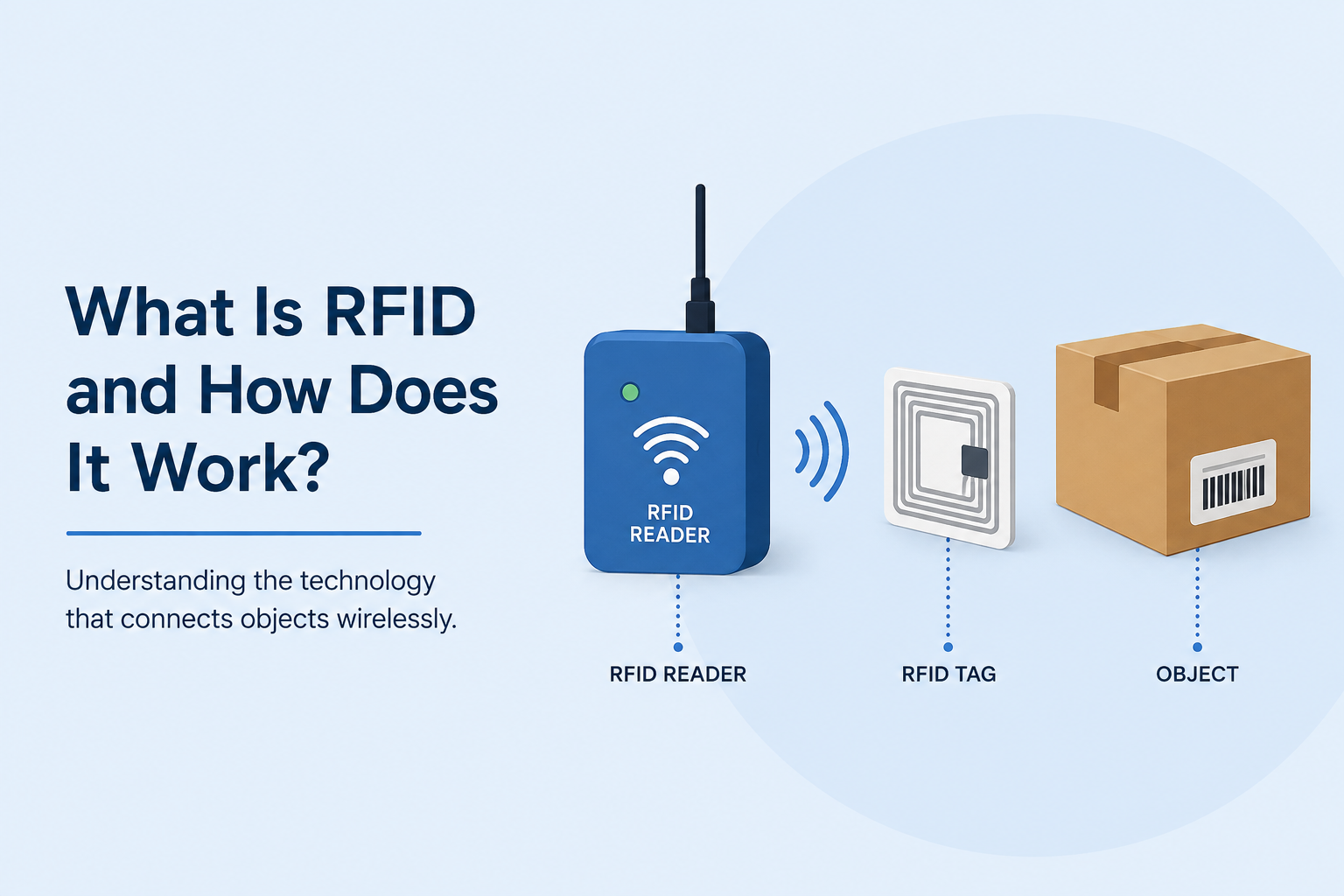
Radio Frequency Identification (RFID) changes the game. Instead of scanning items one by one, RFID reads hundreds of tagged items in seconds — no line of sight required. This guide explains what RFID is, how it works, its components and types, how it compares to barcodes, and how RFID solutions fit into a modern, automated warehouse.
▶ Watch: RFID Solutions Overview
Table of Contents
- What is RFID?
- Why RFID matters in modern warehouses
- How RFID works
- Components of an RFID system
- Types of RFID tags
- RFID vs barcode
- Benefits and applications
- Integration with warehouse systems
- Challenges and best practices
- Real-world examples and the future
- Conclusion and FAQs
What Is RFID?
RFID, short for Radio Frequency Identification, is a technology that uses radio waves to identify and track items automatically. Each item carries a small RFID tag containing a chip and an antenna. When the tag passes near an RFID reader, it transmits its unique ID wirelessly — no scanning by hand, no direct line of sight.
In plain business terms, RFID gives every product, pallet, or asset a digital voice. The moment it moves, the system knows. That simple shift — from manually looking things up to items announcing themselves — is what makes RFID so powerful for inventory management and asset tracking.
Why RFID Is Important in Modern Warehouses
Barcodes served warehouses well for decades, but they have a fundamental limit: someone has to physically scan each one, in the right orientation, one at a time. As order volumes rise and customers expect same-day accuracy, that manual bottleneck becomes costly.
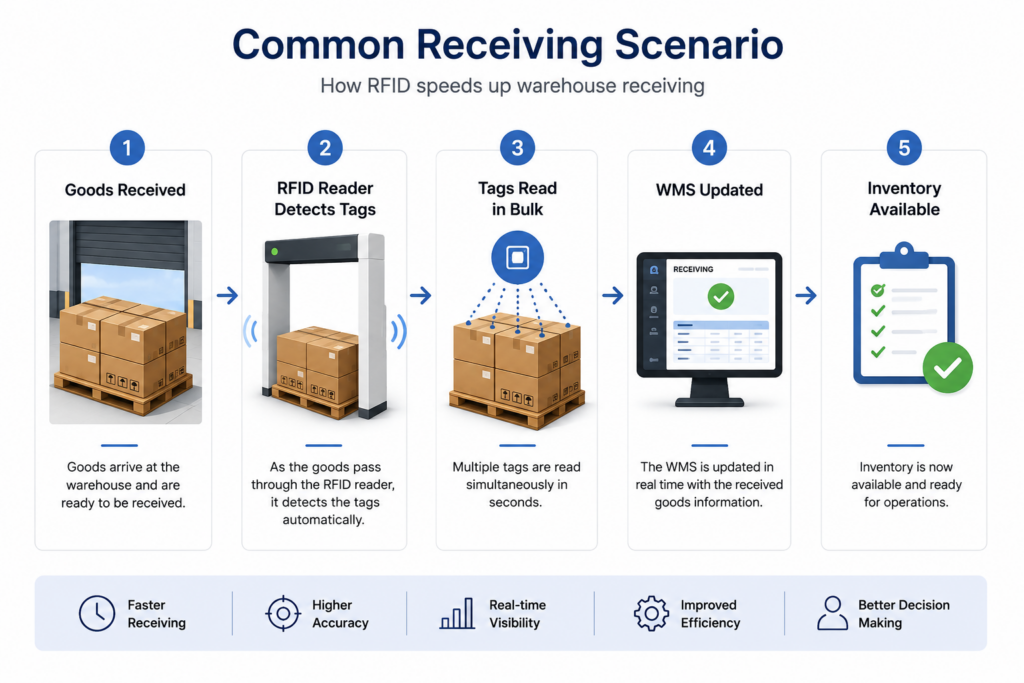
RFID removes it. A single reader can capture an entire pallet of tagged goods as it rolls through a doorway, updating stock instantly. This delivers real-time tracking, near-perfect inventory accuracy, and the warehouse visibility that manual counts and barcodes simply cannot match — which is why so many operations are making the switch.
How RFID Works
Behind the scenes, RFID follows a clear chain from the tag on a box all the way to your business systems. Each stage passes clean data to the next:
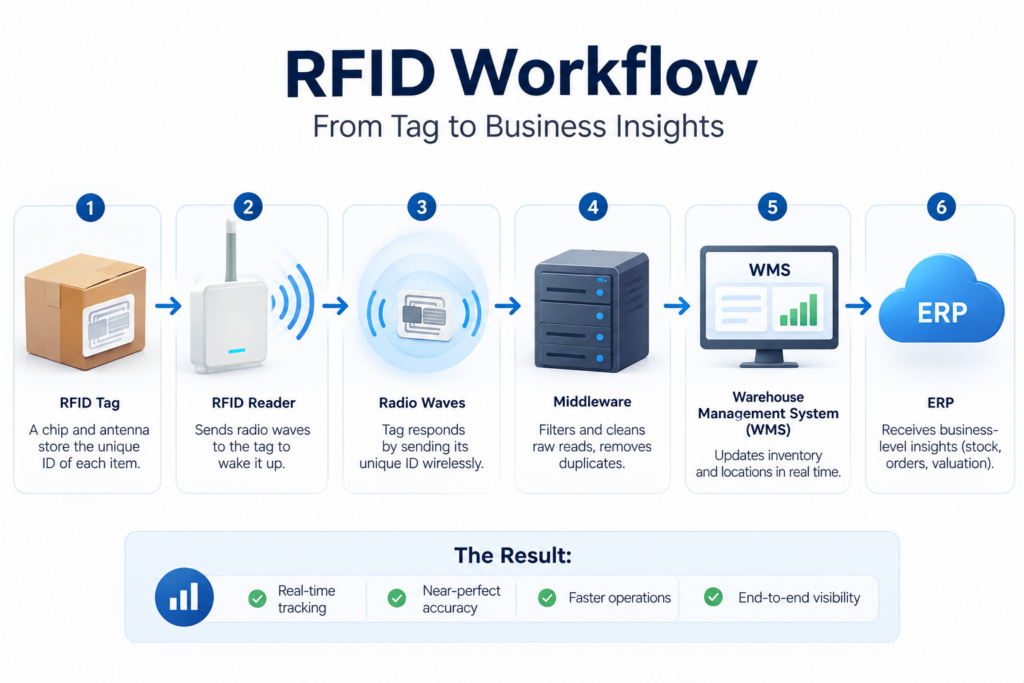
Here is what happens at each step. The RFID tag attached to an item stores its unique identifier. The RFID reader, through its antenna, sends out radio waves that power passive tags and prompt them to respond. Those radio waves carry the tag’s ID back to the reader. Middleware filters and cleans the raw reads, removing duplicates, then passes the meaningful data to the WMS, which updates inventory and locations in real time. Finally, the ERP receives the business-level picture — stock levels, order status, and valuation.
Components of an RFID System
An RFID system is more than just tags. Six elements work together to make it reliable:
- RFID tags: the chip-and-antenna labels attached to items, holding each unique ID.
- RFID readers: devices — fixed or handheld — that communicate with tags via radio waves.
- RFID antennas: the part of the reader that transmits and receives the signal, shaping the read zone.
- RFID software: the application that interprets reads and turns them into useful information.
- Middleware: the layer that filters raw reads and connects the hardware to your business systems.
- Database integration: the link to your WMS and ERP so RFID data drives real decisions.
Types of RFID Tags
Not all tags are the same. The right choice depends on read range, budget, and environment. There are three main types, and they usually operate at low, high, or ultra-high frequency — with UHF RFID tags being the workhorse of warehousing.
| Feature | Passive RFID | Active RFID | Battery-Assisted Passive |
| Power source | Powered by the reader; no battery | Own onboard battery | Small battery assists the response |
| Read range | Up to about 10 metres | 100 metres or more | Longer than passive, shorter than active |
| Cost | Lowest | Highest | Medium |
| Lifespan | Very long — no battery to fail | Limited by battery (a few years) | Limited by battery |
| Typical use | Cartons, apparel, inventory | Vehicles, large assets, yard tracking | Cold chain and sensor logging |
For most warehouse inventory, low-cost passive RFID tags are ideal. Active RFID tags suit large, high-value assets that must be tracked over long distances, while battery-assisted passive tags fit specialised needs like cold-chain sensor logging.
RFID vs Barcode
The most common question buyers ask is how RFID stacks up against the barcodes they already use. Both have their place, but the differences are stark once volume and speed matter.
| Factor | RFID | Barcode |
| Reading speed | Hundreds of tags at once, instantly | One item at a time, manually |
| Line of sight | Not required | Required — must see the code |
| Multiple-item reading | Yes, in bulk | No |
| Accuracy | Very high | Depends on the manual scan |
| Durability | Rugged and reusable | Prone to smudging and damage |
| Cost | Higher tag and setup cost | Very low |
| Inventory visibility | Real-time | Periodic and manual |
| Automation capability | High — hands-free | Limited |
Barcodes remain cheap and simple for low-volume tasks. But where speed, bulk reading, and real-time visibility count, RFID is in a different league — and it is the foundation for hands-free warehouse automation.
The Benefits of RFID
The advantages of RFID compound across the whole operation. The most significant are:
- Real-time inventory tracking: stock updates the instant items move, not hours later.
- Better inventory accuracy: automated reads eliminate the miscounts of manual stocktakes.
- Faster receiving and picking: whole pallets are read at once instead of item by item.
- Reduced human error: less manual data entry means fewer costly mistakes.
- Asset tracking: tools, containers, and equipment are located in seconds.
- Improved warehouse visibility: managers see exactly what is where at any moment.
- Labour savings: staff are freed from repetitive counting for higher-value work.
- Better customer service and decisions: accurate stock data means reliable promises and smarter planning.
RFID Applications
RFID has spread far beyond the warehouse. Wherever items need to be identified quickly and accurately, it adds value:
| Industry / area | How RFID is used |
| Warehouse management | Real-time inventory, faster receiving and put-away |
| Manufacturing | Tracking work-in-progress and components on the line |
| Retail | Stock accuracy, replenishment, and faster checkout |
| Healthcare | Tracking equipment, samples, and medication |
| Cold storage | Traceability without opening sealed packaging |
| 3PL / logistics | Accurate, separated inventory for multiple clients |
| Automotive | Parts sequencing and full traceability |
| Supply chain | End-to-end shipment visibility |
| Asset tracking | Tools, containers, and returnable assets |
| Access control | Secure entry using RFID badges |
RFID Integration with Warehouse Systems
RFID delivers its full value only when connected to the rest of your operation. The data it captures flows into your warehouse management system and ERP so inventory and orders stay accurate everywhere. A warehouse control system can use RFID reads to trigger automation in real time.
In an automated facility, RFID checkpoints confirm goods as they move along conveyors, into ASRS storage, or onto AGVs. This makes RFID a backbone technology for warehouse automation and the smart warehouse.
Challenges of RFID
RFID is powerful, but a successful rollout means planning around a few known issues. Metal and liquids can interfere with radio waves, so tags and readers must be positioned and chosen carefully around metal racking or liquid products. Implementation cost is higher than barcodes, so the business case matters. Reader placement needs thought to avoid missed or duplicate reads. And as with any new system, staff training and clean integration with your existing WMS and ERP are essential to get the full benefit.
Best Practices for RFID Implementation
A smooth deployment comes down to a few practical steps. Start with a clear goal — accuracy, speed, or visibility — and a small pilot in one area before scaling. Choose the right tag type and frequency for your products and environment, testing around metal and liquids up front. Position readers and antennas based on real read-zone testing, not guesswork. Above all, integrate RFID tightly with your WMS and ERP from day one, and train the team so they trust and use the new data.
Real-World RFID Examples
The value is easiest to see in practice. An e-commerce warehouse reads entire inbound pallets in seconds at receiving, cutting hours from stock intake. A manufacturer tracks work-in-progress through each station, so nothing is lost on the line. A retail distribution centre keeps near-perfect stock accuracy across thousands of SKUs, improving replenishment. And a pharmaceutical warehouse maintains full traceability of temperature-sensitive products without ever opening a sealed carton — vital for compliance and safety.
The Future of RFID
RFID is becoming smarter as it converges with other technologies. Combined with Industrial IoT sensors, it feeds a constant stream of real-time data into AI systems that predict demand and flag issues early. Digital twins use that data to model the warehouse virtually, and as Industry 4.0 and autonomous warehouses advance, RFID will be one of the core senses that let facilities run themselves.
Conclusion
RFID has moved from a nice-to-have to a core technology for warehouses that want to compete on speed and accuracy. By letting items identify themselves automatically, it replaces slow, error-prone manual counts with real-time visibility across the whole operation.
Whether you are tracking inventory, assets, or shipments, RFID lays the foundation for a smarter, more automated warehouse. For most growing businesses, the question is no longer whether to adopt it, but how soon to start.
Bring RFID to Your Warehouse with Brilliant Info Systems
Brilliant Info Systems designs and integrates end-to-end RFID solutions — connected to your WMS, WCS, and wider warehouse automation. Talk to our team for expert RFID and Industry 4.0 consulting tailored to your operation.
Frequently Asked Questions
What is RFID in simple terms?
RFID is a technology that uses radio waves to identify and track tagged items automatically, without scanning each one by hand or needing line of sight.
How does RFID actually work?
An RFID reader sends radio waves that power a tag’s chip; the tag responds with its unique ID, which the reader passes through middleware to your WMS and ERP in real time.
What is the difference between passive and active RFID tags?
Passive tags have no battery and are powered by the reader, offering short range at low cost. Active tags have their own battery, giving a long read range for tracking large or distant assets.
Is RFID better than barcodes?
For speed, bulk reading, and real-time visibility, yes. RFID reads many items at once without line of sight, while barcodes are cheaper but must be scanned individually.
What read range does RFID have?
It depends on the tag type and frequency. Passive UHF tags typically read up to about 10 metres, while active tags can reach 100 metres or more.
Does RFID work near metal and liquids?
Metal and liquids can interfere with radio waves, but specialised tags and careful reader placement allow RFID to work reliably even in those environments.
Can RFID integrate with my existing WMS and ERP?
Yes. RFID data flows through middleware into your warehouse management system and ERP, so inventory and orders update automatically across your business.
Is RFID worth the investment?
For operations that value accuracy, speed, and visibility, the labour savings and error reduction usually justify the higher up-front cost within a reasonable period.