
AGV & ASRS Integration: Building an Automated Material-Handling System
Many warehouses automate in pieces. They add a storage system in one corner and some robots in another, then wonder why the gains never quite add up. The problem is not the technology — it is that the islands of automation do not talk to each other. Goods still pile up between the storage area and the packing line because nothing connects the two.
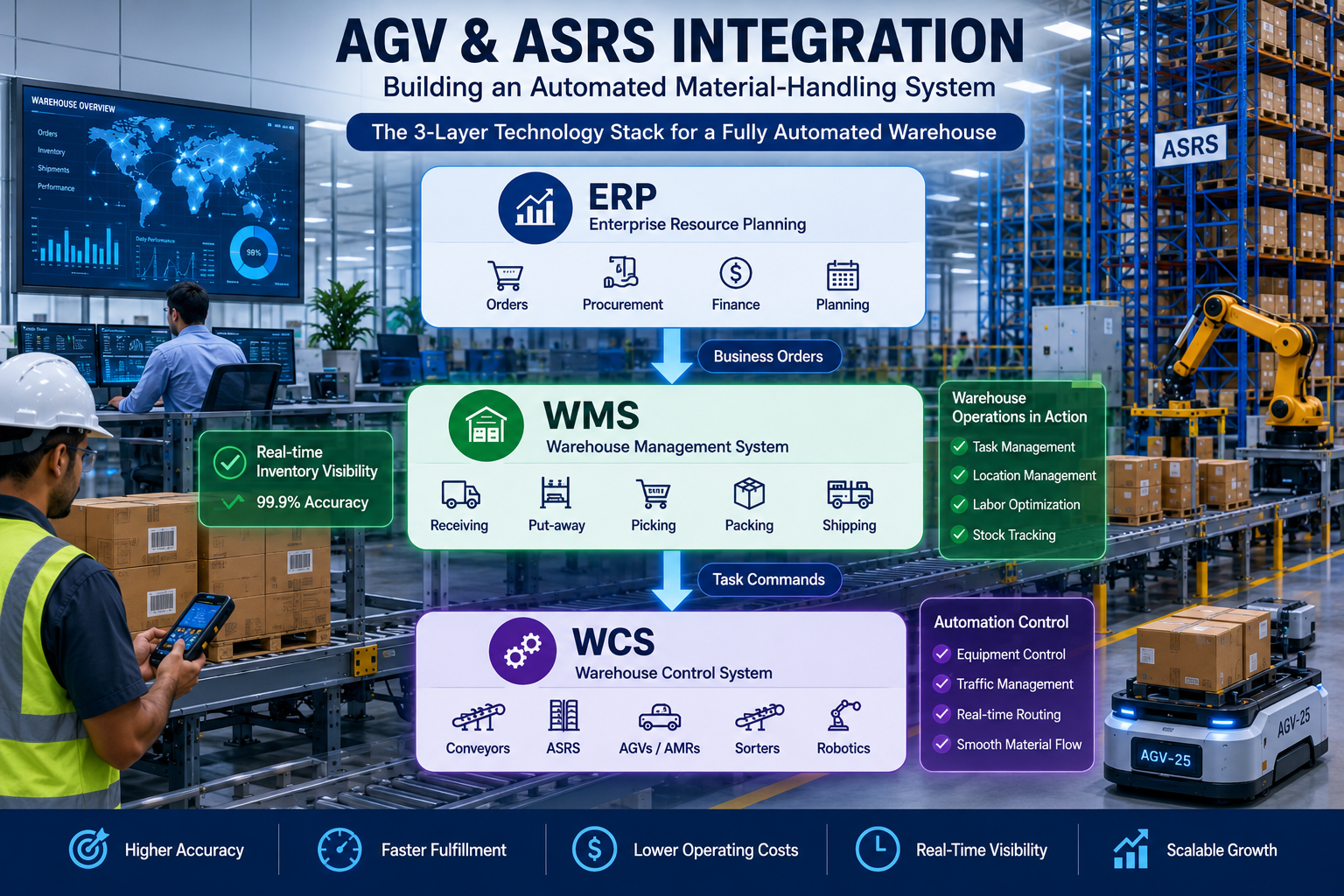
The fix is integration. When automated guided vehicles (AGVs) and an automated storage and retrieval system (ASRS) work as one, you get a true automated material-handling system where goods move from storage to shipping without manual intervention. This guide explains how AGV and ASRS integration works, how to build it, and the benefits it delivers.
▶ Watch: AGV Solution
Table of Contents
- What is an AGV?
- What is an ASRS?
- Why integrate AGV and ASRS?
- How they work together
- Complete system architecture
- Key components
- Material flow process
- Real-world and manufacturing examples
- Benefits, KPIs and industry applications
- Challenges and best practices
- Future trends and FAQs
What Is an AGV?
Automated guided vehicles (AGVs) are mobile robots that transport materials around a facility without a human driver. Guided by wires, magnetic strips, lasers, or vision, they follow set routes to carry pallets, totes, and carts between zones — from receiving to storage, or from storage to packing.
Their great strength is flexible movement. AGVs take over the repetitive, tiring job of moving loads across long distances, freeing people from pushing carts and driving forklifts all day. In doing so they reduce human error and improve safety, because there is less manual traffic on the warehouse floor.
What Is an ASRS?
An automated storage and retrieval system (ASRS) is a combination of machines and software that automatically store and retrieve goods in dense racking. Under the direction of a management system, cranes or shuttles move to a location and store or retrieve items — often full unit loads — in seconds.
Where AGVs move goods across the floor, the ASRS is about high-density storage: using the full height of the building and narrow or no aisles to hold far more in the same footprint. It is precise, fast, and always knows exactly where every item sits.
Why Integrate AGV and ASRS?
On their own, each system solves half the problem. The ASRS stores goods brilliantly but cannot move them across the building. The AGV moves goods brilliantly but has nowhere dense to store them. Bridge that gap and you close the loop.
Integrated, they form complete automated material handling systems: the ASRS holds and presents the load, and the AGV collects it and transports materials to the next stage. Tie both to your warehouse management system and the whole operation runs as one coordinated flow rather than a set of disconnected automation systems.
| AGV (Automated Guided Vehicle) | ASRS (Automated Storage & Retrieval System) | |
| Main job | Transports materials across the facility | Stores and retrieves goods in dense racking |
| Movement | Mobile — travels the floor between points | Fixed — moves within storage racks |
| Strength | Flexible, trackless transport | High-density storage and accuracy |
| Handles | Loads between zones, lines, and docks | Pallets, totes, and unit loads |
| Role together | Collects the load and moves it onward | Stores and presents the load |
How AGV and ASRS Work Together
The intelligence sits in software. The warehouse management systems decide what needs to move and when, while a warehouse control system coordinates the machines in real time. When an order drops, the WMS instructs the ASRS to retrieve the right unit load and present it at a transfer point. The WCS then dispatches an AGV to collect that load and transport it to the next zone — picking, packing, or conveyor automation.
Because both systems share the same live data, there is no waiting and no manual handover. The store-and-retrieve step and the transport step become one seamless motion.
Complete System Architecture
In a fully integrated smart warehouse, the systems form a clear stack, from the business layer down to the machines and back out to the customer:
ERP → WMS → WCS → AGV → ASRS → Conveyor → Shipping
The ERP owns the order, the WMS decides the work, the WCS coordinates the equipment, and the AGV, ASRS, and conveyor carry it out — with confirmation flowing back up so inventory and records stay accurate.
Key Components
A working AGV-ASRS system rests on a few essential building blocks:
- Storage racks and the ASRS machine: dense storage plus the crane or shuttle that stores and retrieves loads.
- AGVs or mobile robots: the trackless vehicles that transport materials between points.
- Transfer stations: the hand-off points where the ASRS presents a load and an AGV collects it.
- Control software: the WMS and WCS that direct, track, and synchronise everything in real time.
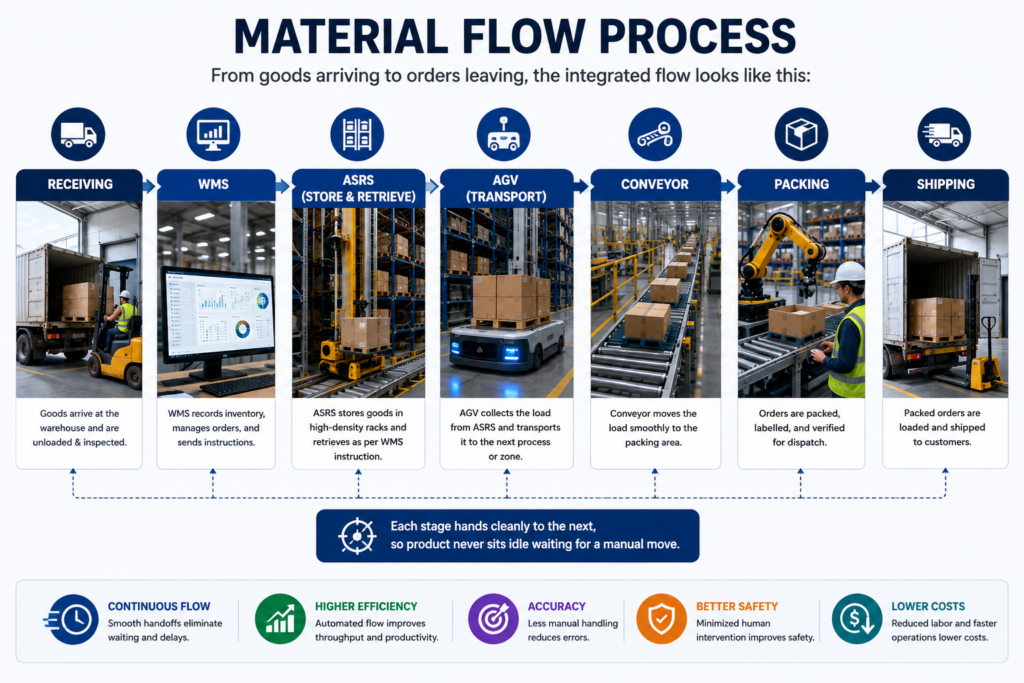
Material Flow Process
Real-World Example: An E-commerce Warehouse
Picture an online retailer shipping thousands of orders a day. When an order arrives, the WMS tells the ASRS to retrieve the required totes and present them at a transfer station. An AGV collects them and carries them to the picking zone, then moves the packed cartons onto the conveyor for dispatch. Staff stay in one ergonomic spot while the machines do the fetching and carrying — throughput climbs and errors fall.
Manufacturing Example
On a production site, the same partnership feeds the line. The ASRS stores raw materials and components in high-density racking; when the line needs them, AGVs transport the right parts from storage to the correct station just in time, then whisk finished goods back into the ASRS. The result is a smooth, continuous supply that keeps the line running without manual material handling.
The Benefits of AGV & ASRS Integration
Bringing the two together delivers gains that neither achieves alone:
| Benefit | What it delivers |
| Maximised space | High-density storage from the ASRS frees valuable floor area |
| Lower labour cost | AGVs and ASRS automate repetitive tasks, reducing manual handling |
| Fewer errors | Automated store-and-retrieve and transport reduce human error |
| Improved safety | Fewer forklifts and manual moves improve safety on the floor |
| Higher throughput | Goods flow continuously from storage to dispatch |
| Scalability | Add AGVs or storage as volumes grow, without redesigning the site |
Challenges to Plan For
Integration is powerful but not effortless. The biggest challenge is software: the WMS, WCS, ASRS, and AGVs must communicate flawlessly, which demands careful integration and testing. Physical layout matters too — transfer points must be positioned so AGVs and the ASRS hand off smoothly. Finally, the up-front investment is significant, so a clear business case and phased rollout are essential to keep the project on track.
Best Practices
A successful build comes down to discipline. Start by mapping your real material flow and setting measurable goals. Get a solid WMS foundation in place before adding hardware, so the data driving the machines is accurate. Introduce the ASRS and AGVs in phases, proving each stage before expanding. And choose scalable, well-supported systems that can grow with your volumes rather than boxing you in.
KPI Improvements
When the integration is working, the numbers move in the right direction. Set a baseline first, then track these metrics:
| KPI | Before | After | Impact |
| Inventory accuracy | 90–95% | 99%+ | Less safety stock |
| Order accuracy | 95–97% | 99.5%+ | Fewer returns |
| Throughput | Baseline | +30–50% | More orders per shift |
| Labour on transport | High | Sharply reduced | Lower operating cost |
| Space utilisation | Baseline | +40–60% | Avoids expansion |
Industry Applications
AGV and ASRS integration is valuable wherever dense storage meets the need to move goods reliably:
| Industry | How AGV & ASRS integration is used |
| E-commerce | Dense tote storage feeding fast, robot-served picking and dispatch |
| Manufacturing | Feeding components to the line and buffering finished goods just in time |
| Pharmaceuticals | Traceable, controlled storage with automated, error-free transport |
| Cold storage | Dense automated storage that limits time people spend in freezing zones |
| Automotive | Sequenced parts delivery from storage to assembly stations |
Future Trends
The technology keeps advancing. AI is making these systems self-optimising, deciding storage locations and vehicle routes automatically. Autonomous mobile robots are adding even more flexibility than fixed-path AGVs. And as Industry 4.0 and warehouse automation mature, integrated storage and transport will become the default for competitive operations rather than the exception.
Conclusion
AGV and ASRS integration is what turns scattered automation into a genuine automated material-handling system. The ASRS stores goods densely and accurately; the AGV moves them wherever they need to go; and shared software makes the two act as one. Together they lift space, accuracy, throughput, and safety all at once.
For any warehouse serious about scaling efficiently, integrating storage and transport is one of the smartest investments available — provided it is planned well and built in the right order.
Build Your Integrated Warehouse with Brilliant Info Systems
Brilliant Info Systems designs and integrates complete automated material-handling systems — ASRS, AGVs and AMRs, conveyor automation, and the WMS and WCS that tie them together. Talk to our team to design an integrated warehouse built around your operation.
Frequently Asked Questions
What is the difference between an AGV and an ASRS?
An AGV is a mobile robot that transports materials across the facility, while an ASRS stores and retrieves goods in dense racking. AGVs move goods; the ASRS stores them. Integrated, they form a complete material-handling system.
Why integrate AGVs with an ASRS?
Alone, each solves half the problem — storage or transport. Integrated, the ASRS presents loads and AGVs move them onward automatically, closing the gap and creating a seamless, low-error flow from storage to shipping.
Do AGVs and ASRS need a WMS?
Yes. A warehouse management system decides what needs to move and when, and a warehouse control system coordinates the machines in real time. Without them, the hardware cannot work together intelligently.
What industries use AGV and ASRS integration?
E-commerce, manufacturing, pharmaceuticals, cold storage, and automotive all use it to combine high-density storage with reliable automated transport.
Is AGV and ASRS integration expensive?
It is a significant investment, but a phased rollout and a clear ROI case make it manageable. The savings in space, labour, and errors typically justify the cost over a few years.