
RFID vs Barcode: Which Is Better for Inventory Tracking?
Every warehouse relies on accurate inventory tracking to maintain efficiency, reduce errors, and improve customer service. Two of the most widely used technologies are Barcode and RFID (Radio Frequency Identification). Both help businesses track inventory, improve visibility, and support warehouse operations, but each offers different advantages depending on business size, operational complexity, and automation goals.
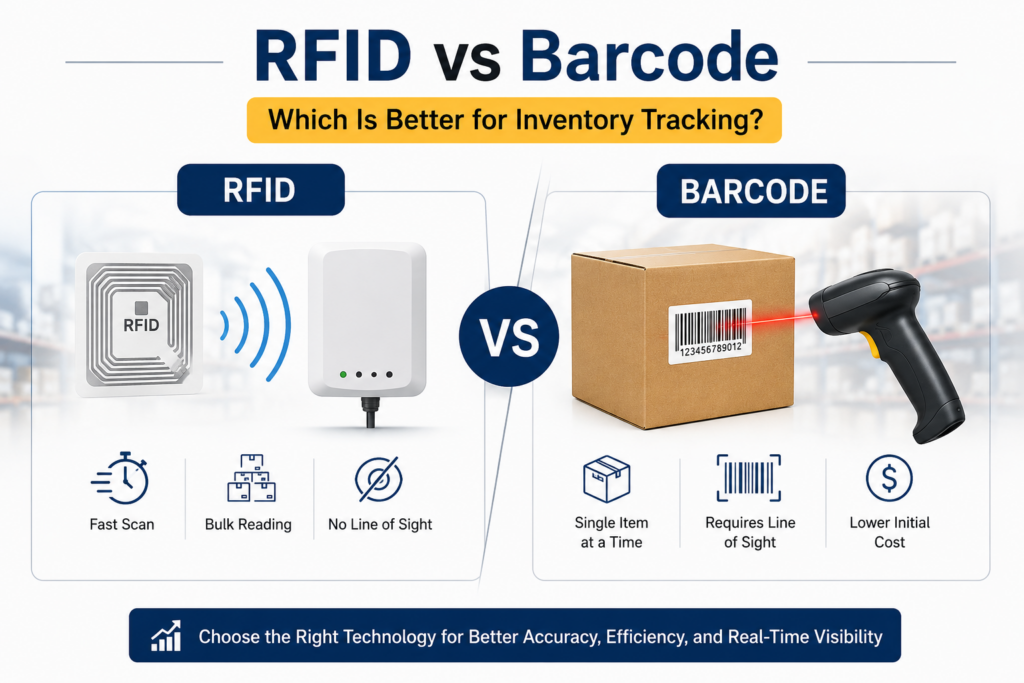
This guide compares RFID and Barcode for inventory tracking, explaining how each technology works, their strengths, limitations, costs, and ideal use cases. Whether you’re managing a small warehouse or a highly automated distribution center, this comparison will help you determine whether Barcode, RFID, or a hybrid approach is the best fit for your operation.
▶ Watch: RFID Solutions Overview
| Key Takeaways 1) Barcode and RFID are both reliable inventory tracking technologies used across modern warehouses. 2) Barcode offers a cost-effective and simple solution for manual inventory management. 3) RFID enables automated data capture, real-time visibility, and bulk item reading. 4) Many businesses achieve the best results by combining Barcode and RFID in a hybrid solution. 5) The right technology depends on inventory volume, operational requirements, automation goals, and budget. |
Table of Contents
- What is barcode technology?
- What is RFID technology?
- Key differences
- How inventory tracking works
- Advantages and disadvantages of each
- Which technology is best?
- Can they work together?
- Real warehouse example and best practices
- FAQs and conclusion
What Is Barcode Technology?
A barcode is a printed pattern of lines or squares that encodes an item’s identifier. A worker points a barcode scanner at the label, the scanner reads the code, and the item is looked up in your system. It is a proven, low-cost method used almost everywhere.
Barcode labels are cheap to print and easy to apply, and barcode scanners are inexpensive and simple to use. In warehouses, barcodes handle receiving, put-away, picking confirmation, and shipping — reliably, as long as someone scans each item within line of sight.
What Is RFID Technology?
RFID — radio frequency identification — uses radio waves instead of a printed code. Each item carries an RFID tag with a tiny chip and antenna. RFID readers emit radio waves that power the tag and read its ID, without any line of sight and without touching the item.
Passive RFID tags have no battery and are powered by the reader, keeping them cheap for everyday inventory. Active RFID tags carry their own battery for long-range tracking of large assets. In the warehouse, RFID reads whole pallets in seconds, enabling real-time inventory and hands-free automation.
RFID vs Barcode: Key Differences
Barcode and RFID both improve inventory visibility, but they use different methods to capture and manage data. Understanding their key characteristics helps businesses choose the most suitable technology for their operational needs:
| Factor | Barcode | RFID |
| Read range | A few centimetres | Up to 10 m (passive), 100 m+ (active) |
| Line of sight | Required | Not required |
| Reading speed | One at a time | Hundreds at once |
| Multiple-item reading | No | Yes |
| Cost | Very low | Higher tag and setup cost |
| Accuracy | Depends on manual scan | Very high, automated |
| Durability | Easily smudged or torn | Rugged and reusable |
| Automation | Limited | High — hands-free |
| Data capacity | Small, fixed | Larger, rewritable |
| Maintenance | Reprint damaged labels | Minimal for passive tags |
| Best use cases | Low-volume, budget setups | High-volume, automated tracking |
How Inventory Tracking Works
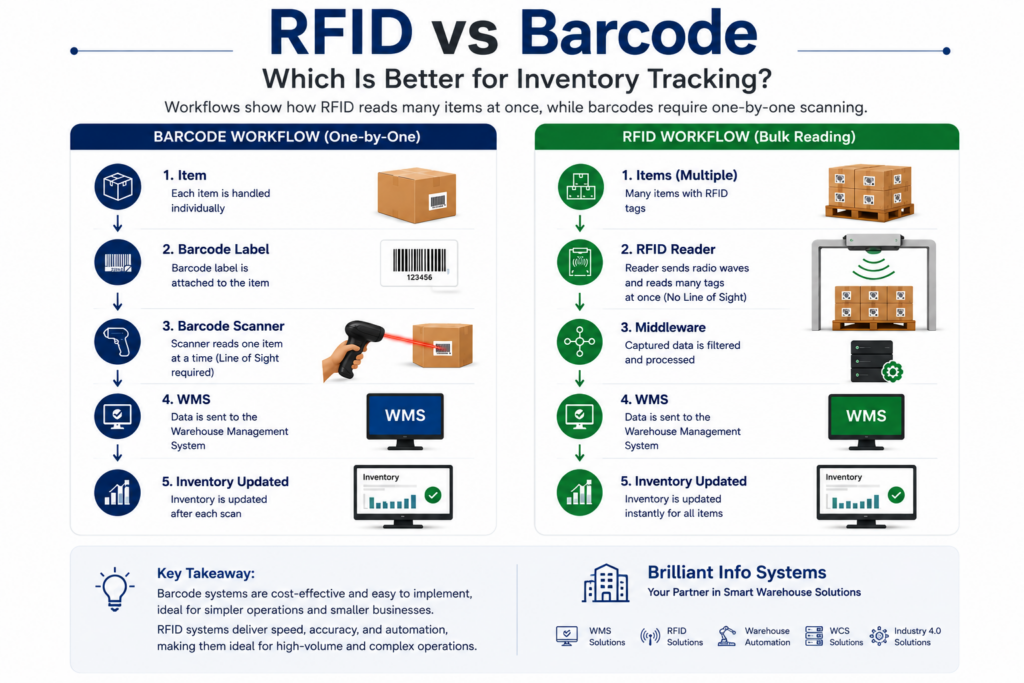
Advantages of Barcode
Barcodes remain popular for good reasons. They are extremely low cost, easy to implement with minimal infrastructure, and simple to train staff on. They are small-business friendly and enjoy near-universal adoption, so suppliers and partners already use them. For steady, lower-volume operations, that simplicity is hard to beat.
Advantages of RFID
RFID’s strengths appear as volume and automation needs rise. It reads items in bulk, delivers real-time tracking and better inventory accuracy, and powers warehouse automation. It makes cycle counts dramatically faster and reduces the labour spent walking and scanning — freeing staff for higher-value work.
Disadvantages of Barcode
The limitations are the flip side of the design. Every item needs a manual scan within line of sight, which is slow at high volume. Labels smudge, tear, or fall off, causing failed reads. And because barcodes cannot be read in bulk or automatically, they cap how far you can automate.
Disadvantages of RFID
RFID’s trade-offs are cost and complexity. Tags and readers cost more than barcodes, and the system needs supporting infrastructure and careful reader placement. Metal and liquids can interfere with radio waves, so tag selection and testing matter. These are manageable, but they make RFID a bigger commitment.
Which Technology Is Best?
There is no single winner — the right fit depends on your operation. This table gives a practical starting point:
| Business type | Recommended Solution | Reason |
| Small business | Barcode | Simple implementation and lower investment |
| Medium warehouse | Barcode or RFID | Depends on inventory volume and growth plans |
| Large distribution centre | RFID or Hybrid | Supports high-volume operations and automation |
| Manufacturing | RFID or Hybrid | Improves material traceability and work-in-progress visibility |
| Retail | Barcode or RFID | Selection depends on inventory complexity |
| Cold storage | RFID | Enables scanning without opening sealed goods |
| Healthcare | RFID | Supports asset traceability and compliance |
| 3PL / logistics | RFID or Hybrid | Handles multiple clients and high inventory movement efficiently |
Can RFID and Barcode Work Together?
Absolutely — and many warehouses do exactly that. A hybrid system uses barcodes where they are cheapest and simplest, and RFID where speed and automation pay off. For example, individual products may carry barcodes while pallets and cases use RFID for fast, bulk receiving.
This lets you automate the high-impact flows without re-tagging every single item, and it eases the transition from a barcode-only past to an RFID-driven future. For most growing businesses, hybrid is the pragmatic middle path.
Real Warehouse Example
A distribution center initially relied on barcode technology for receiving, inventory tracking, and order fulfillment. As order volumes increased and warehouse operations became more complex, manual scanning during receiving and cycle counting started taking more time.
Instead of replacing the existing system, the warehouse implemented a hybrid inventory tracking solution. Barcode continued to support product-level identification and order verification, while RFID was introduced for pallet-level receiving, bulk inventory tracking, and automated warehouse processes.
This combined approach improved inventory visibility, accelerated receiving operations, reduced manual scanning, and shortened cycle counts, while allowing the business to continue using its existing barcode infrastructure where it remained the most practical choice.
Business Benefits
- Improved inventory accuracy
- Faster receiving and inventory verification
- Reduced manual scanning effort
- Better warehouse visibility
- Scalable foundation for future warehouse automation
Best Practices for Choosing
Start with your numbers, not the technology. Measure your order volume, current accuracy, and labor costs, then match them to the comparison above. Pilot before you commit — a small RFID trial in receiving reveals real-world read rates around your products. Choose the right tag type for your environment, and make sure whatever you pick integrates cleanly with your WMS and ERP. When in doubt, a phased hybrid approach lowers risk.
Conclusion
Barcode and RFID are both proven inventory tracking technologies that help businesses improve inventory accuracy, operational efficiency, and supply chain visibility. Barcode remains a practical and cost-effective choice for organizations with straightforward inventory processes, while RFID enables greater automation, real-time visibility, and efficient handling of high-volume operations.
Rather than choosing one technology over the other, many organizations adopt a hybrid approach, using Barcode for product-level identification and RFID for automated receiving, inventory tracking, and warehouse automation. The right solution depends on your business requirements, inventory volume, operational complexity, automation goals, and long-term growth strategy.
By evaluating your current processes and future objectives, you can implement an inventory tracking solution that improves accuracy, increases productivity, and supports sustainable business growth.
Choose the Right Inventory Technology with Brilliant Info Systems
Whether your business requires Barcode, RFID, or a hybrid inventory tracking solution, Brilliant Info Systems can help you design, implement, and integrate the right technology for your warehouse. Our experts provide Barcode solutions, RFID systems, Warehouse Management Systems (WMS), Warehouse Control Systems (WCS), and complete Warehouse Automation solutions tailored to your operational requirements. Contact our team today to discuss the best inventory tracking strategy for your business.
Frequently Asked Questions
Is RFID better than barcode?
Neither technology is universally better. Barcode is a cost-effective and reliable solution for many inventory tracking applications, while RFID offers automated data capture, real-time visibility, and bulk item reading. The right choice depends on your business requirements, inventory volume, automation goals, and budget.
Is RFID more expensive than barcode?
Yes. RFID typically requires a higher initial investment because it involves RFID tags, readers, antennas, and supporting infrastructure. Barcode systems are generally less expensive to implement. However, businesses with high inventory volumes may achieve long-term operational savings through RFID’s automation and efficiency.
Can RFID replace barcodes completely?
Yes, it can in certain applications. However, many organizations choose to use both Barcode and RFID together. A hybrid approach allows Barcode to handle product-level identification while RFID supports automated inventory tracking, receiving, and warehouse automation.
Does RFID need line of sight?
No. RFID uses radio waves to communicate with RFID tags, allowing items to be identified without direct line of sight. Barcode scanners, on the other hand, require the barcode label to be visible during scanning.
Which is more accurate, RFID or barcode?
Both technologies provide reliable inventory tracking when implemented correctly. Barcode accuracy depends on consistent manual scanning, while RFID automates data capture and can improve accuracy in high-volume or highly automated warehouse environments.
Do metal and liquids affect RFID?
Yes. Metal surfaces and liquids can affect RFID signal performance. However, using the appropriate RFID tags, reader placement, and system design helps ensure reliable operation even in challenging warehouse environments.
Which is better for a small business?
For many small businesses, Barcode provides an affordable and easy-to-implement inventory tracking solution. As operations expand and automation requirements increase, RFID or a hybrid solution may become a better fit. The best choice depends on business objectives and future growth plans.
Can RFID and barcode share one WMS?
Yes. Most modern Warehouse Management Systems (WMS) support both Barcode and RFID technologies. A hybrid implementation enables businesses to use Barcode and RFID together while maintaining a single, centralized inventory database.