
How MES, OEE & Andon Systems Improve Manufacturing Productivity
Every manufacturer wants the same thing: more good product, from the same machines and people, at lower cost. The obstacle is that productivity leaks away in dozens of small, hard-to-see ways — a machine idling, a slow cycle, a quality problem caught too late. You cannot fix what you cannot see. That is where MES, OEE, and Andon systems come in.
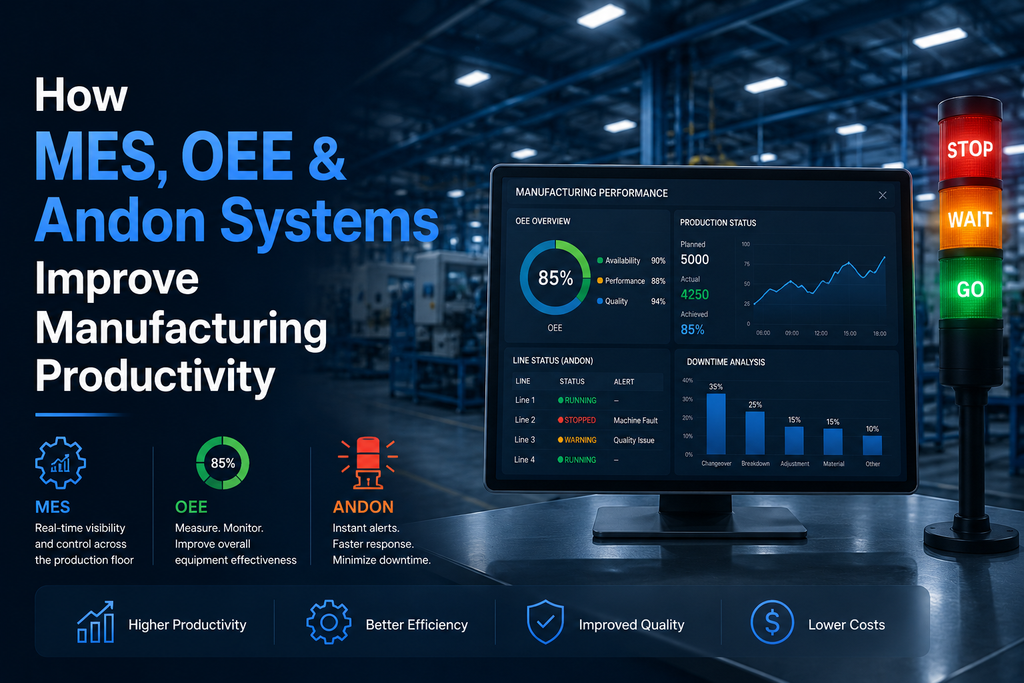
Used together, these three give you real-time visibility of the shop floor, pinpoint exactly where productivity is lost, and trigger a fast response when something goes wrong. This guide explains what each one does and, more importantly, how they combine to improve manufacturing productivity. For the fundamentals, see our guide on what MES is in manufacturing.
▶ Watch: OEE Monitoring
Table of Contents
- The three systems at a glance
- What is MES?
- What is OEE?
- What is Andon?
- How they work together
- The productivity benefits
- Implementation tips
- FAQs and conclusion
The Three Systems at a Glance
MES, OEE, and Andon each solve a different part of the productivity puzzle, and they are strongest when combined:
| System | What it does | Its role in productivity |
| MES | Monitors and controls production in real time | The data backbone tying everything together |
| OEE | Measures availability, performance and quality | Reveals exactly where productivity is lost |
| Andon | Signals problems on the shop floor instantly | Triggers a fast response before losses grow |
What Is MES?
A manufacturing execution system (MES) monitors and controls production on the shop floor in real time. It turns production plans into work orders, tracks progress, and captures live production data from machines and operators. MES software is the data backbone — without it, OEE and Andon have no reliable, real-time information to work from.
What Is OEE?
Overall equipment effectiveness (OEE) is the standard measure of how productively equipment is used. It combines three factors, and multiplying them gives a single, honest score for how well a machine or line is really performing.

Availability captures downtime losses, performance captures slow cycles, and quality captures defects and quality loss. An effective OEE monitoring programme shows exactly which of the three is dragging output down — so you fix the real problem instead of guessing.
What Is Andon?
Andon is a visual signalling system — often a tower light or a digital board — that alerts the team the instant something goes wrong on the line. A red light, an alert, and the right people know immediately that a machine has stopped, a part is missing, or quality has slipped.
The power of andon systems is speed of response. Instead of a problem quietly costing output for an hour, it is flagged and fixed in minutes. Andon turns hidden losses into visible, actionable events.
How MES, OEE and Andon Work Together
Individually, each system is useful. Together, they form a closed loop that continuously drives productivity upward. Here is how the data flows:
- MES captures the data: it tracks production in real time, feeding live production data from every machine and operator.
- OEE turns data into insight: using that data, OEE reveals exactly where availability, performance, or quality losses occur.
- Andon triggers action: when a loss happens, andon instantly signals the floor so the team responds before it grows.
- The loop repeats: every event is recorded, feeding continuous improvement over time.
The result is a shop floor with genuine real-time visibility, where problems are seen, measured, and fixed as they happen. Tied into quality inspection and SPC/SQC, the same loop protects quality as well as output.
Common Productivity Losses These Systems Expose
OEE breaks hidden losses into clear categories, and real-time production tracking makes each one visible: unplanned downtime and breakdowns, long setup and changeover times, slow cycles and minor stops, and defects or rework. With real time data flowing from MES and real time visibility across the floor, managers can finally see which of these losses is costing the most — and tackle it directly rather than guessing. This is the difference between reacting to yesterday’s report and managing production as it happens.
The Productivity Benefits
Bringing these systems together delivers gains that show up directly in output and cost:
- Reducing downtime: fast andon response and OEE availability tracking cut the time machines sit idle.
- Faster cycles: performance data exposes slow cycles so they can be tuned out.
- Less quality loss: problems are caught in real time, reducing scrap and rework.
- Better production management: managers make decisions on live production data, not guesswork.
- Continuous improvement: every recorded event feeds a steady rise in productivity over time.
Because the systems also see material and inventory levels and connect to predictive maintenance, they help keep raw materials flowing and machines running — removing two more common causes of lost productivity.
Implementation Tips
To get the most from MES, OEE, and Andon, start with clean, reliable data — the whole loop depends on it, so connect machines through PLC and HMI and IoT sensors. Begin with one line, prove the productivity gain, then scale. Make sure the systems integrate with your ERP so shop-floor performance connects to the wider business, and involve operators early so they trust and act on the signals. A digital twin can help model improvements before you make them on the real floor.
Conclusion
MES, OEE, and Andon are far more powerful together than apart. MES gives you the real-time data, OEE shows you exactly where productivity is lost, and Andon makes sure problems are fixed fast. The result is a shop floor that continuously sees, measures, and improves its own performance.
For manufacturers under pressure to do more with the same resources, combining these three is one of the surest routes to higher productivity, lower cost, and steady continuous improvement.
Boost Your Manufacturing Productivity with Brilliant Info Systems
Brilliant Info Systems helps manufacturers implement and connect MES, OEE monitoring, and Andon across the shop floor — integrated with ERP and quality inspection. Contact our team to turn real-time data into higher productivity.
Frequently Asked Questions
How do MES, OEE, and Andon improve productivity?
MES captures real-time production data, OEE reveals where availability, performance, or quality losses occur, and Andon triggers a fast response. Together they see, measure, and fix productivity losses as they happen.
What is the difference between MES and OEE?
MES is the software that monitors and controls production and captures the data. OEE is a metric — calculated from that data — that measures how productively equipment is used. MES provides the data; OEE interprets it.
What is an Andon system?
Andon is a visual signalling system, such as a tower light or digital board, that instantly alerts the team when a problem occurs on the line, enabling a fast response before losses grow.
How is OEE calculated?
OEE is Availability × Performance × Quality. Availability reflects downtime, performance reflects slow cycles, and quality reflects defects. Multiplying the three gives a single productivity score.
Do these systems work together?
Yes. MES supplies real-time data, OEE turns it into insight, and Andon triggers action — forming a closed loop that continuously improves productivity and feeds long-term continuous improvement.
Which industries benefit from MES, OEE, and Andon?
Any discrete or process manufacturer — automotive, electronics, pharmaceuticals, food and beverage, and general engineering — benefits from the real-time visibility and faster response these systems provide.