
What Is MES in Manufacturing? A Complete Guide
On a modern factory floor, decisions have to be made in seconds. Is the line running to plan? Which order is late? Did that batch pass quality? Enterprise planning systems are too high-level to answer those questions in real time, and paper and spreadsheets are far too slow. This gap is exactly what a Manufacturing Execution System fills.
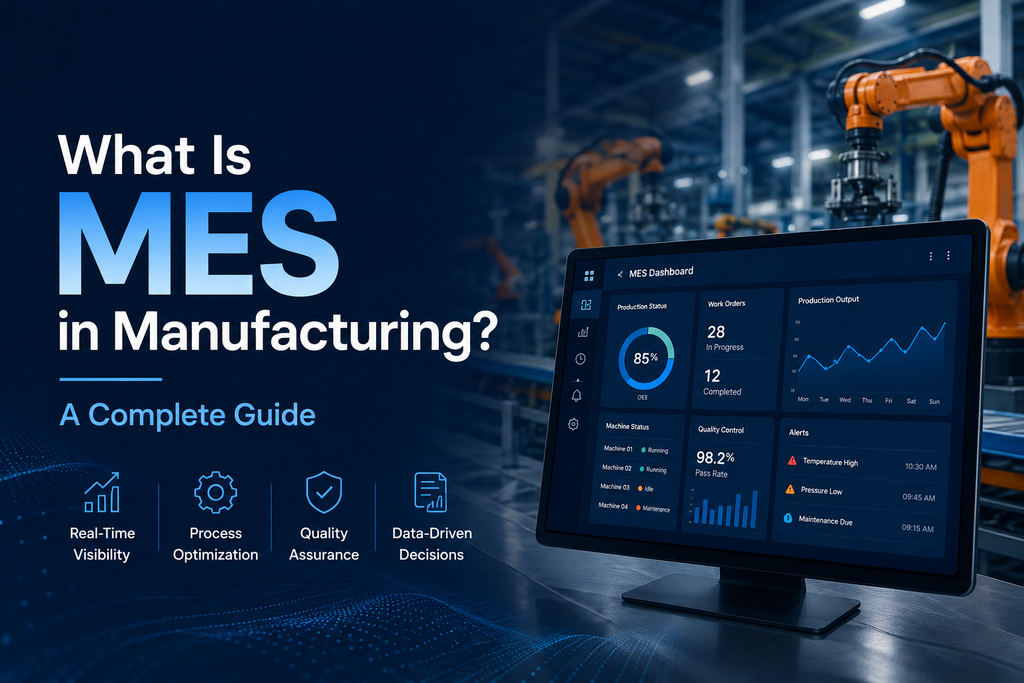
A manufacturing execution system (MES) connects the planning layer to the machines, giving manufacturers real-time visibility and control of production as it happens. This complete guide explains what MES is, how it works, its key functions, how it differs from ERP, and the benefits it delivers on the shop floor.
▶ Watch: Manufacturing Execution System (MES)
Table of Contents
- What is MES?
- Why MES matters
- How MES works
- Key functions of MES
- MES vs ERP
- MES, OEE and quality
- Benefits
- Integration and implementation
- The future and FAQs
What Is MES (Manufacturing Execution System)?
A manufacturing execution system is software that monitors, tracks, and controls production on the factory floor in real time. It takes the production plans handed down from higher-level systems and turns them into executable work orders, then records exactly what happens as those orders are made — machine by machine, batch by batch.
In short, MES is the bridge between planning and doing. It knows what should be produced, tracks the work in progress on the floor, and captures the data needed to manage quality, performance, and traceability. In practice, it gives manufacturers a single place to monitor and control production as it happens — following each order from raw materials through to finished goods. That real-time link between the plan and the floor is what makes MES software so valuable in manufacturing operations management.
Why MES Matters in Manufacturing
Without MES, manufacturers often run blind between planning and production. Managers know what was ordered and, eventually, what shipped — but not what is happening on the line right now. That lag hides problems until they are expensive: a quality issue caught too late, a machine quietly underperforming, a work order slipping behind.
MES closes that gap. By monitoring and controlling production continuously, it lets teams spot and fix issues immediately, optimise production processes, and drive continuous improvement based on real production data rather than guesswork. The payback shows up in fewer defects, less unplanned downtime, tighter control of raw materials and material consumption, and faster, better-informed decisions — the kind of gains that compound shift after shift. For manufacturers under pressure to do more with the same resources, that real-time control is increasingly a competitive necessity rather than a luxury.
How MES Works
MES sits in the middle of the manufacturing technology stack, between business planning and the machines. It receives plans from the ERP above it, and connects downward to control systems such as supervisory control and data acquisition (SCADA) and PLC and HMI on the equipment itself.
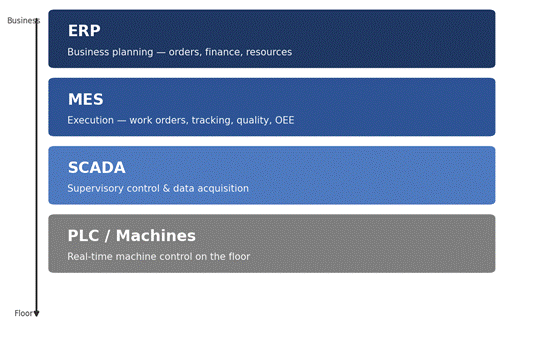
The flow works like this: the ERP sends production plans and work orders to the MES; the MES schedules and dispatches that work to the floor; SCADA and PLCs control the machines and feed live signals back up; and the MES collects that production data, tracks progress and quality, and reports it back to the ERP. Standards like OPC UA and industrial protocols and IoT sensors make this real-time data exchange possible.
The Key Functions of MES
A capable MES covers several core functions, all working from the same live production data:
| MES function | What it does on the floor |
| Production tracking | Monitors work orders and work-in-progress in real time |
| Quality management | Captures quality control data and enforces standards |
| Performance / OEE | Measures overall equipment effectiveness and downtime |
| Material tracking | Records material consumption and genealogy |
| Traceability | Links every product to its full production history |
| Data collection | Gathers production data from machines and operators |
Because all of this runs on one real-time platform, an MES becomes the single source of truth for what is happening in production — feeding OEE monitoring, quality inspection, and SPC/SQC from the same data.
MES vs ERP: What’s the Difference?
MES and ERP are often confused, but they operate at different levels. An enterprise resource planning (ERP) system plans and manages the whole business; an MES executes and monitors production on the floor. The ERP decides what to make and when; the MES makes sure it actually happens, correctly and on time.
| Aspect | ERP | MES |
| Focus | Whole-business planning | Shop-floor execution |
| Questions it answers | What to make and buy, and the finances | How production is actually running, right now |
| Time horizon | Days to months | Real time, second by second |
| Manages | Orders, finance, procurement, resources | Work orders, WIP, quality, OEE |
| Users | Planners, finance, management | Production and quality teams |
The two are complementary, not competing. Integrated, the ERP hands plans to the MES, and the MES feeds real production results back — giving the business one connected view from the boardroom to the machine.
MES, OEE and Quality Management
Two of the biggest wins from MES are performance and quality. By capturing live machine data, MES calculates overall equipment effectiveness (OEE) — revealing exactly where availability, performance, or quality losses are dragging output down. Managers can then target the real bottlenecks instead of guessing.
On quality, MES enforces standards in real time and records every check, linking results to specific products and batches. Combined with quality inspection and statistical tools, this catches defects early and builds the traceability that regulated industries require.
The Benefits of MES
Implemented well, an MES transforms how a factory runs:
- Real-time visibility: see production status, WIP, and issues as they happen.
- Higher productivity: OEE insights reveal and remove bottlenecks.
- Better quality: standards enforced and defects caught early.
- Full traceability: every product linked to its complete production history.
- Less waste: tighter control of material consumption and rework.
- Continuous improvement: decisions driven by real production data, not guesswork.
MES Integration and Implementation
MES delivers its full value when it is well integrated. Upward, it connects to the ERP and order management; downward, to machines via SCADA and PLCs. It can also feed predictive maintenance, a digital twin of the line, and cloud and SaaS analytics platforms.
A successful rollout starts with clear goals — usually visibility, OEE, or quality — and a pilot on one line before scaling. Clean integration with existing systems and proper operator training are what turn MES from a data tool into a genuine driver of shop-floor improvement.
The Future of MES
MES is evolving fast as factories get smarter. Combined with AI, IoT, and analytics, modern MES platforms move from simply recording production to predicting and optimising it — flagging issues before they happen and suggesting improvements automatically. As Industry 4.0 matures, MES sits at the heart of the connected, self-optimising smart factory.
Common MES Implementation Challenges
MES delivers strong results, but implementation needs care. The most common challenge is integration: connecting the MES upward to the ERP and downward to a mix of old and new machines can be complex, especially where equipment speaks different protocols. Data quality matters too — an MES is only as good as the signals it receives, so sensors and connections must be reliable. Change management is often underestimated: operators need to trust and use the system, or the shop floor quietly reverts to old habits. Finally, trying to do everything at once tends to stall projects; starting with one line and a clear goal, then scaling, is far more successful. Planning for these realities up front, ideally with an experienced partner, is what separates a smooth rollout from a stalled one.
Conclusion
A manufacturing execution system is the missing link between planning and the factory floor — turning production plans into real-time execution, and raw machine signals into actionable insight. It is what lets manufacturers see, control, and continuously improve production as it happens.
As factories pursue higher quality, tighter traceability, and Industry 4.0, MES has become essential rather than optional. The key is choosing the right platform for your operation and integrating it cleanly with your ERP and machines.
Bring Real-Time Control to Your Factory with Brilliant Info Systems
Brilliant Info Systems helps manufacturers implement and integrate MES and smart manufacturing solutions — connected to ERP, OEE monitoring, PLC/HMI, and quality inspection. Contact our team to bring real-time visibility and control to your production floor.
Frequently Asked Questions
What is MES in manufacturing?
MES, or a manufacturing execution system, is software that monitors, tracks, and controls production on the factory floor in real time — turning plans into work orders and capturing what actually happens during production.
What is the difference between MES and ERP?
An ERP plans and manages the whole business, while an MES executes and monitors production on the floor. The ERP decides what to make; the MES makes sure it happens correctly and on time. They work together.
What are the main functions of MES?
Core functions include production tracking, quality management, OEE and performance monitoring, material tracking, traceability, and real-time data collection from machines and operators.
How does MES improve OEE?
MES captures live machine data to calculate overall equipment effectiveness, revealing exactly where availability, performance, and quality losses occur so managers can target and remove the real bottlenecks.
Does MES integrate with ERP and machines?
Yes. MES sits between the two — receiving plans from the ERP and connecting to machines through SCADA and PLCs — using standards like OPC UA to exchange data in real time.
Which industries use MES?
MES is used across manufacturing — including automotive, electronics, pharmaceuticals, food and beverage, and general engineering — wherever real-time production visibility, quality, and traceability matter.