
Industrial IoT (IoT) in Warehousing: A Complete Guide to Smart Warehouses
A modern warehouse generates a staggering amount of information every minute — where stock is, how equipment is running, how goods are moving. The problem is that most of it is invisible, locked inside machines and processes nobody can see in real time. Industrial IoT changes that by connecting the warehouse and turning that hidden activity into live, usable data.
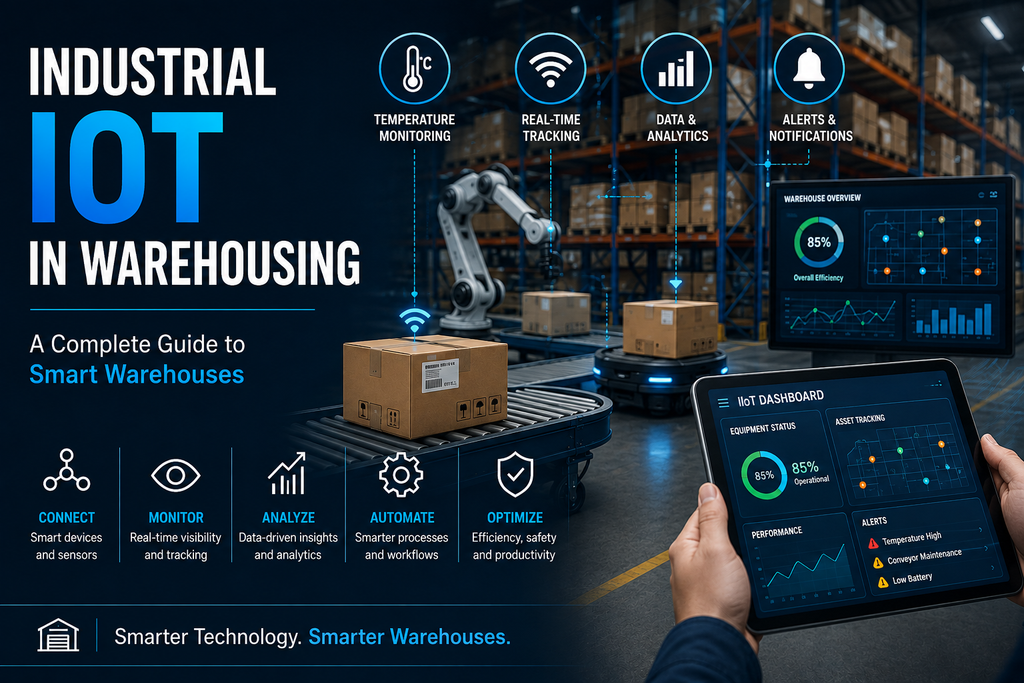
Industrial IoT (IIoT) is the network of connected sensors, devices, and systems that powers today’s smart warehouses. This complete guide explains what IIoT in warehousing is, how it works, its key applications and benefits, and how it underpins smart warehousing across the supply chain.
▶ Watch: Smart Warehouse Solutions
Table of Contents
- What is Industrial IoT (IIoT)?
- How IIoT works in a warehouse
- Key applications
- The benefits
- IIoT, AI and automation
- How to implement IIoT
- Challenges and the future
- FAQs and conclusion
What Is Industrial IoT (IIoT)?
Industrial IoT is the use of connected sensors and devices to collect and share data across industrial operations. In a warehouse, that means IoT sensors on shelves, machines, vehicles, and goods, all feeding information to a central system. This iot technology turns a traditional warehouse into a connected, data-driven one.
In short, IIoT gives a warehouse a nervous system. Every important thing — a temperature, a location, a machine’s status — becomes a live signal, creating the real time data that smart warehouses run on. Without IIoT, smart warehousing simply is not possible.
How IIoT Works in a Warehouse
An IIoT system follows a simple chain, from the sensor on a shelf to the dashboard on a manager’s screen. Each stage adds value to the data:
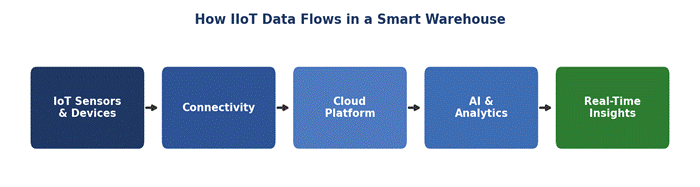
Sensors and devices capture data from across the warehouse; network connectivity carries it to a central platform; that platform stores and processes it, often in the cloud; AI and analytics turn it into insight; and the results appear as real time insights on dashboards and alerts. Standards and smart sensors make this constant flow of information possible, giving managers real time visibility of the entire operation.
Key Applications of IIoT in Warehousing
IIoT shows up across the warehouse in practical, high-value ways. The most common applications include:
| IIoT application | What it does in the warehouse |
| IoT sensors & condition monitoring | Track temperature, humidity, and equipment health in real time |
| Predictive maintenance | Flag failing equipment before it causes downtime |
| RFID & asset tracking | Locate stock, assets, and vehicles automatically |
| Inventory visibility | Keep stock levels accurate with live data |
| Smart sensors & safety | Monitor conditions and protect people and goods |
These connect naturally with wider automation such as automated guided vehicles and ASRS, so goods move and are tracked with minimal human effort.
The Benefits of IIoT in Warehousing
Connecting the warehouse delivers gains that reach every corner of the operation:
- Real-time visibility: always know where stock, assets, and equipment are.
- Reduced operating costs: efficiency and predictive maintenance cut waste and downtime.
- Fewer errors: automated data capture reduces human error.
- Improved efficiency: live data helps optimise every process and improve efficiency.
- Higher customer satisfaction: faster, more accurate fulfilment keeps customers happy.
- Better decisions: real time insights turn guesswork into evidence.
IIoT, AI and Automation
IIoT is the foundation, but its real power emerges when combined with artificial intelligence AI and machine learning ML. The sensors gather the data; AI powered analytics find the patterns — predicting demand, spotting anomalies, and optimising operations automatically. This is what makes a warehouse genuinely smart rather than just connected — able to anticipate problems, adapt to demand, and improve itself over time instead of simply reporting what already happened.
Feeding this data to predictive maintenance, a digital twin, and autonomous mobile robots creates a self-optimising operation. Combined with RFID tags and warehouse management systems, IIoT links the physical and digital warehouse into one intelligent whole.
How to Implement IIoT in Your Warehouse
A successful rollout starts with a clear goal — visibility, efficiency, or reduced operating costs — rather than technology for its own sake. Begin by identifying the biggest pain point, add the right IoT sensors and connectivity, and integrate the data with your existing systems and ERP. Pilot in one area, prove the value, then scale across the warehouse. Clean data and good integration matter more than the number of sensors.
Challenges to Plan For
IIoT delivers strong results, but a few realities need managing. Connecting many devices raises data security and privacy considerations, so protection must be built in from the start. Integrating new sensors with older equipment and systems can be complex. And the volume of data is only useful if it is turned into action, which needs the right analytics and clear ownership. Planning for these up front, ideally with an experienced partner, keeps a project on track.
The Future of IIoT in Warehousing
IIoT is the backbone of the smart warehouse, and its role is only growing. As AI, 5G, and edge computing mature, warehouses will become increasingly autonomous — sensing, deciding, and acting with less and less human intervention. Across the supply chain, connected, data-driven warehouses will set the standard for speed, accuracy, and cost, making IIoT less a competitive advantage and more a baseline expectation.
Conclusion
Industrial IoT is the technology that turns an ordinary warehouse into a smart one. By connecting sensors, devices, and systems, it creates the real-time data and visibility that modern warehouse operations depend on — and lays the foundation for AI, automation, and truly autonomous facilities.
As supply chains grow more demanding, IIoT is fast becoming essential rather than optional. The key is to start with clear goals, connect the right data, and build toward a smarter, more efficient warehouse step by step.
Build Your Smart Warehouse with Brilliant Info Systems
Brilliant Info Systems designs and integrates IIoT-powered smart warehouse solutions — IoT and smart sensors, RFID and asset tracking, predictive maintenance, and automation — connected through ERP integration. Contact our team to build a connected, data-driven warehouse.
Frequently Asked Questions
What is Industrial IoT (IIoT) in warehousing?
IIoT in warehousing is the network of connected sensors and devices that collect and share real-time data across the warehouse, turning a traditional operation into a connected, data-driven smart warehouse.
How does IIoT make a warehouse smart?
IIoT sensors capture live data on stock, equipment, and conditions; that data is analysed, often with AI; and the resulting real-time insights drive automated, optimised decisions across the operation.
What are the main benefits of IIoT in warehousing?
Key benefits include real-time visibility, reduced operating costs, fewer errors, improved efficiency, predictive maintenance, and higher customer satisfaction — all from connecting and analysing warehouse data.
What is the difference between IoT and IIoT?
IoT refers broadly to connected consumer and business devices, while IIoT (Industrial IoT) specifically applies this technology to industrial settings like warehouses and factories, where reliability and scale are critical.
How does IIoT support predictive maintenance?
IIoT sensors continuously monitor equipment health and feed the data to analytics that flag failing machines before they break down, reducing downtime and extending equipment life.
Is IIoT worth the investment for warehouses?
For most operations, yes. The gains in visibility, efficiency, and reduced operating costs typically justify the investment, especially when IIoT is rolled out in stages around clear business goals.