
What Is Smart Manufacturing? Industry 4.0 Explained
For most of history, making things faster meant adding more machines or more people. Today, the biggest gains come from something less visible: data. Factories now generate oceans of information, and the manufacturers that connect and act on it are pulling ahead. This shift has a name — smart manufacturing — and it is the heart of what people call Industry 4.0.
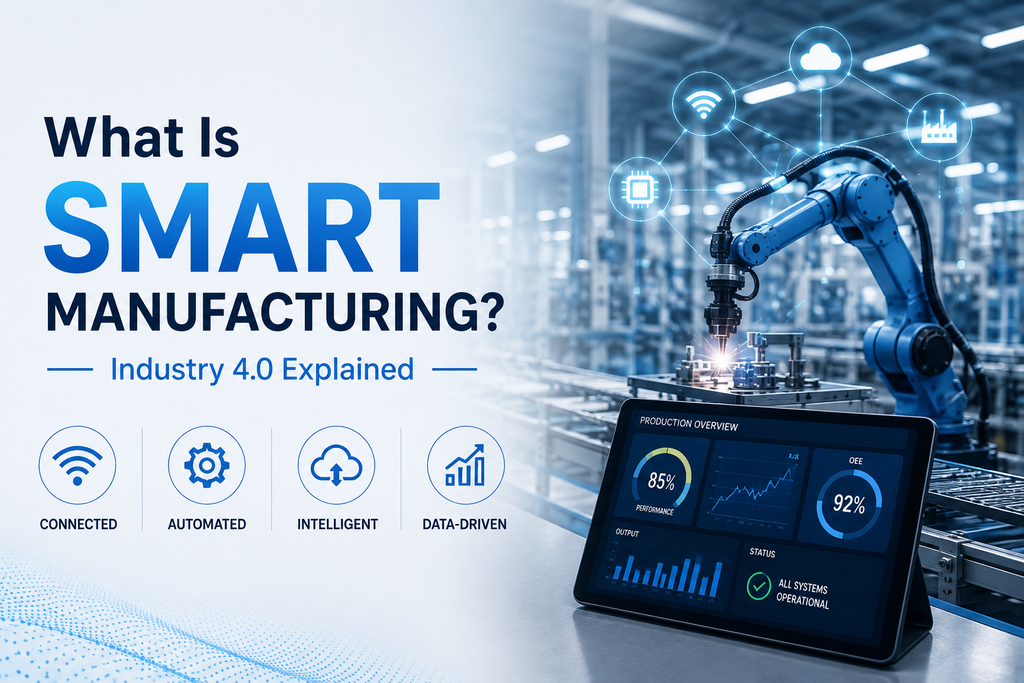
Smart manufacturing uses connected technology, data, and automation to make production faster, cheaper, and more flexible. This guide explains what smart manufacturing is, how it relates to Industry 4.0, the core technologies behind it, and the benefits it brings to the manufacturing industry.
▶ Watch: Factory Automation
Table of Contents
- What is smart manufacturing?
- What is Industry 4.0?
- The pillars of Industry 4.0
- The core technologies
- How it works
- The benefits
- The smart factory
- Implementation and the future
- FAQs and conclusion
What Is Smart Manufacturing?
Smart manufacturing is the use of connected machines, sensors, data analytics, and automation to run production intelligently. Instead of machines working in isolation, they share data through a central computer system, allowing the whole operation to be monitored, optimised, and even self-adjusted in real time.
In simple terms, digital manufacturing turns a factory from a collection of separate machines into one connected, data-driven system. The goal is not just automation for its own sake, but a production process that continuously improves itself — reducing cost, raising quality, and adapting quickly to change.
What Is Industry 4.0?
Industry 4.0 is the name given to the fourth industrial revolution — the current wave of change transforming the manufacturing industry through connectivity, data, and intelligence. It follows three earlier revolutions, each of which reshaped how goods are made:
| Revolution | Driver | What changed |
| Industry 1.0 | Steam and water power | Mechanised production began |
| Industry 2.0 | Electricity | Mass production and assembly lines |
| Industry 3.0 | Computers and electronics | Automation of individual machines |
| Industry 4.0 | Connectivity, data and AI | Connected, self-optimising smart factories |
Where earlier revolutions mechanised and then automated individual tasks, Industry 4.0 connects everything together. Smart manufacturing is essentially Industry 4.0 put into practice on the factory floor.
The Pillars of Industry 4.0
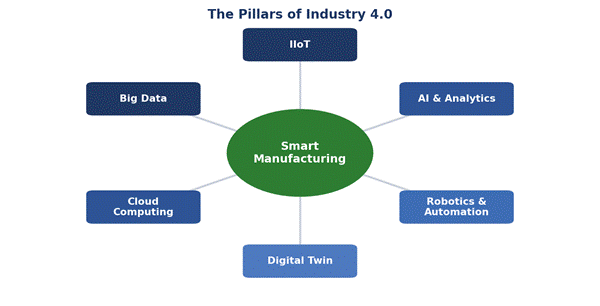
Smart manufacturing rests on a set of connected technologies working together. No single tool makes a factory smart — it is the combination that counts:
The Core Technologies of Smart Manufacturing
Several technologies power the smart factory, each adding a different capability. Industrial IoT sensors connect machines and collect data; AI and data analytics turn that data into insight; and robotics and integrated automation carry out the physical work.
On top of these sit cloud computing for storing and processing data cheaply, a digital twin to model production lines virtually, and predictive maintenance to keep equipment running. Together with control systems like PLC and HMI, they form a complete, connected production environment.
How Smart Manufacturing Works
In a smart factory, connected machines and sensors continuously stream real-time data to a central, often cloud based, platform. Data analytics and AI process that information to spot patterns, predict problems, and recommend or make adjustments automatically. A manufacturing execution system ties the plan to the floor, so production is monitored and controlled as it happens.
The result is a closed loop: the factory senses what is happening, analyses it, and acts on it — improving the production process shift after shift. This is what separates a truly smart factory from one that is merely automated.
Smart Manufacturing vs Traditional Manufacturing
The contrast with traditional manufacturing makes the value clear. In a conventional factory, machines largely work in isolation, data is collected manually and after the fact, and problems are often discovered only once they have caused waste. Decisions rely on experience and periodic reports rather than live information.
Smart manufacturing flips this. Industrial automation connects the machines, sensors capture data continuously, and analytics turn it into real-time insight the moment it is needed. Instead of reacting to yesterday’s numbers, managers see and shape production as it happens. The factory shifts from a set of separate machines to a single, self-improving system — which is exactly why the gains in cost, quality, and speed are so significant.
The Benefits of Smart Manufacturing
Adopting smart manufacturing delivers advantages across the whole business:
- Reduced cost: efficiency, less waste, and predictive maintenance lower operating costs.
- Higher quality: real-time monitoring catches defects early and improves consistency.
- Faster time to market: digital tools speed up product design and production.
- Greater flexibility: connected production lines adapt quickly to new products and demand.
- Better decisions: data analytics replace guesswork with evidence.
- Improved uptime: predictive maintenance reduces unplanned downtime.
The Smart Factory in Action
A smart factory is where all of this comes together. Machines communicate through connected automation systems, quality inspection and SPC/SQC run continuously, and OEE monitoring reveals exactly where to improve. Everything links back to the wider business through ERP integration, giving one connected view from the boardroom to the machine — the essence of digital transformation in manufacturing.
Implementation and the Future
Adopting smart manufacturing is a journey, not a single purchase. Successful digital transformations start with a clear goal — reduced cost, quality, or flexibility — and a pilot on one production line before scaling. Clean data, good integration, and trained people matter more than buying the newest tools.
Conclusion
Smart manufacturing, powered by Industry 4.0, is reshaping how the world makes things. By connecting machines, data, and automation, it turns factories into intelligent systems that produce faster, cheaper, and with higher quality — while adapting quickly to a changing market.
The fourth industrial revolution is well under way, and the manufacturers that embrace it will lead their industries. The key is to start with clear goals, connect the right technologies, and build toward the smart factory step by step.
Start Your Smart Manufacturing Journey with Brilliant Info Systems
Brilliant Info Systems helps manufacturers adopt Industry 4.0 and smart manufacturing solutions — IIoT, digital twins, predictive maintenance, and integrated automation — connected through ERP integration. Contact our team to begin your digital transformation.
Looking ahead, smart factories will grow more autonomous as AI, 5G, and edge computing mature. The line between the physical and digital factory will keep blurring, and connected, data-driven manufacturing will become the standard rather than the exception across the industry.
Frequently Asked Questions
What is smart manufacturing in simple terms?
Smart manufacturing is the use of connected machines, sensors, data, and automation to run production intelligently — turning a factory into one connected, data-driven system that continuously improves itself.
What is the difference between smart manufacturing and Industry 4.0?
Industry 4.0 is the broad concept of the fourth industrial revolution, driven by connectivity and data. Smart manufacturing is Industry 4.0 put into practice — the actual connected, intelligent factory.
What technologies are used in smart manufacturing?
Key technologies include Industrial IoT, AI and data analytics, robotics and automation, cloud computing, digital twins, and predictive maintenance, all working together through connected systems.
What are the benefits of smart manufacturing?
Benefits include reduced cost, higher quality, faster time to market, greater flexibility, better data-driven decisions, and improved uptime through predictive maintenance.
What is a smart factory?
A smart factory is a fully connected production facility where machines, sensors, and systems share data and act on it in real time, enabling continuous, automated optimisation of the production process.
Is smart manufacturing only for large companies?
No. Because it can be adopted in stages, manufacturers of all sizes can start with a single line or process and scale up, gaining the benefits of digital manufacturing without a huge upfront leap.