
How IoT Is Changing Blast and Environmental Monitoring in Mining
Mining has always depended on measurement — how strong a blast was, how much dust is in the air, whether a slope is stable. For most of the industry’s history, those measurements were taken by hand, one reading at a time. The Internet of Things has changed that completely. By connecting sensors across a site and streaming their data in real time, IoT has turned occasional, manual measurement into continuous, automatic intelligence.
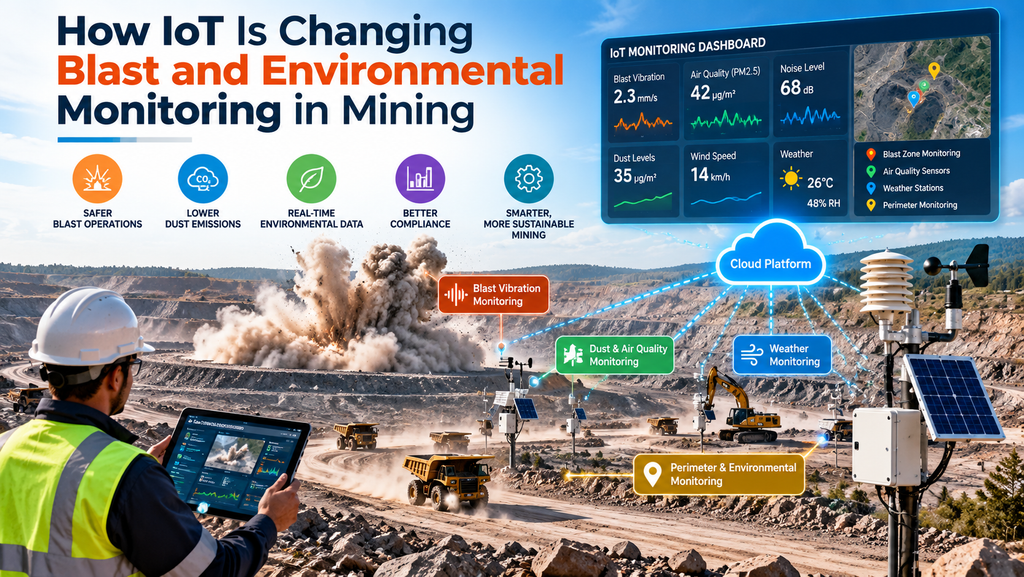
This guide explores how IoT is transforming both blast and environmental monitoring in mining — what industrial IoT is, how it works, and the concrete ways connected mining technology is making sites safer, cleaner, and more efficient. It ties together the tools behind a modern blast vibration monitoring solution.
▶ Watch: Real-Time IoT Monitoring in Action
Table of Contents
- What is IoT in mining?
- How IoT monitoring works
- IoT applications in mining
- How IoT is changing blast monitoring
- How IoT is changing environmental monitoring
- Key technologies: edge, cloud and analytics
- The benefits
- Challenges and the future
- FAQs and conclusion
What Is IoT in Mining?
The Industrial Internet of Things (IIoT) in mining is a network of connected devices — sensors, gateways, and controllers — that continuously collect and share data across a site. Rather than a technician taking a reading, IoT sensors and smart sensors measure conditions automatically and send the data onward for analysis.
This is the foundation of smart mining. Industrial IoT mining connects the physical site to digital systems, so blasts, air quality, equipment, and the environment are all continuously monitoring themselves and reporting real time data. This enables real time monitoring of an entire site from a single platform. The result is a mine that can see and understand itself as never before.
How IoT Monitoring Works
Every IoT monitoring system follows the same basic architecture, whatever it measures:
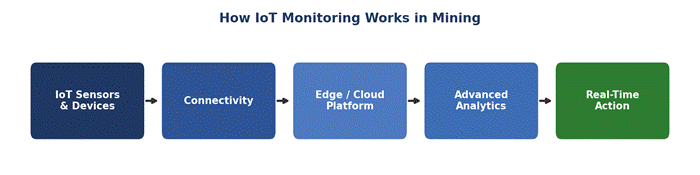
IoT devices and sensors capture data from across the site; connectivity carries it to an edge or cloud platform; advanced analytics process it — often using edge computing to act on urgent data instantly; and the results drive real-time action, from alerts to automated responses. This flow of environmental data and equipment data turns raw readings into decisions, continuously and automatically.
IoT Applications in Mining Monitoring
IoT now underpins monitoring across the whole mine. A few of the most important applications:
| Area | What IoT enables | Learn more |
| Blast monitoring | Real-time vibration and air overpressure data | Real-time blast monitoring |
| Ground vibration | Continuous PPV tracking to protect structures | Ground vibration monitoring |
| Air quality | Live dust and gas monitoring for worker safety | Air quality monitoring |
| Environmental | Site-wide air, water, and weather sensing | Environmental sensors |
| Equipment | Predictive maintenance from vibration data | Predictive maintenance |
Each of these once relied on periodic manual checks. IoT makes them continuous, connected, and instant.
How IoT Is Changing Blast Monitoring
Blasting produces two effects that must be watched closely: ground vibration and air overpressure. IoT has transformed how both are measured. Connected sensors now capture peak particle velocity (PPV) and air pressure in real time, streaming the data to a platform that checks it against limits instantly.
This means an exceedance is flagged the moment it happens, not discovered the next day. IoT-enabled blast monitoring sensors also make it easy to monitor many locations at once and keep a complete, verifiable record. The shift from manual to real-time blast monitoring — covering both ground vibration and air overpressure — is one of IoT’s clearest wins in mining.
How IoT Is Changing Environmental Monitoring
On the environmental side, IoT has been just as transformative. Environmental monitoring systems built on connected sensors now track air quality, dust, water, weather, and slope stability across an entire site, continuously. Instead of occasional samples, operators get a live, always-current view.
This continuous environmental data enables faster response, easier compliance, and lower environmental impact — the benefits explored in our guides on environmental sensors in mining and continuous environmental monitoring. IoT is what makes truly continuous, site-wide environmental monitoring possible.
Key Technologies: Edge, Cloud and Analytics
Several technologies work together to make IoT monitoring powerful. Edge computing processes urgent data on or near the sensor for instant response, while cloud platforms store and analyse vast volumes of data over time. Advanced analytics and AI turn all of it into insight — spotting trends, predicting problems, and even feeding a digital twin of the site.
Together, these IoT solutions handle the huge streams of data a mine generates and turn them into timely, useful information — the difference between simply collecting data and actually acting on it.
The Benefits of IoT in Mining Monitoring
Connecting the mine delivers benefits that reach across safety, efficiency, and cost:
- Enhancing safety: real-time alerts on vibration, air quality, and ground movement protect workers and communities.
- Improving operational efficiency: continuous data helps optimise blasting, haulage, and processing.
- Lower operational costs: early warning prevents incidents, downtime, and remediation.
- Predictive maintenance: equipment data flags faults before they cause failures.
- Fleet management: connected devices track and optimise vehicles and haul trucks across the site.
- Better decisions: real-time data and analytics replace guesswork with evidence.
Beyond monitoring, the same connected foundation supports predictive maintenance and fleet management, and it is why real-time monitoring now outperforms manual inspection for most mining tasks.
A Connected Mine in Practice
Picture a modern quarry that has adopted IoT across the site. Vibration and air-overpressure sensors watch every blast and confirm it stays within limits, alerting the team instantly if it does not. Dust and air-quality sensors track conditions from the pit to the boundary, warning before anything drifts toward the nearby town. On the equipment side, vibration sensors on crushers and conveyors feed predictive maintenance, flagging a failing bearing before it stops production.
None of these systems works in isolation. They all stream data to one connected platform, giving managers a single, live view of safety, compliance, and operations. When a problem appears anywhere on site, the right people know within seconds. That is the practical reality of connected mining technology — not a single gadget, but a web of sensors and analytics working together, continuously.
Challenges and the Future
IoT in mining is powerful but not without challenges. Sites are large and remote, so connectivity and power must be planned; harsh conditions demand rugged devices; and the volume of data requires strong analytics and security. Yet adoption is accelerating worldwide, from Australia to North America, as the benefits become undeniable.
Looking ahead, IoT will grow more capable as edge computing, AI, and 5G mature. Mines will move from monitoring what has happened to predicting what will, with connected sensors, analytics, and automation working together toward increasingly autonomous, self-optimising operations.
Conclusion
IoT has fundamentally changed how mines monitor blasting and the environment — turning slow, manual, point-in-time measurement into continuous, connected, real-time intelligence. From vibration and air overpressure to dust, air quality, and equipment health, connected sensors now watch the whole site at once and act the instant something changes.
For modern mining, industrial IoT is no longer optional — it is the backbone of safe, efficient, and responsible operations. Explore our full range of guides, from blast vibration monitoring to environmental sensors, to see connected mining technology in action.
Build Connected Mining with Brilliant Info Systems
Brilliant Info Systems delivers IoT solutions for mining — from a complete blast vibration monitoring solution and IoT and smart sensors to predictive maintenance and environmental monitoring. Contact our team to bring connected, real-time monitoring to your site.
Frequently Asked Questions
What is IoT in mining?
IoT in mining is a network of connected sensors and devices that continuously collect and share data across a site, automating the monitoring of blasts, air quality, equipment, and the environment in real time.
How is IoT changing blast monitoring?
IoT enables real-time monitoring of ground vibration and air overpressure, streaming data to a platform that checks it against limits instantly — so exceedances are flagged immediately rather than found the next day.
How does IoT improve environmental monitoring?
Connected sensors continuously track air quality, dust, water, and weather across the whole site, giving a live, always-current view that enables faster response, easier compliance, and lower environmental impact.
What technologies power IoT mining monitoring?
Key technologies include IoT sensors and devices, connectivity, edge computing for instant local processing, cloud platforms for storage and analysis, and advanced analytics and AI that turn data into insight.
What are the benefits of IoT in mining?
IoT enhances safety, improves operational efficiency, lowers operational costs, enables predictive maintenance and fleet management, and supports better, data-driven decisions across the operation.
Does IoT replace manual monitoring in mining?
IoT automates continuous monitoring and largely replaces routine manual checks, though skilled inspection still adds value for judgement-based tasks. Most modern mines use a hybrid of both.