
Real-Time Monitoring vs Manual Inspection: Which Is Better for Mining Sites?
For generations, mine safety and oversight relied on people walking the site with a clipboard — checking equipment, sampling dust, reading gauges. Manual inspection is familiar and flexible, but it has a fundamental weakness: it only sees what someone happens to look at, when they look at it. As mines get bigger, faster, and more scrutinised, that gap has become a serious risk. Real-time monitoring offers a different approach — continuous, automated oversight of the whole site. So which is better?
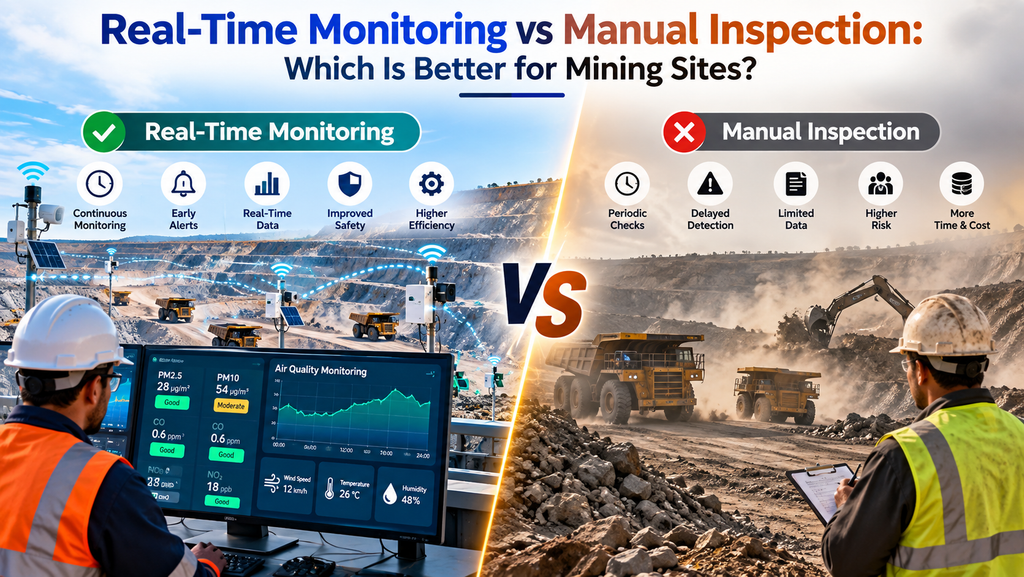
This guide compares real-time monitoring and manual inspection for mining sites, weighing the benefits of real time monitoring against the strengths and limits of manual checks — and explaining why automated mine monitoring is fast becoming the standard.
▶ Watch: Real-Time IoT Monitoring in Action
Table of Contents
- What is manual inspection?
- What is real-time monitoring?
- Side-by-side comparison
- Benefits of real-time monitoring
- Where manual inspection still fits
- The verdict
- FAQs and conclusion
What Is Manual Inspection?
Manual inspection, or manual monitoring, is the traditional approach: trained people physically check equipment, structures, and conditions on a schedule. A technician might take a dust sample, inspect a slope, or read a vibration gauge, then record the result. It relies entirely on human presence and judgment.
Its strengths are flexibility and context — an experienced inspector can notice things a sensor might not and make judgement calls on the spot. Its weakness is coverage: between inspections, and everywhere no one is standing, conditions go unseen. Problems that develop overnight or across a vast site can go unnoticed until the next check, by which point they may have escalated.
What Is Real-Time Monitoring?
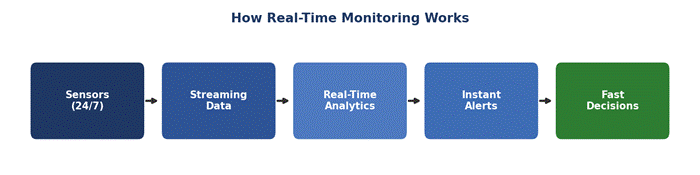
Real-time monitoring uses connected sensors and monitoring software to watch conditions continuously and automatically. Instead of a person taking readings, IoT and smart sensors stream data non-stop to a central, often cloud-based platform, where real time analytics compare it against limits and raise instant alerts.
A real time monitoring system never sleeps and never skips a spot. It watches the whole site 24/7, turning streaming data into real time insights and real time data that let teams act the moment something changes. This is how automated mine monitoring keeps operations running smoothly without relying on someone being in the right place at the right time.
Real-Time Monitoring vs Manual Inspection: Side by Side
Set the two approaches against each other and the contrast is clear:
| Factor | Manual inspection | Real-time monitoring |
| Data | Occasional, point-in-time | Continuous, streaming data |
| Speed | Findings hours or days later | Real-time insights, instantly |
| Coverage | Only where and when someone checks | Whole site, 24/7 |
| Response time | Slow — after the fact | Immediate alerts |
| Consistency | Varies with the inspector | Uniform and objective |
| Safety | People exposed to hazards | Sensors watch risky areas |
| Cost over time | High labour, hidden incident costs | Lower once running |
| Best for | Simple, low-risk checks | Critical, high-tempo operations |
The Benefits of Real-Time Monitoring
Compared with manual inspection, real-time monitoring delivers advantages that directly improve efficiency and safety:
- Continuous coverage: the whole site is watched at all times, with no blind spots between checks.
- Faster response time: instant alerts mean problems are addressed immediately, not after the fact.
- Better decisions: real-time data and analytics tools support informed decisions across business operations.
- Improved efficiency: automation frees skilled staff from routine rounds to focus on higher-value work.
- Greater safety: sensors watch hazardous areas so people do not have to.
- Lower long-term cost: preventing incidents avoids downtime and the hidden costs manual checks miss.
These are the same gains seen across mining applications — from real-time blast monitoring to continuous environmental monitoring and predictive maintenance.
Where Manual Inspection Still Fits
Real-time monitoring is not a total replacement. Manual inspection still has real value for tasks that need human judgment, physical checks a sensor cannot make, or one-off assessments where installing sensors would not be worthwhile. The smartest operations use both: real-time monitoring for continuous, site-wide oversight, and skilled inspectors for the judgement calls and hands-on checks that technology cannot replicate.
The Verdict: Which Is Better?
For continuous oversight of critical conditions across a modern mine, real-time monitoring wins clearly. It provides the coverage, speed, and consistency that manual inspection simply cannot match, and it improves both operational efficiency and safety. Manual inspection remains a valuable complement, but as the primary way of watching a large, high-tempo site, it can no longer keep up.
The best answer is usually a hybrid — automated monitoring as the always-on backbone, supported by targeted manual inspection. Tools like a blast vibration monitoring solution, dust monitoring, and air quality monitoring provide that continuous backbone, while inspectors add the human layer on top.
Conclusion
The debate between real-time monitoring and manual inspection ultimately comes down to coverage and speed. Manual inspection is flexible and adds human judgment, but it cannot watch everywhere, all the time. Real-time monitoring can — turning streaming data into instant, actionable insight that keeps a mine safer and running smoothly.
For modern mining sites, automated monitoring is now the backbone of safe, efficient operations, with manual inspection as a valuable complement. Explore our related guides on environmental sensors in mining and blast vibration monitoring to see real-time monitoring in action.
Modernise Mine Monitoring with Brilliant Info Systems
Brilliant Info Systems delivers automated, real-time mine monitoring — from IoT and smart sensors and predictive maintenance to a complete blast vibration monitoring solution. Contact our team to move from manual checks to real-time oversight
Frequently Asked Question
What is the difference between real-time monitoring and manual inspection?
Manual inspection relies on people checking conditions on a schedule, so it only sees what someone looks at. Real-time monitoring uses sensors to watch continuously and automatically, alerting teams the instant something changes.
What are the benefits of real-time monitoring in mining?
Continuous site-wide coverage, faster response time, better data-driven decisions, improved efficiency, greater safety, and lower long-term cost — because problems are caught immediately rather than at the next inspection.
Is real-time monitoring better than manual inspection?
For continuous oversight of critical conditions, yes — it offers coverage, speed, and consistency that manual checks cannot match. Manual inspection still adds value for judgment-based and hands-on tasks, so a hybrid works best.
Does real-time monitoring replace inspectors?
No. It automates routine, continuous monitoring, freeing inspectors to focus on judgement calls and physical checks that technology cannot replicate. The two complement each other.
How does real-time monitoring work?
Connected sensors stream data continuously to a central platform, where real time analytics compare it against limits and raise instant alerts, often on a cloud based platform — enabling immediate, informed decisions without manual readings.
What is automated mine monitoring?
Automated mine monitoring uses connected sensors and software to watch conditions across a mine continuously and automatically, replacing periodic manual checks with real-time, always-on oversight.