
Remote Blast Monitoring: Improving Visibility Across Multiple Mine Locations
Running one mine is demanding enough. Running several — often spread across regions or even countries — multiplies the challenge, especially when it comes to blasting. Each site produces ground vibration and air overpressure that must be measured, checked against limits, and documented. Doing that site by site, with separate teams and separate records, is slow, inconsistent, and hard to oversee. Remote blast monitoring solves the problem by bringing every site’s blast data into one place.
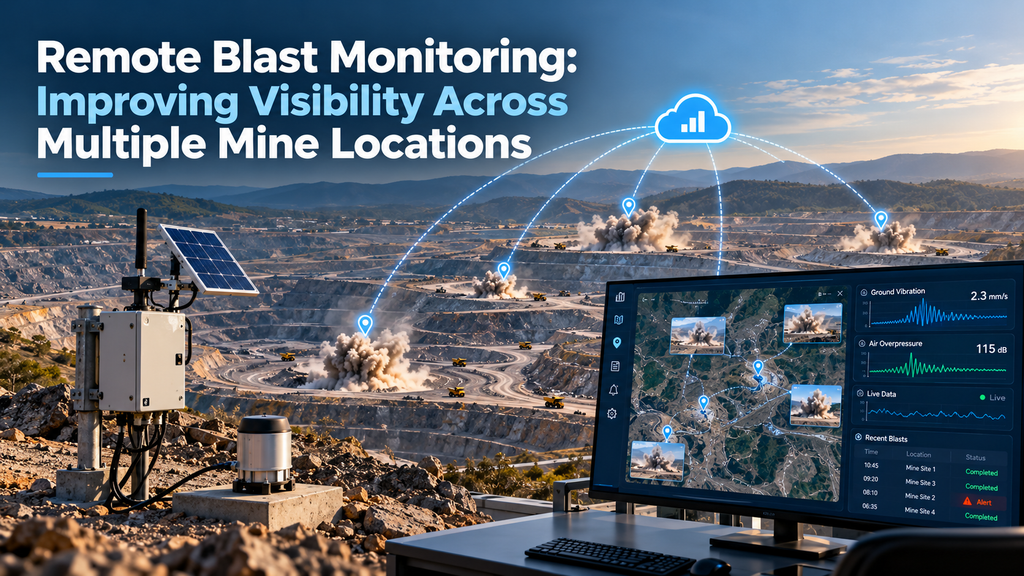
By transmitting blast data from each location to a central platform in real time, remote monitoring gives operators complete visibility across multiple mine sites at once. This guide explains what remote blast monitoring is, how it works, and how it improves safety, consistency, and control for multi-site mining operations. It builds on the technology behind a modern blast vibration monitoring solution.
▶ Watch: Real-Time IoT Monitoring in Action
Table of Contents
- What is remote blast monitoring?
- How it works across multiple sites
- What it monitors
- The blast monitoring lifecycle
- Single-site vs multi-site monitoring
- The benefits
- Blast analysis and machine learning
- Challenges and best practices
- FAQs and conclusion
What Is Remote Blast Monitoring?
Remote blast monitoring is the practice of measuring the effects of blasting — ground vibration and air overpressure — at one or more sites and transmitting that data to a central location for real-time viewing and analysis. Instead of an operator standing at each seismograph, connected monitoring systems send readings automatically to a dashboard that can be anywhere.
The key word is remote. The sensors sit at the blast site; the people watching the data do not have to. For a company running several mines, this means a single team can oversee blasting across every location without travelling to each one — a step change from traditional, site-bound monitoring.
How Remote Monitoring Works Across Multiple Sites
The architecture is straightforward but powerful. At each mine, sensors capture the vibration and air overpressure from every blast. That data is then transmitted — over cellular, satellite, or network connections — to a central cloud platform, where it is stored, analysed, and displayed on one dashboard.
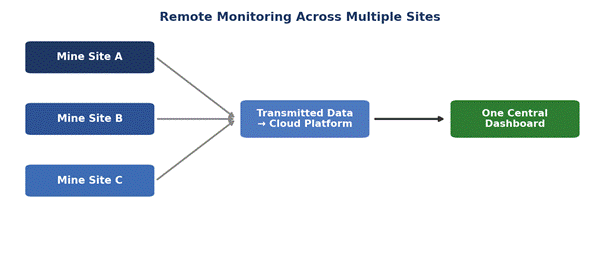
From that single dashboard, a central team sees live data from Site A, Site B, and Site C side by side. The same real-time blast monitoring that protects a single site now scales across an entire portfolio, with every blast at every location captured, checked, and recorded automatically. Nothing depends on whether a technician was present at a particular site on a particular day; the system captures every blast, everywhere, in the same way.
What Remote Blast Monitoring Measures
Whatever the location, remote monitoring captures the same core measurements that define safe blasting:
| What is monitored | Why it matters across sites |
| Peak particle velocity (PPV) | The key measure of ground vibration and structural risk |
| Ground vibration | Protects structures near every site from damage |
| Air overpressure | Controls noise and window damage from each blast |
| Vibration frequencies | Read with PPV to judge true damage potential |
| Pre- and post-blast data | Confirms structural integrity before and after blasting |
These are the industry standard measures of blast impact used in blasting operations worldwide. For the detail behind each, see our guides on peak particle velocity (PPV), ground vibration monitoring, and air overpressure monitoring.
The Blast Monitoring Lifecycle
Remote monitoring supports the full lifecycle of a blast, not just the moment of detonation. That complete view is part of what makes it so valuable:
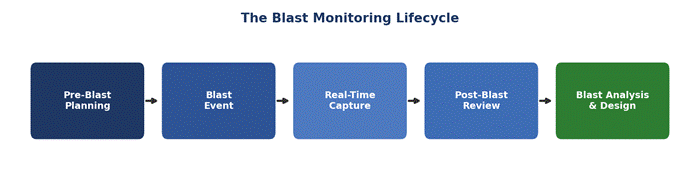
Before the blast, pre-blast surveys and planning establish a baseline and confirm the structural integrity of nearby buildings. During the blast, sensors capture the event in real time. After the blast, post-blast data confirms whether vibration stayed within limits and whether any structural damage occurred. Finally, the data feeds blast analysis that improves the next blast. Remote monitoring keeps this entire pre-blast to post-blast cycle visible from one place, for every site.
Pre-Blast and Post-Blast Monitoring
Two stages of the lifecycle deserve special attention, because they protect the structures and communities around a mine. Pre blast surveys establish the condition of nearby buildings before any blasting begins, documenting existing cracks and recording a baseline of structural integrity. This baseline is vital: without it, there is no way to prove whether later damage was caused by a blast or already existed.
Post blast monitoring then captures what actually happened. Immediately after each blast, the recorded ground vibration and air overpressure are compared against limits, and follow-up surveys check whether any structural damage occurred. Remote monitoring makes both stages far easier across multiple sites: pre blast baselines and post blast results for every location live in the same central system, ready to answer any question a regulator or resident might raise. This complete pre blast to post blast record is one of remote monitoring’s strongest protections against disputes.
Single-Site vs Multi-Site Remote Monitoring
The advantage of remote monitoring grows with every additional site. This comparison shows why multi-site operations benefit most:
| Aspect | Single-site monitoring | Remote multi-site monitoring |
| Visibility | One site at a time | All sites from one dashboard |
| Data | Collected locally | Transmitted data to a central platform |
| Expertise | Needed at every site | Shared from one central team |
| Consistency | Varies by site | One industry-standard approach |
| Response | Local only | Central oversight, fast response |
For a single mine, local monitoring may suffice. But the moment a company runs two or more sites, central remote monitoring transforms oversight — replacing scattered, inconsistent records with one unified, real-time view.
The Benefits of Remote Blast Monitoring
Bringing every site’s blast data together delivers benefits that a site-by-site approach cannot match:
- Complete visibility: see live blast data from all locations on one dashboard.
- Enhancing safety: central oversight catches exceedances at any site instantly.
- Consistency: every location follows the same industry-standard monitoring approach.
- Efficient expertise: a single skilled team covers many sites without travelling to each.
- Stronger compliance: a complete, verifiable record for every blast at every site.
- Better blast designs: comparing data across sites reveals what works best.
This central approach reflects a wider shift, explored in our guide on why real-time monitoring outperforms manual inspection, and in how IoT is changing blast and environmental monitoring.
Blast Analysis and Machine Learning
Bringing data from many sites into one platform unlocks something a single site cannot: scale. With state of the art analytics and machine learning, patterns emerge across hundreds of blasts — which blast designs produce the least vibration, how ground conditions affect results, and where limits are approached too often.
This turns blast analysis from a manual, after-the-fact task into a continuous, data-driven process. Over time, machine learning helps refine blast designs to keep vibration and air overpressure low while maintaining productivity — improving every site by learning from all of them together. It is a level of insight only remote, centralised data collection makes possible.
Challenges and Best Practices
Remote blast monitoring is powerful, but a few factors need planning. Reliable data transmission is essential — remote or underground sites may need cellular, satellite, or mesh connectivity to ensure no blast goes unrecorded. Data security matters when transmitting across networks. And the central platform must be robust enough to handle data from many sites at once.
Best practice is to standardise sensors and thresholds across all sites so the data is truly comparable, ensure reliable transmission with backup where connectivity is weak, and give the central team clear dashboards and alerts rather than raw data. Done well, remote monitoring becomes the single source of truth for blasting across the whole business.
Ensuring Reliable Data Transmission and Security
Because remote monitoring depends entirely on getting data from the field to the central platform, the reliability of that transmission is critical. A blast that is not recorded because of a dropped connection is a serious gap — in both safety and compliance. Sites in remote areas or deep underground can have patchy coverage, so robust connectivity is essential: cellular where available, satellite for isolated locations, and local buffering so data is stored and forwarded once a connection returns.
Security matters just as much. Blast data crossing public networks must be protected so it cannot be intercepted or tampered with, and access to the central platform should be controlled by role. Reliable transmission plus strong security is what lets managers trust that the single dashboard truly reflects what happened at every site — the foundation on which all the other benefits rest.
Remote Monitoring and Compliance Across Locations
Multi-site operators often work across different regions, each with its own vibration and air overpressure limits. Managing that variation manually is error-prone. A central remote monitoring platform can hold the correct limits for each location and automatically check every blast against the right thresholds, flagging any exceedance instantly.
Just as importantly, it keeps a complete, time-stamped, verifiable record for every blast at every site in one place. When a regulator requests evidence, or a community raises a concern, the data is immediately available — no scrambling through separate site records. This consistent, always-ready compliance is one of the clearest reasons multi-site operators adopt remote monitoring.
The Future of Remote Blast Monitoring
Remote monitoring is set to become the norm for multi-site operators. As connectivity, edge computing, and machine learning advance, central platforms will not just display data but predict issues, recommend blast designs, and automate compliance reporting across every location. The direction is clear: from watching individual blasts to intelligently managing blasting across an entire portfolio from one place.
A Multi-Site Operation in Practice
Consider a company running three quarries in different regions. Before remote monitoring, each site kept its own seismograph, its own records, and its own way of doing things. When a complaint came in from near one site, finding and interpreting the relevant blast data took days, and head office had no real-time view of whether any site was approaching its limits.
After adopting remote blast monitoring, every seismograph transmits data to one central platform. A single specialist at head office now watches all three sites live, sees each blast checked against its local limits automatically, and receives an instant alert if any site nears an exceedance. Blast records for all three quarries sit in one system, so answering a regulator takes minutes, not days. And by comparing blast designs and results across the sites, the team steadily improves performance everywhere. The change is not just efficiency — it is a level of control and confidence that separate, site-bound monitoring could never deliver.
Conclusion
Remote blast monitoring transforms how multi-site mining operations manage blasting. By transmitting every site’s ground vibration and air overpressure data to one central platform in real time, it delivers complete visibility, consistent standards, and central control that site-by-site monitoring simply cannot provide.
For any company running more than one mine, remote monitoring is the key to safer, more consistent, and more efficient blasting across the whole portfolio. Explore our related guides on real-time blast monitoring and blast monitoring sensors to see how the technology comes together.
Get Remote Blast Monitoring with Brilliant Info Systems
Brilliant Info Systems delivers a complete blast vibration monitoring solution with remote, multi-site visibility — powered by IoT and smart sensors and real-time analytics. Contact our team to bring every mine’s blast data into one central view.
Frequently Asked Questions
What is remote blast monitoring?
Remote blast monitoring measures ground vibration and air overpressure at a mine and transmits the data to a central location for real-time viewing and analysis, so operators can oversee blasting without being on site.
How does it improve visibility across multiple sites?
By transmitting blast data from every location to one central dashboard, it lets a single team see and analyse live data from all sites at once, replacing scattered, site-by-site records with one unified view.
What does remote blast monitoring measure?
It measures the standard indicators of blast impact — peak particle velocity (PPV), ground vibration, air overpressure, and vibration frequencies — along with pre-blast and post-blast data on structural integrity.
How is data transmitted from remote sites?
Data is sent over cellular, satellite, or network connections from the sensors at each site to a central cloud platform, so readings are available in real time regardless of location.
How does remote monitoring use machine learning?
By pooling data from many sites, machine learning identifies patterns across hundreds of blasts, helping refine blast designs to reduce vibration and air overpressure while maintaining productivity.
Is remote blast monitoring better for multi-site operations?
Yes. The benefits grow with each site — central visibility, consistent standards, shared expertise, and unified compliance make remote monitoring especially valuable for companies running several mines.