
How Automated Alerts Help Mining Teams Respond Faster to Abnormal Conditions
In mining, the difference between a minor issue and a major incident is often measured in minutes. A gas level climbing, a slope beginning to move, a blast exceeding its limit — catch it immediately and you can act; miss it for an hour and it can become a disaster. The problem with traditional monitoring is that someone has to be watching the right data at the right moment. Automated alerts remove that dependency, telling the team the instant something abnormal happens.
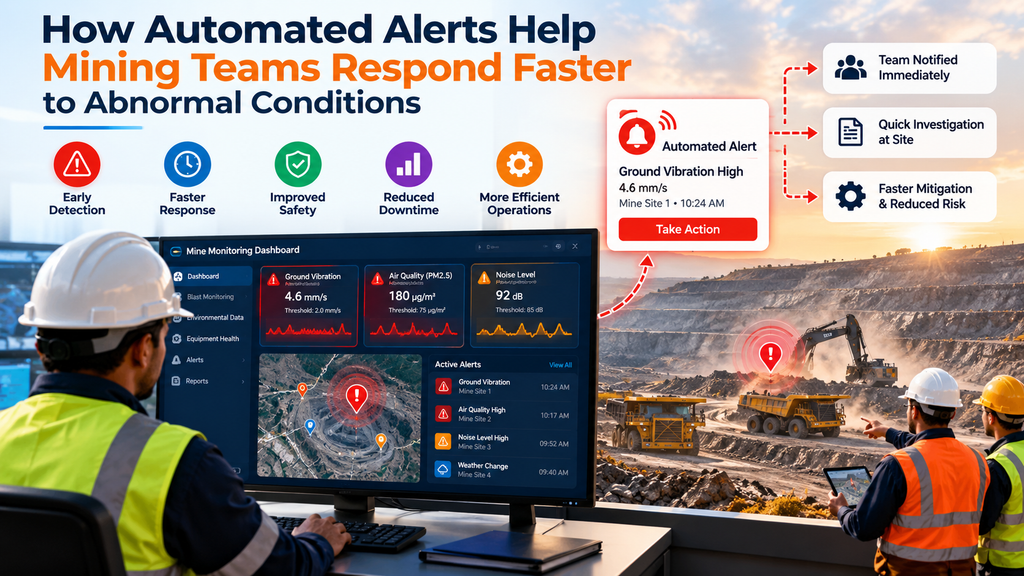
This guide explains how automated alerts help mining teams respond faster to abnormal conditions — how they work, what they detect, and why instant alerting is transforming safety and operations across mining sites. It is a core capability of any modern blast vibration monitoring solution.
▶ Watch: Real-Time IoT Monitoring in Action
Table of Contents
- What are automated alerts?
- How they work
- Abnormal conditions they catch
- Why faster response matters
- The benefits
- Best practices
- FAQs and conclusion
What Are Automated Alerts?
Automated alerts are instant notifications triggered when connected sensors detect a reading outside safe or normal limits. Instead of relying on someone to notice a problem on a screen, the monitoring system watches continuously and, the moment a threshold is crossed, sends an alert — a text, email, dashboard warning, or a siren wired into site control systems — to the right people. In any industrial environment, from a mine to an industrial facility, this is how greater visibility turns into faster action.
The key is that alerts are automatic and immediate. The system never gets tired, distracted, or looks away — it watches every reading, all the time, and speaks up the instant something is wrong.
How Automated Alerts Work
Automated alerting follows a simple but powerful chain, running continuously in the background:
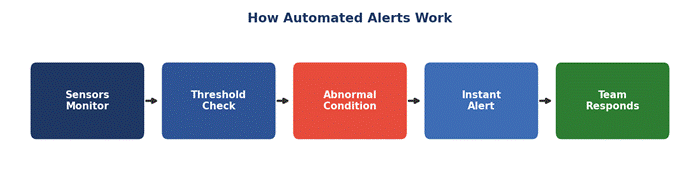
Sensors monitor conditions in real time; the system checks each reading against pre-set thresholds; when a reading crosses a limit, an abnormal condition is detected; an instant alert is sent to the relevant team; and they respond immediately. Because the same real-time monitoring that captures the data also triggers the alert, there is no gap between something going wrong and the team knowing about it.
Abnormal Conditions Automated Alerts Catch
Across a mine, automated alerts watch for many different abnormal conditions, each with its own response. Common examples:
| Abnormal condition | Detected by | Automated response |
| Blast vibration exceedance | Vibration sensors | Alert to pause and review blast design |
| Dangerous gas or dust level | Air quality sensors | Alert to ventilate or evacuate |
| Slope movement | Ground movement sensors | Alert to clear the area |
| Equipment fault | Vibration / condition sensors | Alert maintenance teams |
| Vehicle in a restricted zone | Location sensors | Safety alert to stop movement |
From ground vibration to air quality, any measurable condition can trigger an alert — turning a network of sensors into an always-on safety net that covers even hazardous areas people cannot constantly occupy.
Why Faster Response Matters
In abnormal conditions, speed is everything. A gas leak, a slope failure, or a runaway piece of equipment escalates by the second, and every minute of delay increases the danger and the cost. Automated alerts compress the time between detection and response from potentially hours down to seconds.
This matters most in emergency responses, where an instant alert can trigger evacuation or shutdown before anyone is harmed. It also matters for improving operations day to day: catching a developing equipment fault early lets maintenance teams fix it before it causes a breakdown, and flagging a process drift lets the team correct it before it wastes output. Fast response protects both people and productivity.
The Benefits of Automated Alerts
Automated alerts deliver benefits that ripple across a mining operation:
- Faster emergency response: instant warnings enable evacuation or shutdown before harm occurs.
- Enhanced safety: hazardous areas are watched constantly, protecting workers from unseen risks.
- Less downtime: early alerts let maintenance teams fix issues before they become failures.
- Greater visibility: managers always know the moment something needs attention.
- Better focus: staff are alerted only when needed, rather than watching screens constantly.
- Stronger compliance: every alert and response is logged as a record of diligent oversight.
These gains are why automated alerting sits at the heart of the shift from manual checks to real-time monitoring, and of how IoT is changing mining.
Best Practices for Automated Alerts
To make alerts genuinely useful rather than overwhelming, a few principles matter. Set thresholds carefully so alerts fire for real problems, not normal variation — too many false alarms and people start ignoring them. Route each alert to the right team, so a gas alert reaches safety staff and an equipment alert reaches maintenance teams. Use tiered severity, so a critical alert stands out from a minor one. And always log alerts and responses, both to prove compliance and to learn where problems recur. Well-designed alerts inform action; poorly designed ones just create noise.
Conclusion
In an environment where seconds count, automated alerts are one of the most valuable tools a mine can deploy. By watching conditions continuously and notifying the right people the instant something goes wrong, they compress response time dramatically — protecting workers, equipment, and the environment while keeping operations running smoothly.
As mining becomes more connected, automated alerting is fast becoming standard. Explore our related guides on real-time blast monitoring and environmental sensors in mining to see instant alerting in action.
Respond Faster with Brilliant Info Systems
Brilliant Info Systems builds IoT monitoring with automated, real-time alerts — from a complete blast vibration monitoring solution and IoT and smart sensors to predictive maintenance. Contact our team to help your teams respond faster to abnormal conditions.
Frequently Asked Questions
What are automated alerts in mining?
Automated alerts are instant notifications triggered when sensors detect a reading outside safe limits — such as high vibration, dangerous gas, or slope movement — so mining teams are told immediately and can respond faster.
How do automated alerts help teams respond faster?
They remove the delay of someone having to notice a problem. The moment a sensor reading crosses a threshold, the system alerts the right people instantly, compressing response time from hours to seconds.
What conditions can trigger an automated alert?
Any measurable abnormal condition — blast vibration exceedances, dangerous gas or dust levels, slope movement, equipment faults, or vehicles entering restricted zones — can trigger an alert with a matching response.
Do automated alerts improve safety?
Significantly. By watching hazardous areas continuously and warning instantly, they enable faster emergency response — evacuation or shutdown — before conditions harm workers.
How do you avoid too many false alerts?
By setting thresholds carefully so alerts fire for genuine problems, using tiered severity, and routing alerts to the right team. Well-tuned alerts inform action rather than creating noise.
Can automated alerts help maintenance?
Yes. Alerts on abnormal equipment readings let maintenance teams address a developing fault before it becomes a costly breakdown, reducing downtime and extending equipment life.