
UWB and Bluetooth AoA: How Real-Time Location Tracking Works
Knowing exactly where an asset, vehicle, or person is — indoors, in real time, down to a few centimetres — used to be impossible. GPS stops at the warehouse door. Today two technologies make precise indoor positioning a reality: Ultra-Wideband (UWB) and Bluetooth 5.1 Angle of Arrival (AoA). This guide explains how UWB and Bluetooth AoA real-time location tracking works, how the two methods differ, and how to choose the right one for your site.
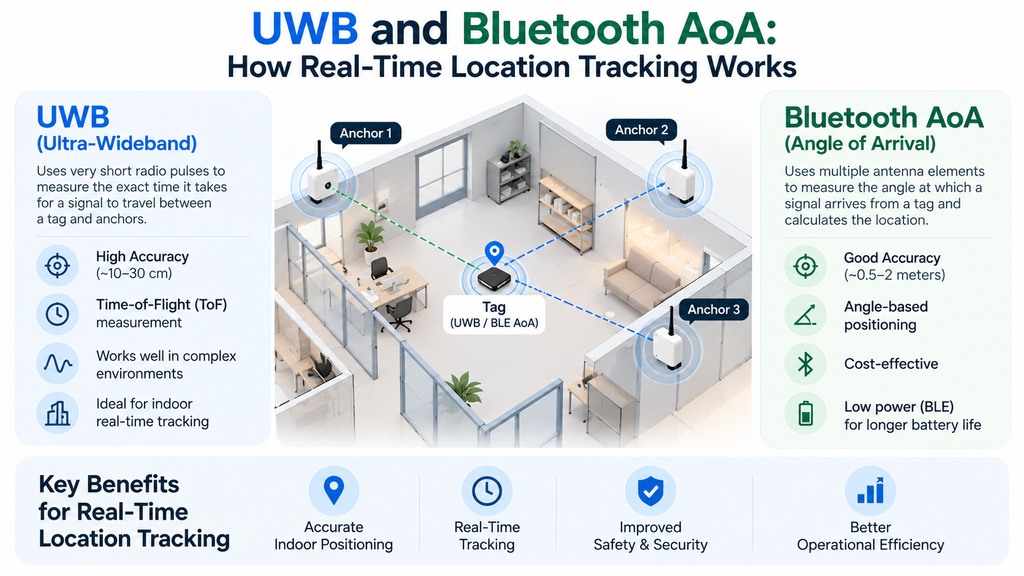
Both are forms of a real time location system (RTLS) — a setup of fixed anchors and mobile tags that work together to pinpoint location continuously. The difference lies in how each one measures where a tag actually is.
▶ Watch: Brilliant Info Systems on YouTube
What You’ll Learn
- What a real-time location system (RTLS) is
- How UWB uses Time of Flight for high precision
- How Bluetooth 5.1 AoA uses Angle of Arrival
- UWB vs Bluetooth AoA vs RFID — a side-by-side comparison
- What affects accuracy, and common use cases
What Is a Real-Time Location System (RTLS)?
A real time location system is a combination of hardware and software that tracks the position of tagged items as they move through a space, and shows that position live on a map. Unlike a barcode or a passive RFID checkpoint, which only records an item when it passes a fixed reader, an RTLS gives continuous real time visibility of where everything is at once. These setups — known in the industry as real time location systems rtls — have become the standard for high accuracy indoor tracking.
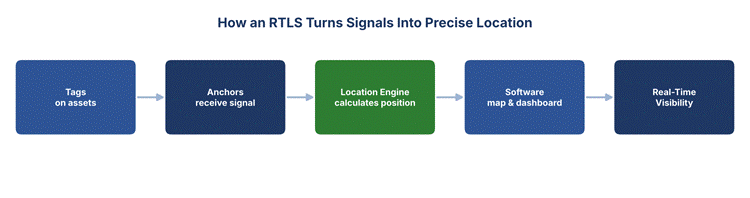
Every RTLS has the same core parts:
- Tags: Small battery-powered devices attached to assets, carts, or badges. UWB tags and BLE tags broadcast a signal that anchors can hear.
- Anchors: Fixed receivers mounted around the building at known positions. They pick up each tag’s signal.
- Location engine: Software that takes the anchor readings and calculates each tag’s precise location in real time.
- Dashboard: A live map and reports that turn raw coordinates into something a team can act on.
This is the backbone of modern real-time location (RTLS) solutions and feeds directly into asset tracking and inventory visibility across a facility. The question is which signal technology sits underneath — and that is where UWB and Bluetooth AoA differ.
How UWB Works: Time of Flight
Ultra-Wideband is a radio tracking technology that transmits over a very wide frequency spectrum using extremely short pulses. That wide bandwidth is the secret to its accuracy: short pulses have a sharp, clear timing signature, so the system can measure exactly when a signal arrives.
UWB locates a tag using Time of Flight (ToF) — it measures how long a radio pulse takes to travel from the tag to an anchor, then multiplies that time by the speed of radio waves to get the distance. With distances from three or more anchors, the location engine triangulates the tag’s precise location. Because the pulses are so short, UWB reaches centimeter level precision, typically 10–30 cm, even in busy indoor spaces.
The time of flight tof method works because radio waves travel at a known, constant speed. If a pulse takes a certain number of nanoseconds to reach an anchor, the exact distance follows directly. Measuring that tiny interval accurately is hard — which is why UWB’s wide bandwidth, with its crisp pulse edges, matters so much. It is also why UWB tags cost a little more than other options: the radio inside them is doing precision timing work. For teams that need the best possible indoor location, that trade-off is well worth it.
UWB performs best with a clear line of sight between tag and anchor, and its wide spectrum makes it strongly resistant to the signal reflections (multipath) that confuse narrower technologies. For the highest high accuracy applications — tool tracking, robotics, safety zones — UWB tracking is the benchmark.
How Bluetooth AoA Works: Angle of Arrival
Bluetooth 5.1 introduced direction finding to Bluetooth Low Energy (BLE), and with it a different way to locate a tag: Angle of Arrival (AoA). Instead of measuring travel time, an AoA anchor uses a special antenna array. As a signal from a BLE tag reaches the array, it hits each antenna element a fraction of a moment apart. By reading those tiny phase differences, the anchor calculates the precise angle the signal arrived from.
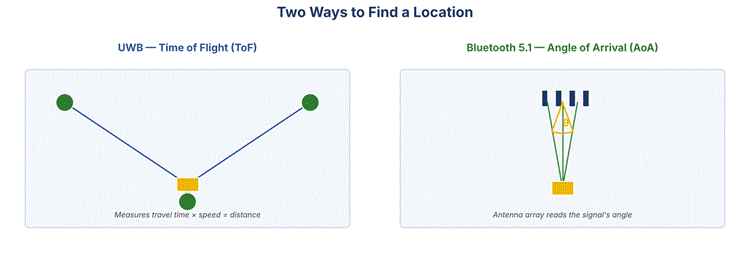
With the angle from one well-placed anchor — or angles from two — the location engine works out where the tag is. The angle of arrival aoa approach is a big step up from older Bluetooth positioning, which relied only on received signal strength (RSSI) to guess rough distance from how strong a signal was. Bluetooth 5.1 AoA brings precision indoor positioning to the huge, low-cost BLE ecosystem, delivering reliable sub-metre accuracy instead of the vague, drifting estimates RSSI produced.
There is also a companion method, Angle of Departure (AoD), where the tag reads the angle instead of the anchor — but AoA is the more common choice for infrastructure-based tracking, because the heavy antenna-array hardware stays in the fixed anchors and the tags remain small and cheap.
Because it is built on bluetooth low energy BLE, AoA tags are cheap, tiny, and last for years on a coin cell. That makes BLE tracking ideal when you need to track many items affordably and sub-metre accuracy is good enough.
UWB vs Bluetooth AoA vs RFID
Each indoor positioning technology has a sweet spot. The table below compares the three most common options for indoor location tracking:
| Factor | UWB | Bluetooth 5.1 AoA | RFID (passive) |
| Method | Time of Flight | Angle of Arrival | Read at a gate |
| Accuracy | 10–30 cm | 0.5–1 m | Zone / checkpoint |
| Tag cost | Higher | Low | Lowest |
| Battery life | 1–5 years | 3–7 years | No battery |
| Best for | Centimetre precision | Scalable, low-cost RTLS | Flow & presence |
In practice, many sites combine them. Passive RFID tracking handles high-volume flow at doors and gates, while UWB or BLE AoA provides live positioning inside the building. The right mix depends on how precise a location you truly need.
What Affects Accuracy
No indoor positioning technology performs the same in every building. Several factors shape the precise location you get:
- Line of sight: Walls, metal racking, and machinery block or reflect signals. UWB handles obstruction better than most, but clear sight lines always help.
- Anchor density: More anchors mean more readings and a tighter fix. Precision indoor positioning needs enough anchors to cover the space.
- Anchor placement: Anchors mounted high and spread around the edges give the best geometry for triangulation.
- Signal method: Time of Flight (ToF) and Angle of Arrival both beat received signal strength, which is only ever a rough estimate.
- Interference: Other radio sources can add noise; UWB’s wide frequency spectrum makes it the most robust against this.
Where Real-Time Location Tracking Is Used
High precision indoor location opens up uses that checkpoint scanning never could:
- Warehouses & manufacturing: Track tools, WIP, carts, and forklifts to cut search time and prevent loss.
- Yard & logistics: Locate trailers and containers for faster yard management and dispatch.
- Healthcare: Find mobile equipment instantly and monitor patient flow.
- Safety: Geofenced zones warn when a person enters a hazardous area near moving machinery.
All of these build on reliable IoT sensors and the real time data they feed into the location engine.
Choosing Between UWB and Bluetooth AoA
There is no single “best” indoor positioning technology — only the best fit for your goal, your space, and your budget. A few questions make the choice clear:
- How precise do you really need to be? If an operation depends on knowing location to within a hand’s width — robotics, tool control, tight safety zones — UWB’s centimeter level precision is the answer. If room-level or aisle-level accuracy is enough, Bluetooth AoA is more than capable.
- How many tags? Tracking thousands of low-value items favours cheap, long-lasting BLE tags. A smaller fleet of critical, high-value assets justifies UWB tags.
- What is the environment like? Cluttered, metal-heavy spaces with poor line of sight reward UWB’s resistance to reflections. Cleaner, more open indoor spaces let BLE AoA shine at lower cost.
- What is the budget? BLE AoA reuses an enormous, affordable ecosystem. UWB costs more per tag and anchor, but delivers accuracy nothing else can match.
Many facilities do not choose just one. A hybrid design — UWB in the areas that demand high precision and BLE AoA for broad, economical coverage — often gives the best return, with every tag shown on a single live map for complete real time visibility.
Conclusion
UWB and Bluetooth 5.1 AoA have made precise, real-time indoor location practical for everyday operations. UWB uses Time of Flight for centimeter level precision where accuracy is critical; Bluetooth AoA uses Angle of Arrival to bring affordable, scalable precision indoor positioning to the wider BLE ecosystem. Understanding how each works is the first step to choosing the right real time location system for your space.
Brilliant Info Systems designs and deploys RTLS using UWB, BLE AoA, and RFID — matched to your site and your accuracy needs. Explore our UWB tracking and BLE tracking solutions, or talk to our team to design a system around your facility.
Frequently Asked Questions
What is the difference between UWB and Bluetooth AoA?
UWB measures the time a radio pulse takes to travel from tag to anchor (Time of Flight) and reaches 10–30 cm accuracy. Bluetooth 5.1 AoA measures the angle a signal arrives at an antenna array and typically reaches 0.5–1 m. UWB is more precise; BLE AoA is cheaper and easier to scale.
How accurate is UWB real-time location tracking?
UWB delivers centimeter level precision, usually within 10–30 cm, thanks to its wide frequency spectrum and short pulses. It is the most accurate mainstream indoor positioning technology available today.
Does Bluetooth AoA need line of sight?
Clear line of sight improves any radio system, but AoA can work with some obstruction. For the highest high accuracy in cluttered environments, UWB is usually the stronger choice.
Can UWB and BLE be used together?
Yes. Many real time location systems use UWB where centimetre precision matters and BLE AoA elsewhere for cost-effective coverage, all shown on one dashboard for full real time visibility.
Is RFID a type of RTLS?
Passive RFID is usually a checkpoint technology — it records an item at a fixed reader rather than tracking it continuously. UWB and BLE AoA provide the live, continuous positioning that defines a true RTLS.