
What Are UWB Anchors and Tags? A Beginner’s Guide
If you have started looking into indoor location tracking, you have probably seen two words again and again: anchors and tags. They are the two building blocks of every Ultra-Wideband (UWB) tracking system. Understand how the anchor and tag work together, and the rest of UWB technology suddenly makes sense.
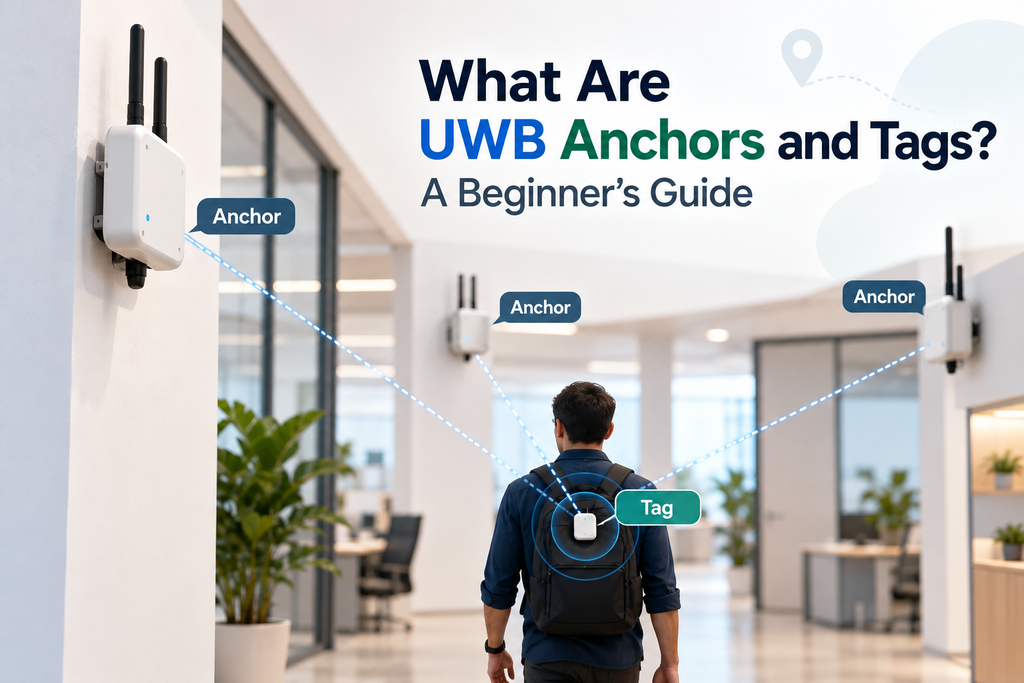
This beginner’s guide explains what UWB anchors and tags are, how they talk to each other, what makes UWB signals so accurate, and where UWB solutions are used. No engineering background needed.
▶ Watch: Brilliant Info Systems on YouTube
What Is UWB?
Ultra-Wideband (UWB) is a short-range wireless communication technology that sends data using very short radio pulses spread across a wide frequency range. That wide band is what gives ultra wideband uwb its superpower: it can measure distance extremely precisely — often to within 10–30 centimetres.
Unlike Wi-Fi or classic Bluetooth, which were built mainly to move data, UWB based systems were designed for precision locating. By timing exactly how long a pulse takes to travel between devices, a UWB system works out real time location with an accuracy most other wireless technologies cannot match. For a wider comparison, see our guide to UWB and Bluetooth AoA tracking.
What Is a UWB Anchor?
A UWB anchor is a fixed device installed at a known, permanent position — usually mounted on a wall, ceiling, or pillar. Think of anchors as the reference points of the system. Because the software knows exactly where each anchor sits, it can use them to work out where everything else is.
Anchors are typically mains- or PoE-powered (Power over Ethernet), since they stay in one place and need to run continuously. Their job is simple but essential: listen for UWB signals coming from tags, record the timing, and pass that information to the location engine. You usually need at least three or four anchors covering an area so the system can triangulate a precise position.
Placement matters as much as the number of anchors. Mounting them high and spreading them around the edges of a zone gives the system the best geometry to work with, which keeps accuracy consistent across the whole space. In a larger facility, anchors are grouped into overlapping cells so a tag is always within range of enough of them — there are no blind spots where tracking drops out.
What Is a UWB Tag?
A UWB tag is a small, portable device that moves with whatever you want to track — a tool, a pallet, a forklift, a vehicle, or a staff badge. Each UWB tag broadcasts short UWB pulses that the anchors around it pick up.
Because tags move around and are often attached to many items, they are designed to be small and battery powered. Battery life depends on how often the tag transmits its position: a tag that updates its location several times a second will use more power than one that reports every few seconds. Good UWB solutions let you tune this balance between update speed and battery life to fit the use case.
Anchor and Tag: The Key Difference
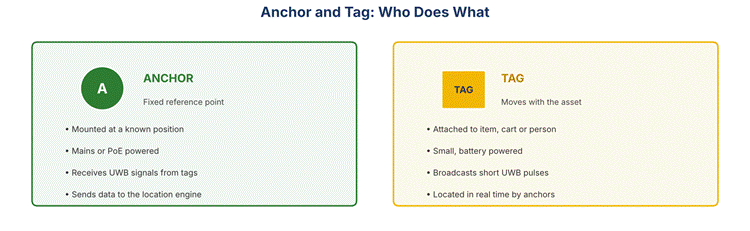
The easiest way to remember it: anchors stay still and know where they are; tags move and need to be found. One is the fixed reference, the other is the moving target. Here is a quick side-by-side:
| UWB Anchor | UWB Tag | |
| Position | Fixed, known location | Moves with the asset |
| Power | Mains or PoE | Battery |
| Role | Receives signals, references | Broadcasts UWB signals |
| Quantity | A few per area | One per tracked item |
| Size | Larger, wall-mounted | Small and light |
How UWB Anchors and Tags Work Together
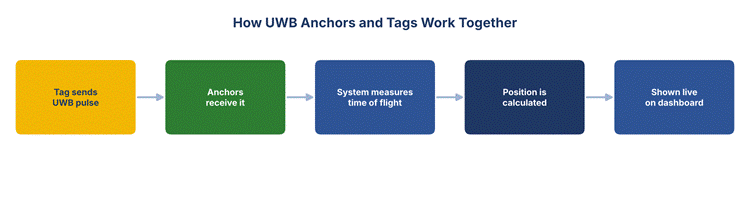
The magic happens in the timing. The most common method is Time of Flight (ToF) — the system measures how long it takes for a signal to travel from the tag to each anchor. This time of flight tof approach is reliable because radio waves move at a known, constant speed, so time converts cleanly into distance. Here is the step-by-step:
- Step 1 – Signal sent: The tag broadcasts a short UWB pulse.
- Step 2 – Anchors listen: Nearby anchors receive the pulse and note the exact time it arrived.
- Step 3 – Distance measured: Because radio waves travel at a known speed, the time for the signal to travel is turned into a precise distance measurement from each anchor.
- Step 4 – Position calculated: With distances from three or more anchors, the location engine triangulates exactly where the tag is.
- Step 5 – Shown live: The position appears on a dashboard map in real time.
Some UWB systems also use Angle of Arrival (AoA), where an anchor reads the direction a signal came from, as an extra way to pin down location. Either way, the anchor and tag relationship stays the same — fixed points locating a moving one.
Where UWB Anchors and Tags Are Used
Because UWB delivers such accurate location tracking, it is used wherever knowing the exact position of something matters:
- Warehouses: Track pallets, tools, and forklifts to cut search time and boost inventory visibility.
- Manufacturing: Follow work-in-progress and high-value assets through every stage of production.
- Logistics & yards: Locate trailers and containers fast for smoother yard management.
- Healthcare: Find mobile equipment and improve patient safety.
These tracking systems often sit alongside other RTLS and RFID solutions, with UWB chosen for the jobs that demand the highest accuracy, all powered by connected IoT sensors.
Why UWB Anchors and Tags Are Worth It
Compared with older tracking systems, a UWB system offers a level of precision that changes what is possible on the floor. Instead of only knowing that an item is “somewhere in the building,” you know the exact aisle, bay, or workstation. That accuracy brings real, everyday benefits:
- Less time searching: Staff stop hunting for misplaced tools, carts, and stock — the dashboard shows precisely where each tagged item is.
- Fewer losses: High-value assets are far harder to misplace or walk off site when their real time location is always visible.
- Better safety: Geofenced zones can warn when a person or vehicle enters a dangerous area, using the same anchor and tag setup.
- Smarter decisions: Movement data collected over time reveals bottlenecks and helps you lay out the space more efficiently.
Because UWB signals are resistant to interference and reflections, these benefits hold up even in busy, metal-heavy environments where other wireless technologies struggle. That reliability is why UWB based tracking is becoming the standard for precision locating in industry.
Conclusion
UWB anchors and tags are the foundation of accurate indoor location tracking. Anchors provide the fixed reference points, tags move with your assets, and together they use the time for a signal to travel to pinpoint position in real time. Once you understand this simple anchor and tag relationship, the rest of UWB technology falls into place.
Brilliant Info Systems designs and deploys UWB-based tracking systems tailored to your site and accuracy needs. Explore our UWB tracking solutions or talk to our team to get started.
Frequently Asked Questions
What is the difference between a UWB anchor and a tag?
An anchor is a fixed device at a known location that receives signals; a tag is a small, battery-powered device attached to a moving item that broadcasts UWB signals. Anchors are the reference points, and tags are what the system locates.
How many anchors do I need?
You typically need at least three or four anchors covering an area so the system can triangulate a tag’s position. Larger spaces need more anchors to maintain accurate, gap-free coverage.
How long does a UWB tag battery last?
It depends on how often the tag reports its location. Tags that update several times a second drain faster than those reporting every few seconds. Many last from one to several years, and the update rate can usually be tuned to balance speed and battery life.
Is UWB better than Bluetooth or RFID for location tracking?
For precise, real time location, UWB is the most accurate of the three, typically within 10–30 cm. Bluetooth and RFID can be cheaper and are better suited to zone-level tracking or presence detection rather than centimetre-level positioning.