
RFID in Cold Chain & Pharma: Compliance and Traceability
In cold chain and pharmaceutical supply chains, a single break in the record can be catastrophic — a spoiled vaccine batch, a failed audit, or a product recall that shatters customer trust. These industries are judged on proof: proof that every product stayed within temperature, moved through approved hands, and can be traced from raw material to finished products. Radio Frequency Identification (RFID) is the technology that makes that proof automatic.
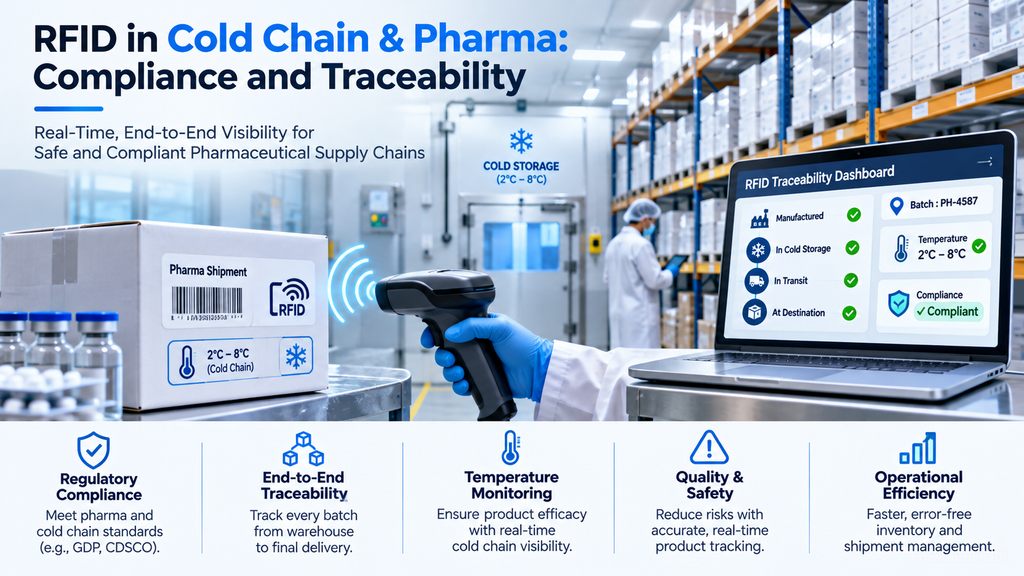
This guide explains how RFID in cold chain and pharma supports compliance and traceability — how it works, the benefits it brings, and why it has become essential for food safety and regulated supply chains.
▶ Watch: Brilliant Info Systems on YouTube
What You’ll Learn
- Why traceability matters in cold chain and pharma
- How RFID delivers end-to-end traceability
- How RFID supports regulatory compliance
- The wider business benefits
Why Traceability Matters
Cold chain and pharmaceutical products are sensitive, high-value, and tightly regulated. A vaccine that warms above 8°C may lose potency; a food shipment that breaks temperature can become unsafe. When something goes wrong, companies must answer two questions fast: which products are affected, and where are they now? Without reliable traceability, the only safe answer is to recall everything — slow, expensive, and damaging.
Traceability is the ability to follow a product and its history through every stage of the supply chain. In practice there are two types of traceability: tracking forward (where did this batch go?) and tracing back (where did this unit come from?). Strong RFID technology gives you both, automatically, which is why traceability has become non-negotiable in these industries.
How RFID Delivers Traceability
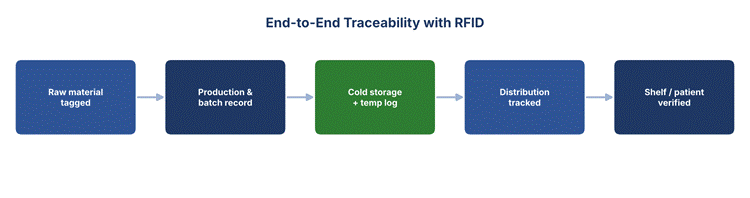
Radio Frequency Identification rfid tags each item, carton, or pallet with a chip that a reader can identify wirelessly — no line of sight, many tags at once. As goods move, RFID enables an automatic record at every step:
- Raw material: Incoming raw material is tagged and logged on arrival, starting the chain of custody.
- Production: Batch and lot details are captured as products are made, linking every unit to its source.
- Cold storage: RFID identifies stock while sensors log temperature, so each item carries a verified cold-chain history.
- Distribution: Pallets are read automatically at every gate and dock, tracking finished products in real time.
- Point of use: A final scan confirms the right product reached the shelf or patient.
Because readers capture data automatically, the trace is complete and accurate without staff typing anything. Pairing RFID tracking with temperature IoT sensors turns a paper trail into a live, trustworthy digital record across the whole chain systems landscape.
How RFID Supports Compliance
Regulations in pharma and food are strict — from serialisation and track-and-trace rules for medicines to food safety standards that demand full traceability. Meeting them manually is slow and error-prone. RFID builds regulatory compliance into daily operations:
- Automatic audit trail: Every movement is time-stamped and stored, ready for inspectors without a scramble.
- Temperature proof: Linked sensor data shows each batch stayed in range, satisfying cold-chain requirements.
- Fast, targeted recalls: When an issue arises, you pull exactly the affected lots — efficiently reducing waste and risk instead of recalling everything.
- Anti-counterfeiting: Unique tag IDs make it far harder for fake products to enter the supply chain.
The result is compliance that is provable on demand, protecting both patients and the business.
The Business Benefits
Beyond compliance, RFID delivers real operational efficiency across cold chain and pharma supply chain management:
| Benefit | What It Means |
| Accurate inventory | Real-time stock counts improve inventory management and cut waste from expiry. |
| Less shrinkage | High-value products are tracked, reducing loss and theft. |
| Faster operations | Bulk, no-line-of-sight reads speed up receiving and dispatch. |
| Stronger customer trust | Proven quality and provenance build confidence with buyers and regulators. |
| Fewer recalls | Targeted traceability limits the scope and cost of any recall. |
These gains explain the growing applications of RFID across regulated sectors. The same approach extends naturally to asset tracking and inventory visibility in manufacturing and e-commerce, and connects to live location data through RTLS solutions where real-time positioning is needed.
Where RFID Cold Chain Traceability Is Used
Across regulated industries traceability has moved from a nice-to-have to a baseline expectation, and RFID is being adopted wherever products are temperature-sensitive or safety-critical:
- Pharmaceuticals & vaccines: Serialised tracking and cold-chain proof from factory to pharmacy, protecting potency and meeting strict rules.
- Food & beverage: Batch-level traceability for food safety, enabling fast, precise recalls and fresher stock rotation.
- Biologics & blood products: Chain-of-custody tracking for highly sensitive materials where every unit must be accounted for.
- Medical devices: Unique identification and location tracking across hospitals and distribution.
In each case the goal is the same — a complete, provable record that protects the product, the patient or consumer, and the brand.
Conclusion
In cold chain and pharma, you cannot manage what you cannot trace — and you cannot prove compliance without a trustworthy record. RFID turns traceability from a manual burden into an automatic, real time capability that follows every product from raw material to the shelf. The payoff is provable regulatory compliance, safer products, lower waste, and the customer trust these industries depend on.
Brilliant Info Systems builds RFID and traceability solutions for cold chain, pharma, and food supply chains. Explore our RFID technology and RFID tracking solutions, or talk to our team to make your supply chain fully traceable.
Frequently Asked Questions
What is RFID traceability in cold chain and pharma?
It is the use of RFID tags and readers to automatically record a product’s journey through the supply chain — from raw material to finished products — along with its temperature history, creating a complete, verifiable trace for compliance and recalls.
How does RFID help with regulatory compliance?
RFID creates an automatic, time-stamped audit trail and, combined with temperature sensors, proves products stayed within range. This makes it easy to satisfy pharma serialisation and food safety rules and to run fast, targeted recalls when needed.
What is the difference between RFID and barcodes here?
Barcodes need line of sight and are scanned one at a time; RFID reads many tags at once, wirelessly, even inside cartons. For high-volume, high-value cold chain and pharma goods, RFID enables faster, more reliable traceability.
Does RFID track temperature too?
RFID identifies the product; temperature is captured by sensors (sometimes built into the tag). Linking the two gives each item a verified cold-chain record — essential proof for food safety and pharmaceutical compliance.