
Tracking Forklifts and Pallets with UWB in Warehouses
In a large warehouse, two things are always moving and always getting lost: forklifts and pallets. A misplaced pallet can hold up an order for hours, and a forklift in the wrong aisle wastes fuel, time, and labour. Ultra-Wideband (UWB) tracking fixes this by showing the exact, real time location of every forklift and pallet on a live map — accurate to within a few centimetres.
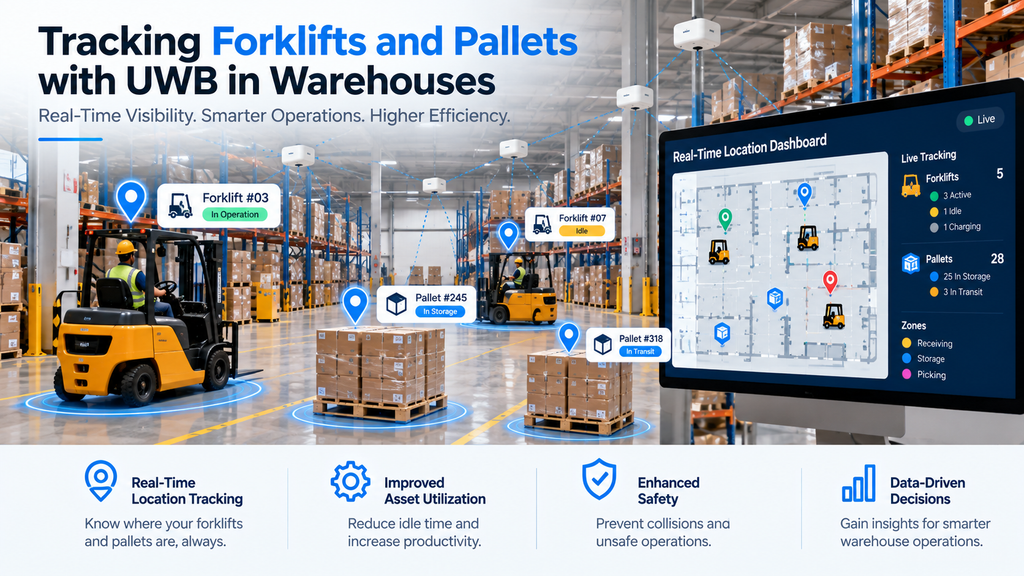
This guide explains how tracking forklifts and pallets with UWB in warehouses works, why UWB is the right technology for the job, and the gains it delivers for safety and efficiency.
▶ Watch: Brilliant Info Systems on YouTube
What You’ll Learn
- Why forklift and pallet tracking matters
- How UWB tracking works in a warehouse
- The benefits for safety and efficiency
- How it connects to your existing systems
Why Track Forklifts and Pallets?
Warehouses run on the movement of goods, and most of that movement happens on a forklift. When you cannot see where your forklifts and pallets are, small problems pile up fast: staff search for stock, vehicles criss-cross the floor inefficiently, and near-misses become a safety risk. Knowing the real time location of every vehicle and load removes that uncertainty.
Good forklift tracking answers the everyday questions that slow a warehouse down — where is that pallet, which forklift is free, why is this aisle congested — and it does so automatically, without anyone keying data by hand. The result is the foundation for better asset tracking and inventory visibility across the site.
Why UWB Is the Right Technology
Several technologies can track assets indoors, but UWB stands out for this job because of its accuracy. UWB measures the time a radio pulse takes to travel between a tag and fixed anchors, pinning a location down to roughly 10–30 centimetres — precise enough to know which specific rack or bay a pallet is in, not just the general area.
That precision matters for forklifts, which move fast and need accurate positions to be useful. UWB also resists the signal reflections that metal racking and machinery cause, so it stays reliable in a cluttered warehouse where other RTLS tracking solutions can struggle. For the detail on the technology, see our UWB tracking page.
How It Works
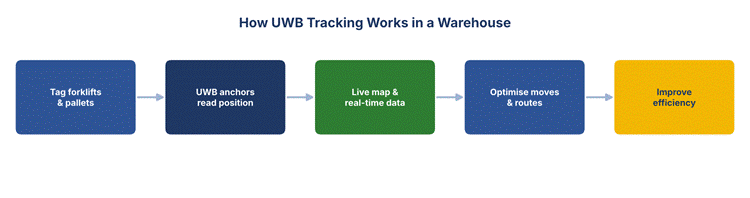
The setup is straightforward:
- Tag forklifts and pallets: A small UWB tag goes on each forklift and on pallets or their loads.
- Install anchors: Fixed UWB anchors mounted around the warehouse pick up each tag’s signal.
- Calculate position: The system works out each tag’s exact position in real time and shows it on a live floor-plan map.
- Act on the data: Staff and software use the live positions to direct work, optimise routes, and locate stock instantly.
Because the system can track assets continuously, the map always reflects what is really happening on the floor, second by second.
The Benefits
Tracking forklifts and pallets with UWB pays off across safety and operations:
| Benefit | What It Means on the Floor |
| Less search time | Find any pallet or forklift instantly instead of walking the aisles. |
| Improved efficiency | Optimised routes and task assignment cut wasted forklift movement. |
| Better safety | Zone alerts and anti-collision warnings reduce near-misses. |
| Accurate inventory | Pallet location updates keep stock records right in real time. |
| Usage insight | See how forklifts are really used to plan fleet size and shifts. |
Safety is a standout. Because the system knows where every vehicle and person is, it can warn drivers before a collision — pairing naturally with anti-collision systems to protect staff on a busy floor.
Connecting to Your Existing Systems
UWB tracking delivers the most value when its data flows into the tools you already run. Integrated with your WMS or ERP, a pallet’s location can update stock automatically, and a forklift’s position can drive task assignment. Built on reliable IoT sensors, the system plugs into existing systems rather than replacing them, so you improve efficiency without ripping out what works. The same data can extend to yard management and, where lower-cost identification is enough, complement RFID technology at gates and checkpoints.
Conclusion
Forklifts and pallets are the heartbeat of a warehouse, and UWB finally makes both fully visible. With centimetre-level, real time location on a live map, you can cut search time, improve efficiency, raise safety, and keep inventory accurate — all while plugging into the systems you already use. For any warehouse serious about productivity, UWB forklift and pallet tracking is one of the highest-impact upgrades available.
Brilliant Info Systems designs UWB tracking solutions for warehouses, from forklifts and pallets to full-site visibility. Explore our UWB tracking and RTLS solutions, or talk to our team to plan your deployment.
Frequently Asked Questions
How accurate is UWB forklift tracking?
UWB typically locates a tag to within 10–30 centimetres — precise enough to know the exact rack or bay a pallet or forklift is in, not just the general zone. That makes it far more accurate than Wi-Fi or basic Bluetooth tracking.
Do I need to tag every pallet?
It depends on your goal. Many warehouses tag forklifts plus high-value or fast-moving pallets, and let the forklift’s position update the load it is carrying. Tracking solutions can scale from a few key assets to the whole fleet.
Will it work with my current WMS?
Yes. UWB platforms are built to integrate with existing systems such as your WMS or ERP through APIs, so location data updates stock and tasks automatically rather than requiring manual entry.
Is UWB better than RFID for this?
For live, precise location, yes — UWB gives continuous real time location, while passive RFID mainly records items at fixed checkpoints. Many sites use both: UWB for live tracking and RFID for low-cost identification at gates.