
Warehouse Automation for 3PL Providers: Multi-Client Efficiency at Scale
Third-party logistics providers live and die by efficiency. A 3PL warehouse does not store one company’s goods — it juggles dozens of clients, each with different products, service levels, and billing rules, all under one roof. As client numbers grow, manual processes buckle: picking slows, errors rise, and margins get squeezed. Warehouse automation is how leading 3PLs break that ceiling and run many clients efficiently at scale.
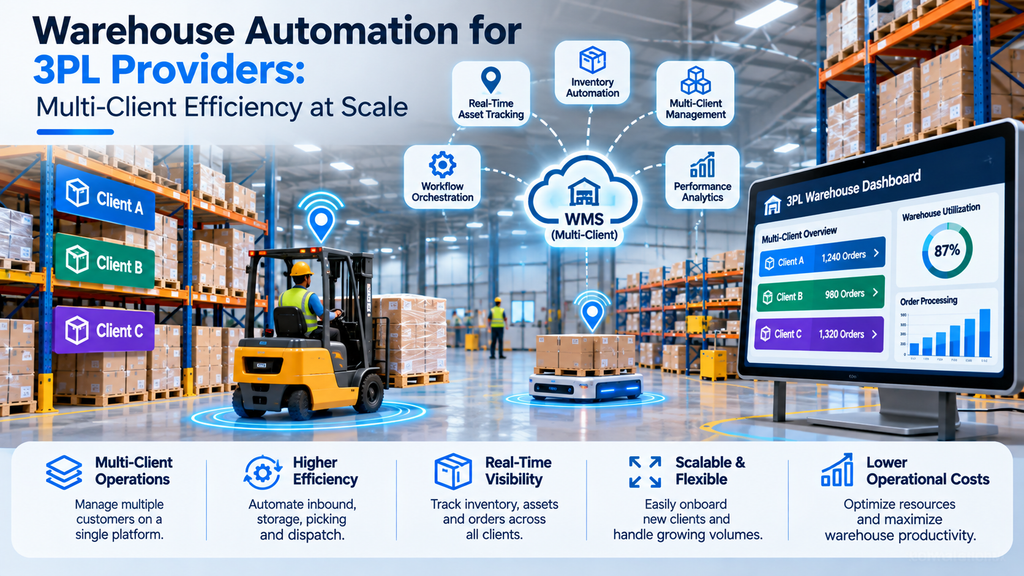
This guide explains how warehouse automation for 3PL providers delivers multi-client efficiency at scale — the challenges it solves, the technologies involved, and the gains it brings to speed, accuracy, and cost.
▶ Watch: Brilliant Info Systems on YouTube
What You’ll Learn
- Why multi-client operations are uniquely hard
- How automation solves the 3PL challenge
- The key technologies in a 3PL automation stack
- The efficiency and cost gains at scale
The Multi-Client Challenge
A single-client warehouse can be optimised around one set of products and processes. A 3PL cannot. Each client brings its own SKUs, packaging, order profiles, and reporting needs, and they all share the same space, staff, and equipment. That multi client complexity is the core challenge of party logistics operations.
Done manually, it creates friction everywhere: staff learn different rules per client, stock gets mixed up, and billing each client accurately is a headache. As volumes grow across the supply chain, these problems multiply. The only way to keep speed and accuracy high while adding clients is to let an automation system handle the complexity — which is exactly what modern warehouse automation solutions do.
How Automation Solves It
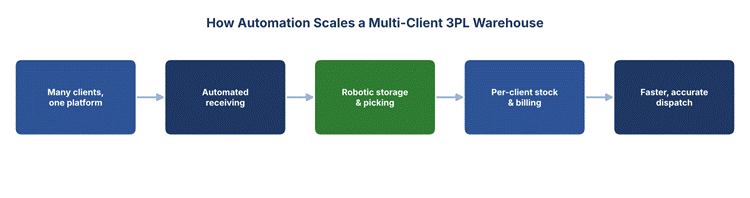
3PL automation works by putting every client on one intelligent platform and letting software and machines do the heavy lifting. The flow looks like this:
- One platform, many clients: A central management system keeps each client’s stock, rules, and data separate while running them on shared infrastructure.
- Automated receiving: Inbound goods are identified and logged automatically, tagged to the right client from the first scan.
- Robotic storage & picking: Automated systems store and retrieve goods, guiding fast, accurate picking and packing regardless of which client an order belongs to.
- Per-client visibility & billing: Real time inventory tracking gives each client an accurate, live view of their own stock, and makes activity-based billing simple.
The result is a warehouse that scales by adding clients to software, not by adding chaos to the floor.
The 3PL Automation Technology Stack
No single product automates a 3PL — it is a stack of technologies working together:
Storage & Movement Automation
Automated storage and retrieval (ASRS) and automated guided vehicles move goods without manual forklifts, maximising space and cutting walking time across warehouse operations.
Identification & Tracking
Automatic identification keeps every client’s stock accurate and separate. RFID technology and real-time RTLS solutions provide live inventory tracking and inventory visibility, so nothing gets mixed up or lost.
Picking & Order Fulfilment
Technologies like pick-to-light speed up picking and packing while cutting errors, and an order management system routes each order through the right workflow. Built on reliable IoT sensors, the whole automation system runs as one.
The Efficiency and Cost Gains
For a 3PL, automation turns into measurable efficiency gains across the operation:
| Gain | What It Means for a 3PL |
| Higher throughput | Handle more clients and orders in the same space. |
| Lower labor costs | Automation reduces reliance on hard-to-find manual labour. |
| Better accuracy | Fewer mispicks means fewer returns and happier clients. |
| Faster onboarding | New clients are added in software, not by rebuilding processes. |
| Scalability | Grow volume without a matching rise in headcount. |
Crucially, automation lets a 3PL grow profitably: revenue rises with new clients while labor costs stay flat. Paired with labour management tools, it also makes the remaining workforce more productive — a long term advantage as the business scales.
Getting Started: A Phased Approach
The best 3PL automation projects start where the pain is greatest, prove the return, then expand. A phased path keeps risk and cost under control:
- Fix identification first: Accurate, automatic inventory tracking per client is the foundation everything else builds on — and often the fastest win.
- Automate the busiest flows: Target the picking and packing lanes that handle the most volume, where speed and accuracy gains pay back quickly.
- Add storage automation as you grow: Bring in ASRS or AGVs once volumes justify the investment, expanding capacity without more floor space.
- Integrate everything: Connect the automation system to each client’s own systems so data flows both ways in real time.
This modular approach means even a mid-sized 3PL can begin without a huge upfront spend, and scale the automation in step with new client wins. Choosing a partner who understands multi-client warehouse operations — not just single-site automation — is what keeps the rollout smooth and the long term returns strong.
Conclusion
For third-party logistics providers, automation is no longer optional — it is how you serve many clients efficiently at scale. By putting every client on one intelligent platform and letting machines handle storage, picking and packing, and tracking, a 3PL can grow volume and client count without growing chaos or cost. The payoff is higher throughput, lower labor costs, better accuracy, and the ability to onboard new clients fast — a durable, long term edge in a competitive market.
Brilliant Info Systems designs warehouse automation solutions for 3PL providers, from identification and picking to full-site systems. Explore our automation and warehouse solutions or talk to our team to scale your multi-client operation.
Frequently Asked Questions
Why do 3PL warehouses need automation more than others?
Because they run many clients at once, each with different rules and products. Manual processes don’t scale across that complexity, so automation is what lets a 3PL add clients and volume while keeping speed, accuracy, and margins intact.
How does automation keep each client’s stock separate?
A central management system tags every item to its client from receiving onward, and real-time inventory tracking keeps the records accurate. Each client sees only their own live stock, and billing is calculated from their actual activity.
Is 3PL automation only for large providers?
No. Automation scales — a growing 3PL can start with the highest-impact areas (such as identification and picking) and expand over time. Warehouse automation solutions are increasingly modular and affordable for mid-sized providers.
What is the biggest benefit of 3PL automation?
The ability to grow without a matching rise in labour and errors. Automation decouples volume from headcount, so a 3PL can win and onboard new clients profitably while maintaining service levels.