
RTLS in Automotive Manufacturing: Tracking WIP on the Assembly Line
An automotive plant is a river of moving parts. Thousands of components, sub-assemblies, and half-built vehicles flow along the production line every day, and at any moment a manager needs to know: where is each one, and is it on schedule? When that visibility is missing, bottlenecks hide, parts go astray, and cycle time creeps up. Real time location systems (RTLS) give automotive manufacturers a live map of every piece of work in progress on the shop floor.
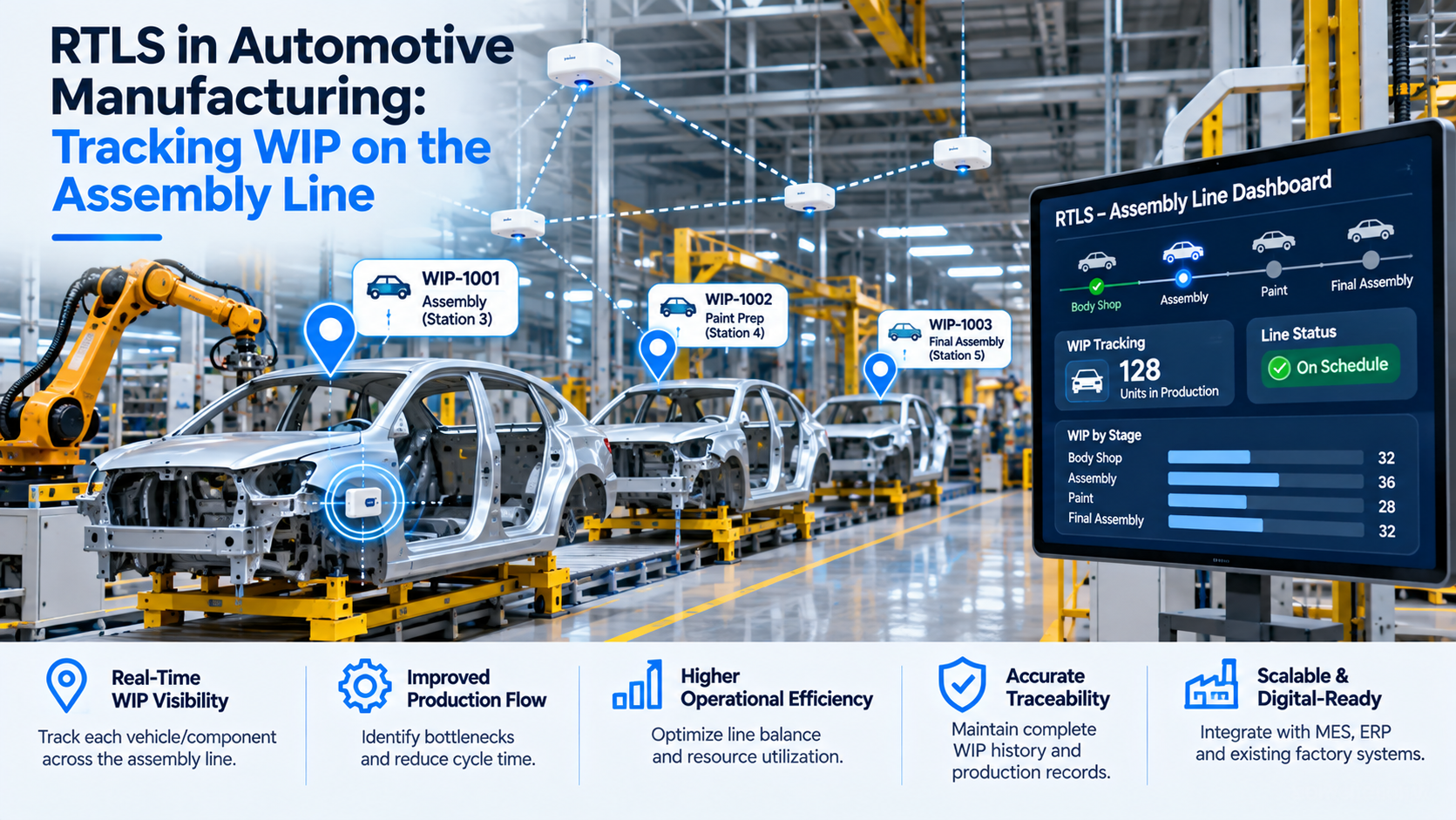
This guide explains how RTLS in automotive manufacturing works for tracking WIP on the assembly line — the problems it solves, how it works, and the gains it delivers for flow, quality, and lead time.
▶ Watch: Brilliant Info Systems on YouTube
What You’ll Learn
- Why WIP visibility is hard — and costly
- How RTLS tracks WIP on the assembly line
- The benefits for flow, quality, and cost
- How it connects to your production systems
Why WIP Visibility Is So Hard
Work in progress (WIP) — also called work in process — is everything between raw materials and finished goods: the engines, doors, wiring looms, and part-built bodies moving through the plant. In a complex automotive production process, these unfinished goods are constantly moving, branching to sub-lines, and queuing between stations.
Traditional tracking systems rely on manual scans at a few checkpoints, which leaves long blind spots in between. A part can sit in the wrong buffer for hours before anyone notices. Without continuous real time visibility, managers are always reacting late — chasing missing sub-assemblies, guessing at production flow, and firefighting bottlenecks after they have already slowed the line.
How RTLS Tracks WIP on the Assembly Line
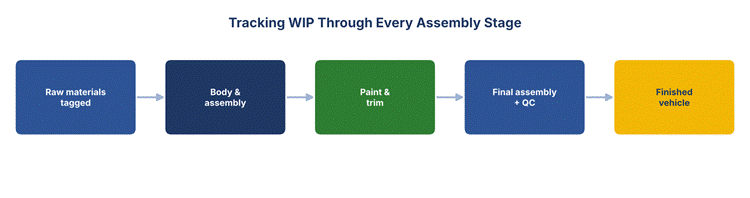
RTLS replaces checkpoint guesswork with continuous location data. A tag is attached to each item, carrier, or vehicle body, and fixed anchors around the plant track its position live. As WIP moves through the line, the system records exactly where it is at every moment:
- Tag the WIP: Raw materials, carriers, and vehicle bodies get a small RTLS tag as they enter the line.
- Track through stages: Anchors follow each item through body, paint, trim, and final assembly — no manual scanning needed.
- See it live: A live map shows every piece of work in progress, its stage, and how long it has been there.
- Act on the data: The system flags bottlenecks and missing items instantly, so the team can intervene before the line stalls.
Technologies such as UWB give the centimetre-level accuracy needed to know the exact station a body is at, while BLE suits zone-level tracking of carriers and bins. Both feed one RTLS platform for complete asset tracking across the plant.
The Benefits of WIP Tracking
Live WIP tracking turns hidden problems into visible, fixable ones. The gains show up right across automotive manufacturing:
| Benefit | What It Means on the Line |
| Shorter cycle time | Spot and clear bottlenecks fast, keeping the line moving. |
| Lower WIP levels | Reducing WIP frees cash and floor space without starving the line. |
| Less searching | Find any missing part or sub-assembly instantly. |
| Better quality | Trace each unit’s route for faster root-cause analysis on defects. |
| Shorter lead time | Smoother flow means vehicles reach finished goods sooner. |
Good WIP management is about flow. By making the whole production line visible, RTLS helps engineers balance stations, cut queues, and keep raw materials converting into finished vehicles at a steady, predictable pace.
Connecting RTLS to Your Production Systems
WIP location data is most powerful when it feeds the systems that run the plant. Integrated with your MES or ERP, an RTLS can update build status automatically, trigger the next operation, and feed OEE monitoring with real production flow data. Built on reliable IoT sensors, it becomes part of a connected smart manufacturing setup rather than a standalone screen.
It also complements existing identification: where RFID technology confirms a part’s identity at a station, RTLS adds the continuous “where is it now” layer, and the combination gives both identity and live position for every item — the foundation of true inventory visibility on the shop floor.
Beyond the Line: Wider RTLS Uses in Automotive
Once the infrastructure is in place, the same RTLS does far more than track bodies through assembly. Automotive plants use it across the whole operation:
- Tooling and equipment: Locate shared tools, torque guns, and test rigs instantly, so operators never hunt for the one they need.
- Returnable containers: Track racks, dollies, and bins that circulate between the plant and suppliers, cutting loss and buffer stock.
- Finished-vehicle yards: Find any completed car in a vast outbound lot in seconds, speeding dispatch.
- Operator safety: Geofenced zones warn when people and automated vehicles get too close on a busy shop floor.
Because every use runs on the same tags, anchors, and platform, each new application adds value at little extra cost — which is why RTLS has become core infrastructure in modern automotive plants rather than a single-purpose tool.
Conclusion
In automotive manufacturing, flow is everything — and you cannot manage flow you cannot see. RTLS gives the plant a live map of every piece of work in progress on the assembly line, turning hidden bottlenecks and lost parts into visible, fixable issues. The result is shorter cycle time, lower WIP, faster lead time, and better quality, all built on continuous, accurate location data. For any car plant chasing efficiency, WIP tracking with RTLS is one of the highest-impact upgrades available.
Brilliant Info Systems designs RTLS solutions for automotive and discrete manufacturing, from WIP tracking to full shop-floor visibility. Explore our RTLS solutions or talk to our team to bring your production line into real time.
Frequently Asked Questions
What is WIP tracking in automotive manufacturing?
It is the continuous tracking of work in progress — the parts, sub-assemblies, and part-built vehicles between raw materials and finished goods — as they move along the assembly line, using RTLS tags and anchors to show each item’s live location and stage.
How is RTLS better than barcode scanning for WIP?
Barcodes only record an item at fixed scan points, leaving blind spots in between. RTLS tracks items continuously and automatically, giving real time visibility of where every piece of WIP is at all times — no manual scanning required.
Does RTLS help reduce WIP and cycle time?
Yes. By making bottlenecks and queues visible instantly, RTLS lets teams balance the line and clear blockages, which lowers WIP levels and shortens cycle time and overall lead time.
Which RTLS technology suits an assembly line?
UWB is ideal where you need the exact station a body is at, thanks to centimetre-level accuracy. BLE suits zone-level tracking of carriers and bins. Many plants use both on one platform to match accuracy to need and cost.