
Put-to-Wall Sortation: How It Speeds Up Multi-Order Fulfillment
When a warehouse ships hundreds or thousands of small orders a day, the slowest part is rarely the picking — it is the sorting. Walking the aisles to pick one order at a time wastes hours in travel. Put-to-wall sortation flips the problem: pick many orders at once, then sort the items into individual orders at a wall of cubbies. The result is dramatically faster multi-order fulfillment with fewer errors.
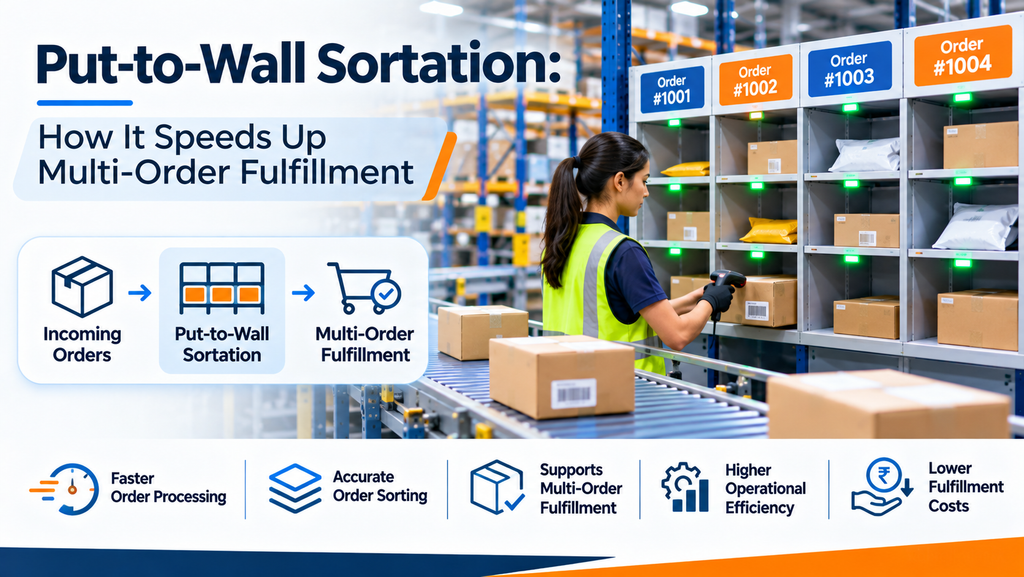
This guide explains put-to-wall sortation and how it speeds up multi-order fulfillment — what a put wall is, how the process works, and the benefits for any high-volume operation.
▶ Watch: Brilliant Info Systems on YouTube
What You’ll Learn
- What put-to-wall sortation is
- How the process works, step by step
- Why it speeds up fulfillment
- When put-to-wall is the right choice
What Is Put-to-Wall Sortation?
A put wall is a large rack of cubbies, where each cubby is assigned to one customer order. Instead of picking orders one by one, workers use batch picking to collect items for many orders in a single trip through the warehouse. Those items are then brought to the wall and “put” into the right cubby — sorting the big batch back into individual orders.
Light displays guide the process: a scan of an item lights up the cubby (or cubbies) it belongs to, so the worker knows instantly where to place it. This is the same proven idea behind pick-to-light, applied to sorting. Modern put wall systems make order consolidation fast, accurate, and simple to learn.
How the Process Works
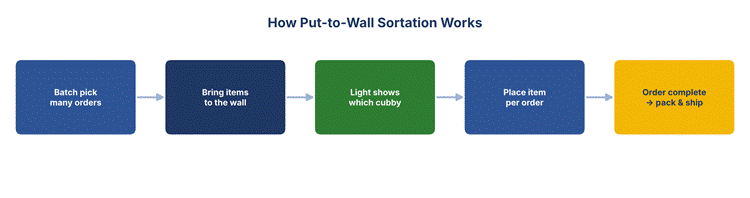
Put-to-wall turns many small orders into one efficient flow:
- Batch pick: A worker picks the items for many orders at once in a single pass, cutting travel time dramatically.
- Bring to the wall: The mixed batch of items is carried to the put wall for sorting.
- Scan and sort: Each item is scanned; a light shows which cubby — which order — it belongs to.
- Place the item: The worker puts the item in the lit cubby, building each order piece by piece.
- Complete the order: When an order is complete, the cubby signals it is ready to pack and ship.
This two-step rhythm — batch pick, then sort — is what makes the whole order fulfillment process so much faster than picking orders individually.
Why It Speeds Up Fulfillment
Put-to-wall attacks the biggest hidden cost in fulfilling orders: walking. The gains compound across the operation:
| Benefit | What It Means on the Floor |
| Less walking | Batch picking replaces many single-order trips with one, saving hours. |
| Faster order processing | Items flow from batch to sorted orders in a smooth, continuous rhythm. |
| Fewer errors | Light-directed sorting makes it hard to put an item in the wrong order. |
| Faster delivery speeds | Orders are completed and shipped sooner, improving service. |
| Easy to learn | New or seasonal staff get productive fast, with little training. |
Because order consolidation happens at the wall rather than on the warehouse floor, a single picker’s effort now serves dozens of orders at once. That is the core reason put-to-wall speeds up multi-order fulfillment so effectively, often without the extra cost of complex automation.
When Put-to-Wall Is the Right Choice
Put-to-wall shines in specific situations — it is not for every warehouse:
- High order volume: Many orders per day, especially small e-commerce orders, where travel time dominates.
- Many shared SKUs: When the same items appear across many orders, batch picking is especially efficient.
- Tight delivery windows: When orders must ship within business days or same-day, speed and accuracy matter most.
It pairs naturally with an order management system, pick validation, and inventory visibility, and is a strong fit for busy e-commerce fulfilment. Built on reliable IoT sensors and light hardware, it integrates cleanly with the rest of the warehouse.
Put-to-Wall vs Other Picking Methods
It helps to see where put-to-wall fits among common fulfilment methods:
| Method | Best For |
| Single-order picking | Low volumes or large orders — simple but lots of walking. |
| Batch picking (no wall) | Many small orders, but still needs a separate sort step. |
| Put-to-wall | High volumes of small, multi-item orders needing fast, accurate sorting. |
| Full automation (robots) | Very high volumes with the budget for heavy capital investment. |
Put-to-wall sits in a sweet spot: it captures most of the speed of automation at a fraction of the cost. Because the heavy lifting is organisation and light guidance rather than robotics, it delivers faster order processing and faster delivery speeds without the extra cost and long payback of a fully automated system. For many growing operations, that balance of speed, accuracy, and affordability is exactly why put wall systems have become so popular.
Conclusion
Put-to-wall sortation turns the slowest part of fulfillment — sorting many small orders — into its fastest. By combining batch picking with light-directed order consolidation at a wall of cubbies, warehouses cut walking, speed up order processing, reduce errors, and ship sooner. For any high-volume operation chasing faster delivery speeds without heavy automation cost, put-to-wall is one of the highest-impact upgrades available.
Brilliant Info Systems designs put-to-wall, pick-to-light, and order fulfilment systems for high-volume warehouses. Explore our put-to-wall solutions or talk to our team to speed up your multi-order fulfillment.
Frequently Asked Questions
What is a put wall?
A put wall is a rack of cubbies, each assigned to one order. Workers batch pick many orders at once, then sort the items into the correct cubbies — guided by lights — to build each order quickly and accurately.
How is put-to-wall different from pick-to-light?
Pick-to-light guides a worker to pick items from storage; put-to-wall guides them to place picked items into order cubbies. Put walls are used for the sorting step after a batch pick, to consolidate items into individual orders.
Does put-to-wall reduce errors?
Yes. Light-directed sorting tells the worker exactly which cubby each item goes in, so it is very hard to place an item in the wrong order. This makes the order fulfillment process both faster and more accurate.
Is put-to-wall only for e-commerce?
It is most popular in e-commerce because of high volumes of small, multi-item orders, but any operation fulfilling many orders from shared SKUs — retail, pharmacy, or parts distribution — can benefit from put wall systems.