
Air Overpressure Monitoring in Blasting: What Mining Teams Need to Know
Ask a resident near a mine what they notice most about blasting, and it often is not the ground shaking — it is the bang and the rattling windows. That pressure wave through the air is called air overpressure, and it is one of the most common sources of complaints against blasting operations. Yet it is frequently overlooked in favour of ground vibration. For mining teams, understanding and monitoring air overpressure is just as important as watching the ground.
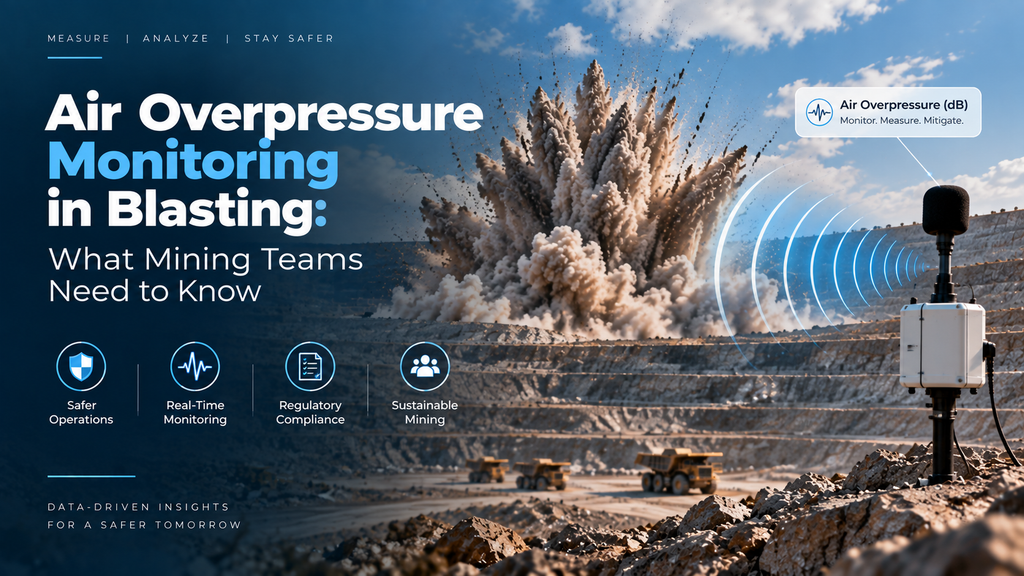
This guide covers what air overpressure is, why it matters, how it is measured and monitored, and how it fits alongside ground vibration in a complete blast vibration monitoring solution.
Table of Contents
- What is air overpressure?
- Air overpressure vs ground vibration
- Why it matters
- How it is measured
- Air overpressure limits
- How monitoring works
- What causes high overpressure
- FAQs and conclusion
What Is Air Overpressure?
Air overpressure is the pressure wave that travels through the air when a blast is detonated. As explosives fire, they push against the surrounding air and create a rapid change in air pressure that spreads outward — much like the shock wave you hear as a loud bang. Part of it is audible noise; part of it is low-frequency energy below human hearing that can still shake structures.
It is essentially the airborne cousin of ground vibration. Where ground vibration travels through the earth, air overpressure travels through the atmosphere — and both are produced by every blasting event. Measuring only one gives an incomplete picture of a blast’s impact.
Air Overpressure vs Ground Vibration
These are the two main by-products of blasting, and mining teams need to monitor both. They are related but distinct, as this comparison shows:
| Aspect | Air overpressure | Ground vibration |
| Travels through | The air | The ground |
| What you feel | A pressure wave, bang, or window rattle | The ground shaking underfoot |
| Measured in | Decibels (dB) or pascals | Millimetres per second (PPV) |
| Sensor | Microphone / overpressure sensor | Geophone |
| Main risk | Windows, noise, complaints | Structural and foundation damage |
Ground vibration, measured as peak particle velocity (PPV), is the bigger risk for structural damage, while air overpressure is the more common cause of noise complaints and rattled windows. Our guide to ground vibration monitoring covers the other half of the picture in detail.
Why Air Overpressure Matters
Air overpressure deserves close attention for several reasons. Although it rarely causes serious structural damage on its own, it is a frequent trigger for disputes and regulatory action:
- Window and cosmetic damage: strong pressure waves can crack or break windows and loosen fittings.
- Noise and complaints: the audible bang is the most noticeable effect for nearby residents, driving most community complaints.
- Regulatory limits: air overpressure limits are set by regulators, and exceedances can halt blasting.
- Reputation and trust: repeated loud blasts erode community goodwill, even when no damage occurs.
For mining teams, controlling air overpressure is often as much about maintaining a social licence to operate as it is about physical safety.
How Air Overpressure Is Measured
Air overpressure is measured with a microphone or a dedicated overpressure sensor, usually built into the same seismograph used for ground vibration at a monitoring station. It is expressed in decibels — specifically dB(L), a linear scale suited to the low-frequency energy of blasting — or sometimes in pascals of pressure.
Because the sensor must capture very low frequencies, a specialised blast microphone is used rather than an ordinary sound-level meter. Positioned at sensitive locations, it records the peak air overpressure of each blast, and modern IoT sensors and smart sensors stream that data automatically for analysis.
Air Overpressure Limits and Standards
Like ground vibration, air overpressure is governed by limits set in standards and regulations rather than a single universal number. These limits are defined in decibels and vary by country, regulator, and the sensitivity of nearby structures. Exceeding them can lead to complaints, investigations, and suspension of blasting.
Because the exact limit depends on where you operate, mining teams should always work to the specific air overpressure limit set for their site — and monitor against it on every blast rather than assuming compliance.
How Air Overpressure Monitoring Works
Monitoring follows a clear chain from the blast to a compliance record, running in parallel with ground vibration monitoring:
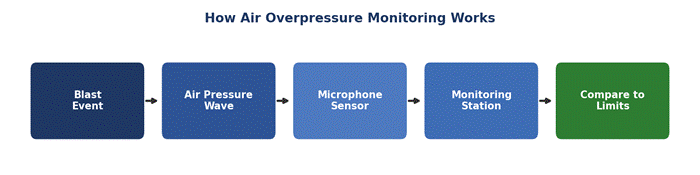
A blasting event creates an air pressure wave; a microphone sensor at the monitoring station detects it; the reading is captured and analysed; and the peak value is compared against the applicable limit. When monitoring is done in real time, any exceedance is flagged instantly — the same principle covered in our guide to real-time blast monitoring. Because the same monitoring systems capture both air overpressure and ground vibration, teams get a complete view of each blast from a single station.
What Causes High Air Overpressure?
Understanding the causes helps teams keep air overpressure down. Several factors increase it: insufficient stemming (the material that seals the blast hole), which lets gases escape into the air; exposed detonating cord; poor blast timing; and shallow or poorly confined charges. Weather plays a role too — wind direction and temperature inversions can carry and even amplify the pressure wave toward communities.
The good news is that most of these are controllable. Good blast design, proper stemming, and checking weather conditions before firing all help reduce air overpressure — and monitoring data shows whether those measures are working.
Best Practices for Mining Teams
To manage air overpressure well, monitor it on every blast at the most sensitive locations, not just occasionally. Know the decibel limits that apply to your site, and keep the microphone sensors calibrated. Pay attention to weather before firing, since conditions can turn a normal blast into a complaint. And use the accumulated data to refine blast design over time, reducing both overpressure and ground vibration together.
Conclusion
Air overpressure is the blast effect mining teams feel and hear the most, and the one that most often lands as a complaint. Though it rarely causes serious structural damage, it carries real regulatory and reputational weight — which makes monitoring it essential, not optional.
Measured properly and monitored alongside ground vibration, air overpressure becomes a managed, defensible part of every blast. A complete blast vibration monitoring solution captures both from one station, giving mining teams the full picture they need to blast safely and keep the community onside.
Monitor Air Overpressure with Brilliant Info Systems
Brilliant Info Systems provides a complete blast vibration monitoring solution that captures both air overpressure and ground vibration — powered by IoT and smart sensors with real-time data and alerts. Contact our team to monitor every blast with confidence.
Frequently Asked Questions
What is air overpressure in blasting?
Air overpressure is the pressure wave that travels through the air when a blast is detonated, heard as a bang and capable of rattling or breaking windows. It is measured in decibels and monitored alongside ground vibration.
How is air overpressure different from ground vibration?
Air overpressure travels through the air and is measured in decibels with a microphone, mainly risking windows and causing noise. Ground vibration travels through the earth, is measured as PPV with a geophone, and mainly risks structural damage.
How is air overpressure measured?
It is measured with a specialised blast microphone or overpressure sensor, usually part of a seismograph at a monitoring station, and expressed in decibels — typically dB(L) — to capture the low-frequency energy of blasting.
Why does air overpressure cause complaints?
Because it is the most noticeable effect of a blast for nearby residents — the audible bang and rattling windows. Even when no damage occurs, repeated loud blasts drive community complaints.
What causes high air overpressure?
Common causes include insufficient stemming, exposed detonating cord, poor timing, and shallow charges. Weather, such as wind and temperature inversions, can also carry and amplify the pressure wave.
Can one system monitor both air overpressure and ground vibration?
Yes. Modern monitoring systems capture both from a single monitoring station — a microphone for air overpressure and a geophone for ground vibration — giving a complete view of each blast.