
Blast Monitoring Sensors: From Vibration Detection to Actionable Insights
A sensor on its own does not keep a mine safe. It detects a vibration, records a number — and unless that number reaches the right person in a useful form, it changes nothing. The real value of blast monitoring lies in the full journey: from a sensor detecting ground movement, through accurate data, to a clear insight someone can act on. That journey is what separates a pile of readings from genuine control over blasting.
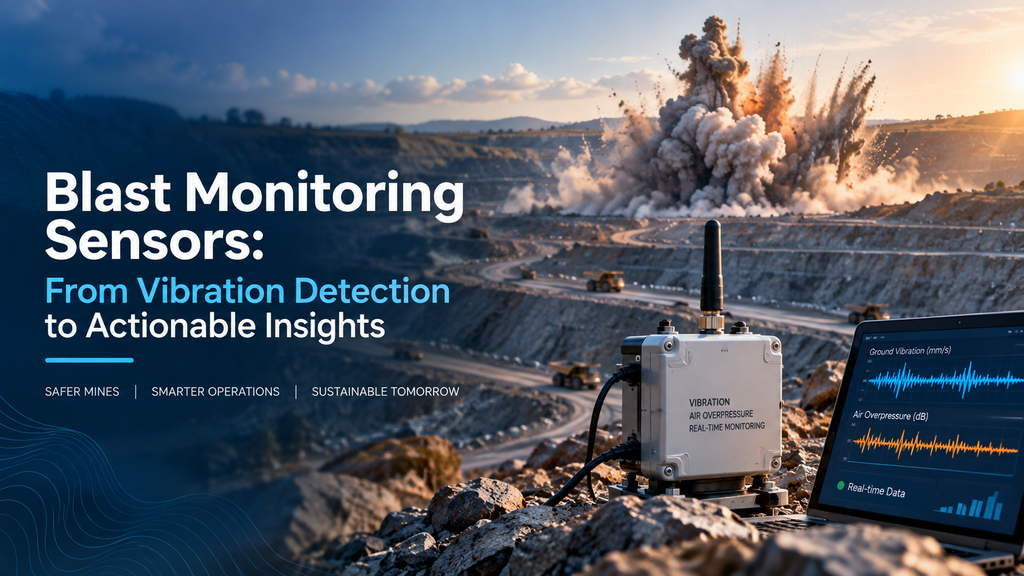
This guide follows that path end to end. It explains what blast monitoring sensors are, the types available, how raw detection becomes accurate data, and how a modern blast vibration monitoring solution turns that data into actionable insights that protect surrounding structures and improve operations.
▶ Watch: Smart Mining Monitoring
Table of Contents
- What are blast monitoring sensors?
- Types of sensors
- The journey: detection to insight
- Step 1: Detection
- Step 2: Accurate data
- Step 3: Remote monitoring
- Step 4: Analysis and insight
- Why the full journey matters
- FAQs and conclusion
What Are Blast Monitoring Sensors?
Blast monitoring sensors are the instruments that detect and measure the effects of blasting. They sit at the very start of the monitoring chain, converting physical events — the shaking of the ground, the pressure wave in the air — into electrical signals that can be recorded and analysed.
The best known is the geophone, which detects ground vibration and underpins any vibration monitoring system. But a complete setup uses several sensor types together, each detecting a different effect. On their own they only detect; their value comes from what happens to the signals afterwards.
Types of Blast Monitoring Sensors
Different sensors capture different aspects of a blast. Most operations combine them into a single monitoring station:
| Sensor | What it detects | Captured as |
| Geophone | Ground vibration | Peak particle velocity (mm/s) |
| Microphone | Air overpressure | Decibels (dB) |
| Triaxial sensor | Movement on three axes | Full vibration waveform |
| Gas / dust sensor | Post-blast air quality | Concentration levels |
The geophone measuring peak particle velocity (PPV) and the microphone measuring air overpressure are the two core sensors, covering the ground and air effects explored in our guides on ground vibration monitoring and air overpressure monitoring.
The Journey: From Detection to Actionable Insight
The real story of blast monitoring is a five-stage journey. Each stage adds value, turning a raw physical event into something a team can act on:
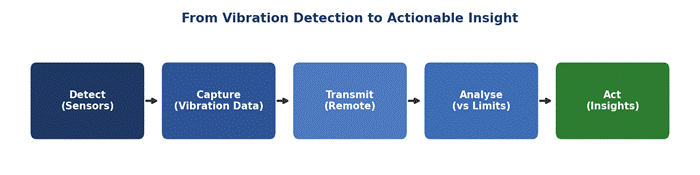
| Stage | What happens |
| 1. Detection | Sensors detect ground vibration and air overpressure at the source |
| 2. Capture | Readings are recorded as accurate vibration data |
| 3. Transmission | Data is remotely monitored and streamed to a platform |
| 4. Analysis | Values are compared against limits and analysed for trends |
| 5. Insight | Results become real-time insights and clear actions |
Skip or weaken any stage and the whole chain suffers — perfect sensors are useless if the data never reaches anyone, and fast data is wasted if no one can interpret it. The sections below walk through each step.
Step 1: Detection at the Source
Everything begins with detection. Sensors placed at carefully chosen locations — typically at or near the surrounding structures most at risk — pick up the ground vibration and air overpressure from each blast. Placement is critical: a sensor in the wrong spot measures the wrong thing, so sensors are positioned where the impact actually matters, not just near the blast.
Good detection also means using the right sensor for the job. A triaxial geophone captures ground movement in three directions at once, ensuring no component of the vibration is missed. This first step sets the ceiling on everything that follows: you cannot analyse what you never accurately detected.
Step 2: From Detection to Accurate Data
Detection produces raw signals; the next step is turning them into accurate data. The monitoring equipment digitises each sensor’s output, records the full waveform, and identifies the key values — the peak particle velocity, the peak air overpressure, and the associated frequencies.
Accuracy here is everything. Clean calibration, correct sampling rates, and proper installation ensure the recorded vibration data truly reflects what happened. Poor data quality at this stage quietly corrupts every decision downstream, which is why reliable capture matters as much as the sensors themselves.
Step 3: Remote Monitoring and Transmission
Historically, data sat in a device until someone collected it. Modern monitoring systems change that: the data is remotely monitored, streamed automatically from the field to a central platform. Connected IoT sensors and smart sensors mean readings from every blast arrive in seconds, wherever the team happens to be.
This remote capability transforms monitoring from a periodic chore into continuous oversight. Sensors at multiple locations can all be remotely monitored from one dashboard, and unattended stations keep watch around the clock — the foundation of real-time blast monitoring.
Step 4: From Data to Actionable Insight
The final and most important step is turning data into insight. Raw numbers mean little to most people; what matters is the answer to simple questions — was this blast within limits? Is vibration trending upward? Do we need to change the next blast design?
Analytics and clear dashboards answer these questions automatically. The monitoring system compares each blast against its limits, flags exceedances instantly, and highlights trends over time. Instead of a spreadsheet of readings, the team gets real time insights: a green light to proceed, an alert to act, or a recommendation to adjust. That is the moment detection finally becomes decision.
Why the Full Journey Matters
It is tempting to focus only on the sensors, but the value of blast monitoring is spread across the whole chain. The best geophone in the world adds nothing if its data is never transmitted, and the fastest network is wasted if the results are not turned into clear insight. Each stage depends on the ones before and after it.
This is why choosing a complete, integrated system matters more than choosing individual components. When detection, accurate data, remote monitoring, and analysis work as one, blasting becomes genuinely controllable — safer for surrounding structures, easier to prove compliant, and continuously improvable. That end-to-end capability is what separates a modern monitoring solution from a simple sensor.
Best Practices
To get the most from blast monitoring sensors, place them at the most sensitive surrounding structures, not just at the blast. Use triaxial sensors so no component of vibration is missed, and keep everything calibrated so the data stays accurate. Choose systems that can be remotely monitored in real time, and make sure the output is genuine insight — clear pass or fail results and trends — not just raw numbers. Finally, review the accumulated data to refine future blasts.
Common Pitfalls to Avoid
Even with good sensors, blast monitoring can fall short in predictable ways. The most common is poor sensor placement — measuring where it is convenient rather than where the risk actually is. Another is neglecting calibration, so the data slowly drifts and quietly loses accuracy. Some operations still rely on manual data collection, discovering an exceedance long after the blast when it is too late to act. And many stop at raw numbers, leaving the team to interpret spreadsheets instead of receiving clear insight. Each of these breaks the journey somewhere between detection and decision, which is exactly where value is lost.
How Insights Improve Blasting Over Time
The payoff of reaching genuine insight is not just a single pass-or-fail result — it is continuous improvement. When every blast is captured accurately and analysed, patterns emerge: which blast designs produce the least vibration, how conditions affect results, and where limits are being approached too often. Over dozens of blasts, this accumulated intelligence lets engineers fine-tune charge sizes, timing, and layout to keep vibration low while maintaining productivity.
In other words, the journey from detection to insight is also a feedback loop. Each blast teaches the operation something, and monitoring systems that deliver clear insight make that learning possible — turning compliance data into a tool for getting steadily better at blasting.
Conclusion
Blast monitoring sensors are only the beginning of the story. Their real value emerges across the full journey — from detecting a vibration, to capturing accurate data, to delivering an insight a team can act on. A sensor detects; a complete system decides.
For mining and quarrying operations, investing in that end-to-end capability is what turns raw vibration into real control over blasting. A complete blast vibration monitoring solution carries every blast from detection to actionable insight — protecting surrounding structures and improving operations with each one.
Turn Blast Data Into Insight with Brilliant Info Systems
Brilliant Info Systems provides a complete blast vibration monitoring solution — from sensors and IoT data capture to real-time analysis and insight. Contact our team to turn blast monitoring data into decisions you can act on.b
Frequently Asked Questions
What are blast monitoring sensors?
Blast monitoring sensors are instruments — such as geophones and microphones — that detect and measure the ground vibration and air overpressure produced by blasting, forming the first stage of a monitoring system.
What sensors are used in blast monitoring?
The main sensors are geophones for ground vibration (measuring peak particle velocity), microphones for air overpressure, and often gas or dust sensors for post-blast air quality, usually combined in one monitoring station.
How do blast sensors turn detection into insight?
Sensors detect the event, the system captures it as accurate vibration data, the data is remotely monitored and transmitted, and analytics compare it against limits — producing real-time insights and clear actions for the team.
Can blast sensors be monitored remotely?
Yes. Modern connected sensors are remotely monitored, streaming data from the field to a central platform in real time, so teams see every blast from anywhere without visiting each device.
Why is accurate data important in blast monitoring?
Because every decision depends on it. Poor data quality — from bad calibration or placement — leads to false alarms or missed exceedances, so accurate capture is as important as the sensors themselves.
What makes a good blast monitoring system?
One that handles the whole journey well — accurate detection, reliable data capture, remote real-time monitoring, and analytics that turn readings into actionable insights, rather than just providing raw sensor output.