
Mining Blast Monitoring: How Blast Vibration Monitoring Works
Blasting is essential to mining and quarrying, but it sends vibrations through the ground that can travel well beyond the site. Too much vibration risks damaging nearby residential structures, triggering complaints, and breaching regulations. Blast vibration monitoring is how operators keep blasting both productive and safe — measuring exactly what each blast produces and proving it stays within safe limits.
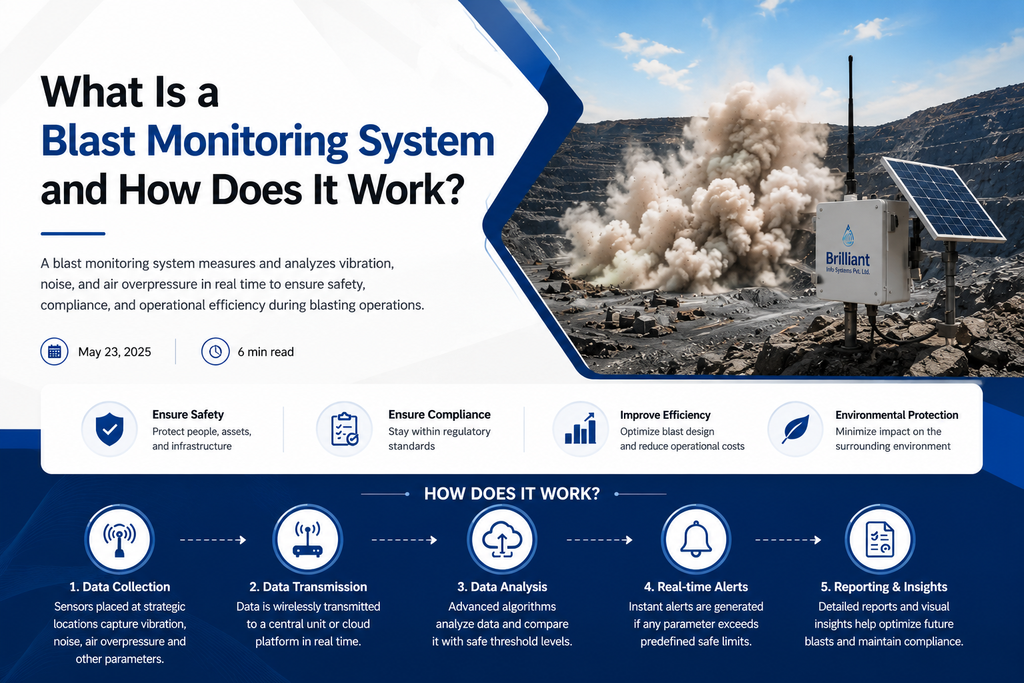
This guide explains what mining blast monitoring is, why it matters, how it works, and the equipment and parameters involved.
Table of Contents
- What is blast vibration monitoring?
- Why it matters
- How it works
- Blast monitoring equipment
- Key parameters measured
- Benefits and best practices
- FAQs and conclusion
What Is Blast Vibration Monitoring?
Blast vibration monitoring is the practice of measuring the ground vibrations and air pressure produced when explosives are detonated. Using specialised sensors, a monitoring system records how strongly the ground moves at nearby locations and compares those readings against regulatory limits.
The goal is simple: allow productive blasting while protecting people, buildings, and the environment around the site. A good monitoring system turns each blast into hard data, replacing guesswork and disputes with objective evidence.
Why Blast Monitoring Matters
Uncontrolled ground vibrations can crack walls, damage foundations, and unsettle communities near a mine or quarry. Because vibration travels through rock and soil, even a blast deep inside a site can be felt by residential structures some distance away.
Monitoring matters for three reasons: safety, keeping vibration below levels that could damage nearby property; compliance, proving to regulators that blasts stay within legal limits; and trust, giving operators objective data to answer community complaints fairly. Without vibration monitoring, a single dispute can halt operations.
How Blast Vibration Monitoring Works
The process follows a clear chain from the blast to a compliance report:
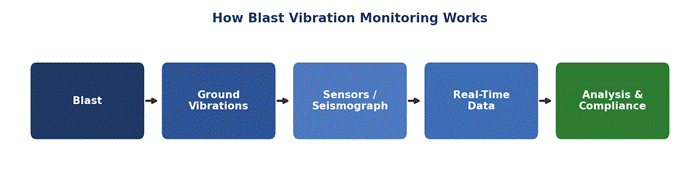
When a blast is detonated, it sends ground vibrations and an air pressure wave outward. Monitoring equipment — typically a seismograph with a geophone and a microphone — placed near the point of concern detects these signals. The readings are captured as real-time data, then analysed against the applicable vibration limits to confirm the blast was within safe bounds and to generate a compliance record.
Blast Monitoring Equipment
The core of any setup is the blast monitoring equipment. A seismograph is the main instrument: it combines a geophone, which measures ground movement in three directions, with a microphone that captures air overpressure. Modern units connect to networks and, increasingly, to IoT sensors that stream readings automatically to a central platform.
Units may be attended (an operator present for a single blast) or unattended and permanently installed for continuous, real-time monitoring at sensitive locations such as the boundary nearest homes. Placement matters: sensors are positioned at the structures or areas most at risk, not just at the blast itself.
Key Parameters Measured
Blast monitoring focuses on a few well-defined measurements that together describe the blast’s impact:
| Parameter | What it measures |
| Peak Particle Velocity (PPV) | How fast the ground moves — the key measure of vibration intensity |
| Frequency | How rapidly the ground oscillates, in hertz; low frequencies are riskier for buildings |
| Air overpressure | The pressure wave (air blast) that can rattle windows and be heard as noise |
| Displacement | How far the ground actually shifts during the blast |
Of these, peak particle velocity (PPV) is the headline figure most regulations are built around, usually assessed alongside frequency, because the same PPV can be more or less damaging depending on how fast the ground oscillates.
Benefits and Best Practices
Effective blast vibration monitoring delivers clear benefits: it prevents damage to nearby structures, keeps operations compliant, reduces disputes, and provides data to refine blast design so future blasts are both safer and more efficient.
Best practice is straightforward. Place monitors at the nearest or most sensitive structures, know the vibration limits that apply in your area, keep instruments calibrated, and record every blast — not just the ones you expect to be large. Continuous, real-time monitoring at fixed points gives the strongest protection and the clearest evidence trail.
Conclusion
Blast vibration monitoring is what allows mining and quarrying to blast productively without harming the communities and structures nearby. By measuring ground vibrations and air overpressure with the right equipment and comparing them to safe limits, operators protect property, stay compliant, and build trust.
As sensors and connectivity improve, real-time monitoring systems are making this easier and more reliable than ever — turning every blast into clear, defensible data.
Talk to Brilliant Info Systems About Monitoring
Brilliant Info Systems builds connected monitoring solutions powered by IoT and smart sensors with real-time data and analytics. If you need reliable, connected sensor-based monitoring, contact our team to discuss your requirements.
Frequently Asked Questions
What is blast vibration monitoring?
It is the measurement of ground vibrations and air overpressure produced by blasting, using sensors such as seismographs, to ensure blasts stay within safe and legal limits for nearby structures.
What equipment is used for blast monitoring?
The main instrument is a seismograph, combining a geophone to measure ground movement with a microphone to measure air overpressure. Modern systems connect to networks and IoT platforms for real-time data.
What is PPV in blast monitoring?
PPV, or peak particle velocity, measures how fast the ground moves during a blast. It is the key indicator of vibration intensity and the figure most regulatory limits are based on, usually alongside frequency.
Why is blast monitoring important?
It protects nearby residential structures from damage, proves regulatory compliance, and gives operators objective data to resolve community complaints — allowing blasting to continue safely and productively.
Can blast monitoring be done in real time?
Yes. Unattended monitoring systems with connected sensors can capture and report vibration data in real time, alerting operators immediately if a blast approaches or exceeds set limits.