
RTLS in Hospitals: Tracking Wheelchairs, Beds and Equipment
Ask any nurse what wastes their time, and “looking for equipment” will be near the top of the list. A missing wheelchair, a bed that cannot be found, an infusion pump hidden in the wrong ward — every search pulls staff away from patients. Real time location systems rtls solve this by giving hospitals live visibility of where every mobile asset is, the moment they need it.
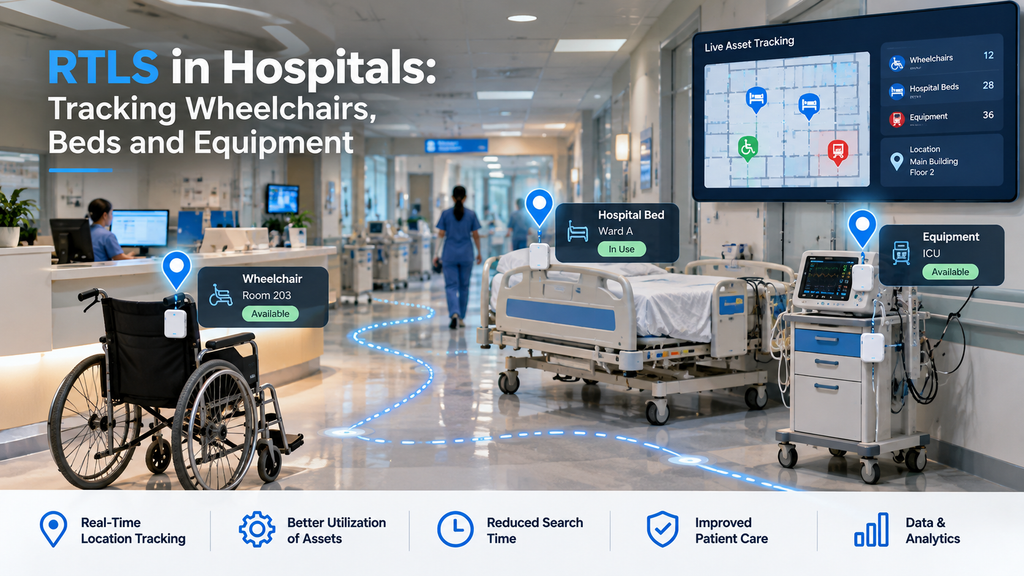
This guide explains how RTLS works in hospitals for tracking wheelchairs, beds, and equipment — the problems it solves, the technologies behind it, and the real benefits for staff and patients alike.
▶ Watch: Brilliant Info Systems on YouTube
What You’ll Learn
- The hidden cost of lost hospital equipment
- How RTLS tracks wheelchairs, beds, and equipment
- The technologies behind hospital RTLS
- The benefits for staff and patients
The Hidden Cost of Lost Equipment
Hospitals run on mobile assets — wheelchairs, hospital beds, infusion pumps, monitors, and hundreds of other devices that move constantly between wards. Because they move, they go missing. Studies repeatedly show nurses can spend a large part of each shift simply hunting for equipment, and the costs add up fast.
The search time itself is only the start. When staff cannot find a device, hospitals over-purchase “just in case,” so expensive equipment sits idle in one ward while another runs short. Time spent searching is time not spent on care, and every delayed wheelchair or missing pump chips away at the patient experience. Strong asset management is the answer, and RTLS is what makes it possible.
How RTLS Tracks Hospital Assets
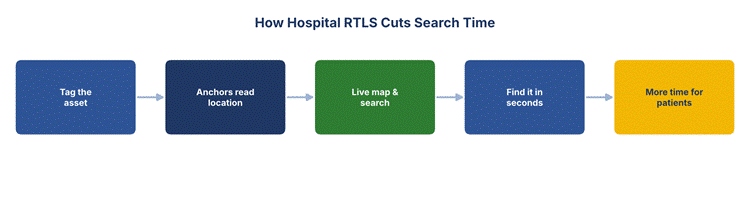
The idea is simple. A small tag is attached to each asset, and fixed receivers (anchors) around the hospital pick up each tag’s signal and report its position to a central system. Staff then see every tagged item on a live map and can find it in seconds. The flow is the same for any mobile asset:
- Tag the asset: A durable tag goes on each wheelchair, bed, or pump.
- Read the location: Anchors throughout the building capture each tag’s signal continuously.
- Show it live: The tracking system plots every asset on a floor-plan map with real time visibility.
- Find it fast: Staff search the app by asset type and go straight to it — no ward-by-ward hunt.
Because the location data updates continuously, the map always reflects reality, even as porters and nurses move assets around the clock.
What Hospitals Track with RTLS
Almost any mobile asset benefits, but a few are the usual starting points:
| Asset | The Problem | What RTLS Delivers |
| Wheelchairs | Vanish across departments | Instantly locate the nearest free one |
| Hospital beds | Hard to find when wards are full | See available beds in real time |
| Infusion pumps | High-value, often hoarded | Track every pump, cut over-buying |
| Monitors & devices | Shared across teams | Know location and availability at a glance |
Tracking an infusion pump is a classic example: these are expensive, move everywhere, and are frequently “hoarded” on wards. With equipment tracking, a hospital can see every pump, rebalance stock, and often avoid buying more at all.
The Technologies Behind Hospital RTLS
Several rtls technologies can power a hospital deployment, and the right choice depends on how precisely you need to locate assets and your budget.
Bluetooth Low Energy (BLE)
Bluetooth Low Energy BLE is the most common choice for hospitals. BLE tags are small, inexpensive, and have excellent battery life — often lasting years — which matters when you are tagging thousands of assets. It typically gives room-level or zone-level accuracy, which is plenty for finding a wheelchair or pump.
Ultra-Wideband (UWB)
Where a hospital needs to know an asset’s position to the exact bay or bed, UWB delivers centimetre-level accuracy. It costs more per tag and anchor, so it is often used for the highest-value or most safety-critical equipment.
Wi-Fi and Hybrid Setups
Some hospitals use their existing wi fi network as a starting point for coarse location, then add BLE or UWB where more accuracy is needed. Many real deployments mix technologies on one RTLS and RFID platform, choosing the right tool for each asset and area, all fed by reliable IoT sensors.
The Benefits for Staff and Patients
The payoff of a hospital RTLS reaches every part of the organisation:
- Less search time: Staff find equipment in seconds, freeing more time for patient care.
- Lower costs: Better use of existing assets means less over-purchasing and renting.
- Better utilisation: Usage data shows which assets are overstocked and which are in short supply, improving inventory visibility.
- Improved patient experience: Faster access to a wheelchair or bed means less waiting and smoother journeys through the hospital.
- Maintenance and hygiene: Tracking helps ensure devices are serviced and cleaned on schedule, supporting compliance.
In short, more time for patient care and less time hunting for equipment — the single clearest return an rtls solution offers a hospital.
Beyond Finding Equipment
Once a hospital has an RTLS in place, the same infrastructure can do far more than locate a wheelchair. The anchors and platform that track assets can also support a range of other uses, often with only software changes:
- Utilisation analytics: Historic location data shows how often each asset is used and where it spends its time, guiding smarter purchasing decisions.
- Maintenance scheduling: Knowing exactly where a device is makes it easy to pull it for servicing or cleaning on schedule, which matters for infection control.
- Theft and loss prevention: Alerts fire if a high-value asset leaves a defined area, protecting costly equipment from walking out of the building.
- Workflow insights: Movement patterns reveal bottlenecks — for example, where patients wait too long for transport — so processes can be improved.
This is why many hospitals treat RTLS as a platform investment rather than a single-purpose tool: the first use case pays for the infrastructure, and the rest follow at little extra cost.
Getting Started with Hospital RTLS
The most successful hospital deployments start small and prove value before scaling. A sensible path is to pick one high-impact asset type — wheelchairs or infusion pumps are popular first choices because their loss is felt daily — and roll out tracking in one or two departments first.
From there, measure the results: how much search time was saved, how utilisation improved, and how staff responded. With evidence in hand, the hospital can expand the tracking system to more asset types and more wards with confidence. Choosing an experienced partner matters, because good anchor placement and the right mix of technologies are what determine whether the system delivers reliable accuracy across a complex, busy building.
Conclusion
In a hospital, time is the most precious resource there is, and too much of it is lost searching for equipment. RTLS gives staff real time visibility of every wheelchair, bed, and pump, turning minutes of hunting into seconds of searching. The result is lower costs, better-used assets, and — most importantly — more time for patients. For any hospital serious about efficiency and care, asset tracking with RTLS is one of the highest-impact investments available.
Brilliant Info Systems designs RTLS deployments for hospitals and healthcare facilities, tracking wheelchairs, beds, and equipment on one platform. Explore our asset tracking solutions or talk to our team to plan a system for your facility.
Frequently Asked Questions
What is RTLS in a hospital?
RTLS (a real time location system) is technology that tracks the live location of mobile assets — wheelchairs, beds, infusion pumps, and more — using tags and fixed receivers. Staff see every tagged item on a live map and can find it in seconds.
How does RTLS reduce the time nurses spend searching?
Instead of walking ward to ward looking for a device, staff search the system by asset type and go straight to the nearest available one. This cuts search time dramatically and returns that time to patient care.
Which technology is best for hospital asset tracking?
Bluetooth Low Energy (BLE) suits most hospital needs — it is low-cost with long battery life and room-level accuracy. UWB is used where centimetre-level precision is needed. Many hospitals combine both on one platform.
Can RTLS track high-value equipment like infusion pumps?
Yes — infusion pumps are one of the most common and valuable things hospitals track. RTLS shows every pump’s location, helps rebalance stock across wards, and often removes the need to buy more.