
How AI Vision Improves Quality Inspection in Manufacturing
Quality inspection has always faced an impossible trade-off. Inspect every item by hand and you get accuracy but not speed; inspect by sampling and you get speed but let defects slip through. Even traditional machine vision, for all its value, could only catch the specific defects it was explicitly programmed to find. AI vision changes this equation entirely.
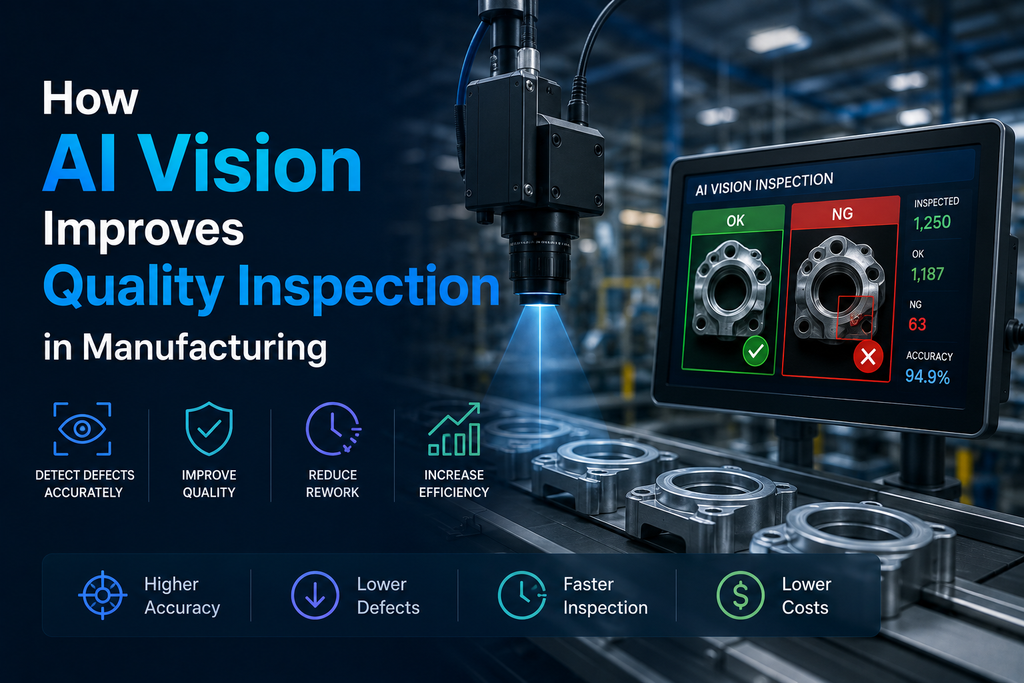
By combining high-resolution cameras with artificial intelligence, AI vision can inspect every product at line speed and learn to spot defects a rule-based system would miss. This guide explains how AI vision improves quality inspection in manufacturing processes, how the technology works, and the benefits it brings to the shop floor. It builds on our automated quality inspection solutions.
▶ Watch: AI Quality Inspection
Table of Contents
- What is AI vision?
- Traditional vs AI vision inspection
- How AI vision works
- Key benefits
- Applications on the shop floor
- How to implement it
- Challenges and the future
- FAQs and conclusion
What Is AI Vision in Quality Inspection?
AI vision — also called AI-powered machine vision or computer vision — is the use of artificial intelligence to interpret images from cameras and decide whether a product meets quality standards. Instead of a person or a rigid rule-based system checking each item, AI models analyse high-resolution images and flag defects automatically.
The key difference from traditional machine vision is learning. Rather than being hand-programmed with every rule, AI vision systems are trained on example images of good and defective products. Using machine learning and deep learning, they learn what a defect looks like — including subtle or unusual ones — and get better over time. This is automated visual inspection that adapts, rather than simply following fixed instructions.
Traditional vs AI Vision Inspection
It helps to see how AI vision compares with the manual checks and rule-based systems it improves upon:
| Aspect | Traditional inspection | AI vision inspection |
| Method | Manual checks or rule-based machine vision | AI powered, self-learning models |
| Defect types | Only pre-programmed, known defects | Learns subtle and novel defects |
| Consistency | Varies with fatigue and operator | Consistent 24/7 |
| Speed | Limited by human pace | High-speed, real-time |
| Setup | Heavy programming required | Train models on example images |
Traditional rule based systems still have their place for simple, well-defined checks. But where defects are varied, subtle, or hard to describe in rules, AI vision’s ability to learn from examples is transformative.
How AI Vision Inspection Works
An AI vision system follows a clear sequence, from capturing an image to acting on the result:
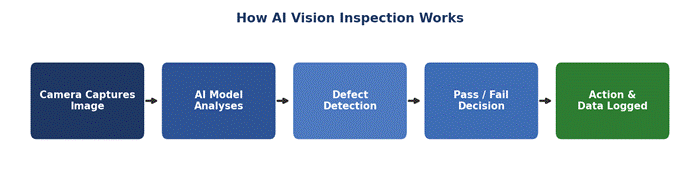
A high resolution camera captures an image of each product as it passes; the trained AI model analyses that image; defect detection identifies any flaws and where they are; the system makes a pass or fail decision; and the result triggers an action — rejecting the item, alerting an operator, or logging the data for SPC/SQC analysis. All of this happens in a fraction of a second, with little or no human intervention.
The Key Benefits of AI Vision
The benefits of AI vision for quality inspection are substantial and reach across the operation:
- Higher accuracy: AI catches subtle and novel defects that humans and rule-based systems miss.
- 100% inspection: every item is checked, not just a sample.
- Consistency: no fatigue, distraction, or variation between shifts.
- Speed: inspection keeps pace with high-speed production lines.
- Less manual effort: staff move from repetitive checking to higher-value work.
- Data and traceability: every inspection is recorded for quality control and improvement.
Applications on the Shop Floor
AI vision is used across manufacturing wherever quality matters. It inspects surface finish, welds, and assembly completeness; verifies labels, prints, and packaging; checks electronic components for tiny faults; and confirms correct assembly before products ship. It also extends beyond the product itself — related computer-vision systems handle pick validation, PPE detection for safety, and dock monitoring — showing how the same AI technology improves quality and operations together.
How to Implement AI Vision Inspection
Rolling out AI vision works best as a focused, staged project. Start with a high-impact inspection point where defects are costly or hard to catch manually. Fit suitable high-resolution cameras and lighting, then collect and label example images of good and defective parts to train models. Validate the system against known samples, integrate its decisions into your line and quality workflow, and refine as it sees more products.
Connecting the results to your MES, OEE monitoring, and ERP turns inspection data into a driver of continuous improvement across the whole operation.
Challenges to Plan For
AI vision is powerful but needs planning. It requires good training data — enough labelled images of defects to learn from — plus proper cameras and consistent lighting. Building and validating models takes expertise, and the system must be integrated into the line to act on its decisions. Starting with one well-chosen application, proving the value, and scaling from there keeps these challenges manageable.
The Future of AI Vision in Manufacturing
AI vision is advancing quickly. Models are becoming more capable and easier to train with less data, edge devices are running inspection directly on the line for instant decisions, and systems increasingly explain why they flagged a defect. As part of the smart factory, AI vision will keep merging with wider AI technology to make quality inspection faster, smarter, and almost entirely automated.
Conclusion
AI vision solves the old trade-off between inspection speed and accuracy. By combining high-resolution cameras with self-learning AI models, it inspects every product at line speed and catches defects that traditional quality methods let slip — with little human intervention.
As AI technology matures, automated visual inspection is fast becoming a standard part of the modern shop floor. The key is to start with a high-impact application, train the models well, and integrate the results into your quality and production systems.
Improve Quality Inspection with Brilliant Info Systems
Brilliant Info Systems designs and integrates AI-powered quality inspection and machine-vision solutions — connected to your manufacturing systems, SPC/SQC, and OEE monitoring. Contact our team to bring AI vision to your shop floor.
Frequently Asked Questions
What is AI vision in manufacturing?
AI vision uses artificial intelligence and cameras to inspect products automatically, analysing high-resolution images with machine learning to detect defects — going beyond the fixed rules of traditional machine vision.
How does AI vision improve quality inspection?
It inspects every item at line speed, catches subtle and novel defects that rule-based systems miss, stays consistent around the clock, and records every check for traceability and continuous improvement.
What is the difference between AI vision and traditional machine vision?
Traditional machine vision follows hand-programmed rules and only catches known defects. AI vision learns from example images using deep learning, so it can identify subtle and previously unseen defects and improve over time.
Does AI vision require programming?
Far less than traditional systems. Instead of heavy programming of rules, AI vision is trained on example images of good and defective products, then refined — making it faster to deploy for complex inspections.
What defects can AI vision detect?
It can detect surface flaws, cracks, scratches, missing components, assembly errors, label and print faults, and packaging defects — including subtle issues that are hard to define with fixed rules.
Is AI vision worth it for manufacturers?
For operations where quality is critical or manual inspection is slow and inconsistent, yes. The gains in accuracy, speed, and full inspection coverage typically justify the investment, especially when started at one high-impact point.