
Predictive Maintenance Using Industrial IoT: A Practical Guide
Unplanned equipment failure is one of the most expensive events in any industrial operation. A single critical machine going down can halt a whole line, blow through the maintenance budget, and wreck a delivery schedule — all without warning. For decades, the only defences were to fix things after they broke or to service everything on a fixed schedule, whether it needed it or not. Industrial IoT offers a smarter third way: predictive maintenance.

Predictive maintenance uses IoT sensors and data to watch equipment health in real time and predict failures before they happen — so you fix the right machine at the right moment. This practical guide explains what predictive maintenance is, how the industrial internet of things (IIoT) enables it, how to build a predictive maintenance system, and how to implement it successfully.
▶ Watch: Machine Monitoring
Table of Contents
- What is predictive maintenance?
- Maintenance strategies compared
- Why it matters
- How IIoT enables it
- How it works
- The technology stack
- Key techniques
- Why data quality matters
- Implementing predictive maintenance
- Benefits, challenges and the future
- FAQs and conclusion
What Is Predictive Maintenance?
Predictive maintenance (PdM) is a maintenance strategy that uses real-time condition data to predict when equipment is likely to fail, so it can be serviced just before that happens. Instead of guessing based on a calendar or waiting for a breakdown, PdM listens to what the machine itself is telling you through sensor data. In practice it means continuous, real time monitoring of equipment, with real time data flowing from the machine to analytics that never stop watching.
The idea is simple but powerful: every machine gives off signals — vibration, temperature, noise, current draw — that change subtly as components wear. By continuously monitoring these signals and comparing them against normal operating conditions, a predictive maintenance system can spot trouble developing and raise the alarm while there is still time to act.
Maintenance Strategies Compared
To see why predictive maintenance is such a leap, it helps to compare the three main approaches:
| Strategy | How it works | Trade-off |
| Reactive | Fix equipment after it breaks | Cheapest to start, most costly downtime |
| Preventive | Service on a fixed schedule | Reduces failures but over-maintains |
| Predictive | Service based on real condition data | Highest value; needs sensors and data |
Reactive maintenance is simple but gambles on failure. Preventive maintenance is safer but wasteful, often replacing parts with plenty of life left. Predictive maintenance targets service precisely where and when it is needed — capturing most of the benefit of both while avoiding their biggest costs.
Why Predictive Maintenance Matters
The business case for PdM is compelling. Unplanned downtime is enormously expensive once you count lost production, emergency labour, expedited parts, and missed orders. Predictive maintenance attacks all of these by turning surprise failures into planned, scheduled work.
It also cuts maintenance costs directly. By servicing based on real condition rather than a fixed schedule, you stop over-maintaining healthy equipment and avoid the collateral damage a sudden failure can cause to surrounding components. Over time, this extends asset life and smooths out both spending and staffing.
Which Equipment Benefits Most from Predictive Maintenance
Predictive maintenance delivers the greatest return on assets that are critical, expensive, or prone to sudden failure. Rotating equipment such as motors, pumps, fans, compressors, and gearboxes is ideal, because wear shows up clearly in vibration and temperature data long before failure. So are assets whose downtime stops a whole line, and machines where a breakdown creates a safety risk.
It is usually not worth instrumenting every low-value, easily replaced item. The art is to focus first on the handful of assets where a predicted failure saves the most money and disruption, then expand once the approach has proven itself. Starting narrow keeps the investment sensible and the results easy to measure.
How Industrial IoT Enables Predictive Maintenance
Predictive maintenance is not new as an idea — what makes it practical today is the industrial internet of things (IIoT). Cheap, reliable smart sensors can now be attached to almost any machine, and connectivity lets their data flow continuously to a central platform for analysis.
This is the same connected foundation behind smart manufacturing and IIoT in warehousing. Without IIoT, gathering enough real-time data to predict failures at scale was simply too expensive. With it, real-time monitoring of an entire fleet of machines becomes affordable and routine. A single technician can now oversee the health of hundreds of assets from a dashboard, with the system flagging only those that need attention — a complete reversal of the old model where problems were found by chance or on a fixed inspection round.
How Predictive Maintenance Works
A predictive maintenance system follows a clear pipeline, from the sensor on a motor to the alert on a technician’s phone:
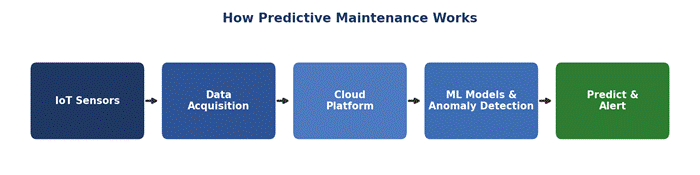
First, IoT sensors capture condition data such as vibration and temperature. Data acquisition digitises and collects it, and connectivity carries it to a cloud platform. There, the data is stored as time series data and fed to machine learning models, which identify patterns and detect anomalies that signal developing faults. When something looks wrong, the system predicts the likely failure and alerts the team — ideally with enough lead time to plan the repair.
The Predictive Maintenance Technology Stack
Several layers work together to make this possible. Understanding them helps when planning a deployment:
| Layer | Role in the predictive maintenance system |
| IoT sensors | Capture vibration, temperature, current, and more |
| Data acquisition | Collect and digitise sensor data reliably |
| Connectivity | Carry data from machines to the platform |
| Cloud platform | Store and process large volumes of time series data |
| Machine learning models | Identify patterns and predict equipment failures |
| Dashboards & alerts | Turn predictions into action for the team |
These layers often connect to control systems such as PLC and HMI and use standards like OPC UA to gather data, with cloud computing providing the storage and processing power for large-scale data collection and analysis.
Key Techniques Behind the Predictions
The intelligence of predictive maintenance lives in how it analyses data. A few core techniques do the heavy lifting:
- Anomaly detection: spotting readings that deviate from normal operating conditions, often the first sign of a developing fault.
- Time series analysis: tracking how sensor data changes over time to reveal gradual wear and trends.
- Machine learning models: learning each machine’s normal behaviour and predicting when it is heading toward failure.
- Pattern recognition: using historical failure data to identify patterns that precede specific breakdowns.
Together, these turn raw sensor streams into reliable predictive models — the difference between simply monitoring a machine and genuinely predicting its future.
Why Data Quality Matters
A predictive maintenance system is only as good as the data feeding it. Poor data quality — gaps, noise, wrong sensor placement, or inconsistent sampling — leads to false alarms or, worse, missed failures. Getting data acquisition right is therefore not a detail but a foundation.
That means choosing the right sensors for each failure mode, placing them correctly, sampling at an appropriate rate, and cleaning the data before it reaches the models. Time spent on data quality up front pays back many times over in the accuracy of the predictions that follow. It is also worth investing in consistent data collection standards across assets, so models can be trained and compared reliably. A small amount of clean, well-labelled data usually beats a large amount of noisy data — quality genuinely matters more than quantity here.
Implementing Predictive Maintenance: A Step-by-Step Approach
Implementing predictive maintenance works best as a staged journey rather than a big-bang project. Rushing to instrument an entire plant at once tends to overwhelm both the budget and the team, and it delays the moment you can show results. A focused, staged approach lets you learn, prove value, and build internal confidence before scaling. A practical sequence looks like this:
- Identify critical assets — start with the machines whose failure hurts most.
- Define failure modes — understand how each asset typically fails and what signals precede it.
- Select and fit the right IoT sensors for those failure modes.
- Set up reliable data acquisition and connectivity to a central platform.
- Collect baseline data to learn each machine’s normal operating conditions.
- Build and train machine learning models to detect anomalies and predict failures.
- Integrate alerts into your maintenance workflow so predictions drive action.
- Start with a pilot, prove the value, then scale across more assets.
Integrating the results with your OEE monitoring, ERP, and even a digital twin of the equipment turns predictive maintenance from a standalone tool into part of a connected, self-optimising operation.
The Benefits of Predictive Maintenance
Done well, predictive maintenance delivers gains that reach across the operation:
- Less unplanned downtime: failures are caught and planned for in advance.
- Lower maintenance costs: service is done only when genuinely needed.
- Longer asset life: problems are fixed before they damage surrounding components.
- Safer operations: catastrophic failures and the hazards they create are avoided.
- Better planning: maintenance and production can be scheduled around predictions.
- Data-driven decisions: real condition data replaces guesswork and rules of thumb.
Predictive Maintenance Use Cases Across Industries
The same core approach adapts to many settings. In manufacturing, PdM watches motors, pumps, and CNC machines to keep production lines running. In warehousing and logistics, it monitors conveyors, sortation systems, and material-handling equipment whose failure would stall fulfilment. In energy and utilities, it protects turbines, transformers, and pumps where downtime is extremely costly. In facilities and HVAC, it keeps critical building systems reliable.
Across all of these, the pattern is identical: sensors capture condition data, analytics identify patterns that precede failure, and teams act on early warning. Only the specific assets and failure modes change from one industry to the next.
The ROI of Predictive Maintenance
The return on predictive maintenance comes from several directions at once. The largest is almost always avoided downtime — a single prevented failure on a critical line can pay for an entire deployment. On top of that sit lower maintenance costs from servicing only when needed, reduced spare-parts spend, longer asset life, and fewer safety incidents.
A simple way to build the business case is to estimate the cost of one hour of downtime on a critical asset, multiply by the hours of unplanned downtime you currently suffer, and compare that against the cost of instrumenting and monitoring those assets. For most critical equipment, the numbers favour predictive maintenance within the first year or two — which is why it is one of the most widely adopted applications of the industrial internet of things.
Challenges to Plan For
Predictive maintenance is powerful but not effortless. It requires an up-front investment in sensors, connectivity, and software, and a clear business case to justify it. Building accurate machine learning models takes good data and expertise. Integrating with older equipment can be complex, and the organisation has to be ready to act on predictions rather than ignore them. None of these is a barrier — they are simply factors to plan for, ideally starting small and scaling as confidence grows.
Predictive Maintenance vs Condition Monitoring
A common point of confusion is the difference between condition monitoring and predictive maintenance. Condition monitoring simply measures and reports an asset’s current state — showing, for example, that a bearing is running hot right now. Predictive maintenance goes a step further: it uses that condition data, together with history and machine learning models, to forecast when a failure is likely to occur and how long you have to act.
Put simply, condition monitoring tells you what is happening, while predictive maintenance tells you what is about to happen. Condition monitoring is an essential input, but on its own it still leaves a human to interpret every reading. Predictive maintenance adds the intelligence that turns a stream of measurements into a clear, forward-looking recommendation — which is what makes it so much more valuable at scale.
Common Pitfalls to Avoid
Teams new to predictive maintenance tend to stumble in a few predictable ways. The first is trying to instrument everything at once, which overwhelms both budget and analysis; starting with a few critical assets is far more effective. The second is neglecting data quality, then wondering why the predictions are unreliable. The third is treating PdM as a purely technical project and forgetting the human side — if alerts are not built into the maintenance workflow and trusted by technicians, even perfect predictions get ignored. Avoiding these traps is usually the difference between a pilot that scales and one that quietly fades away.
The Future of Predictive Maintenance
Predictive maintenance is advancing quickly as AI, edge computing, and IIoT mature. Models are becoming more accurate and easier to deploy, edge devices are running analytics directly on the machine for instant response, and prescriptive maintenance — which not only predicts a failure but recommends the fix — is emerging. As these capabilities spread, condition-based, data-driven maintenance is set to become the norm across industry rather than the exception.
Conclusion
Predictive maintenance using Industrial IoT turns maintenance from a cost and a gamble into a source of reliability and savings. By listening to what machines are telling you through sensor data — and using machine learning to predict equipment failures before they happen — you can fix the right machine at the right time, every time.
The technology is now affordable and proven. The key is to start with your most critical assets, get the data right, and scale from a successful pilot. Done well, predictive maintenance is one of the highest-return applications of the industrial internet of things available today.
Build Predictive Maintenance with Brilliant Info Systems
Brilliant Info Systems designs and integrates predictive maintenance solutions powered by IoT sensors and analytics — connected to your manufacturing systems, OEE monitoring, and ERP. Contact our team to predict failures before they happen and keep your equipment running.
Frequently Asked Questions
What is predictive maintenance using Industrial IoT?
It is a maintenance strategy that uses IIoT sensors and data analytics to monitor equipment health in real time and predict failures before they happen, so machines are serviced just in time rather than too early or too late.
How does predictive maintenance work?
IoT sensors capture condition data, which is collected and sent to a platform where machine learning models detect anomalies and identify patterns that signal developing faults, then alert the team to act before failure occurs.
What is the difference between preventive and predictive maintenance?
Preventive maintenance services equipment on a fixed schedule regardless of condition, while predictive maintenance services it based on real-time condition data — avoiding both unnecessary work and unexpected breakdowns.
What sensors are used in predictive maintenance?
Common IoT sensors measure vibration, temperature, current, pressure, and acoustic signals — chosen to match the specific failure modes of each machine being monitored.
Why is data quality important in predictive maintenance?
Because predictions are only as reliable as the data behind them. Poor data quality causes false alarms or missed failures, so correct sensor placement, sampling, and clean data acquisition are essential.
Is predictive maintenance worth the investment?
For operations with critical or costly equipment, usually yes. The savings from reduced downtime, lower maintenance costs, and longer asset life typically justify the investment, especially when rolled out in stages.