
Warehouse Inventory Management Best Practices: 15 Strategies
Inventory is the beating heart of any warehouse — and one of the easiest things to get wrong. When stock records drift out of line with reality, the whole operation suffers: stockouts, overstocking, slow order fulfilment, and staff wasting hours hunting for goods. The good news is that inventory management is a discipline, not a mystery, and a handful of proven practices make an enormous difference.
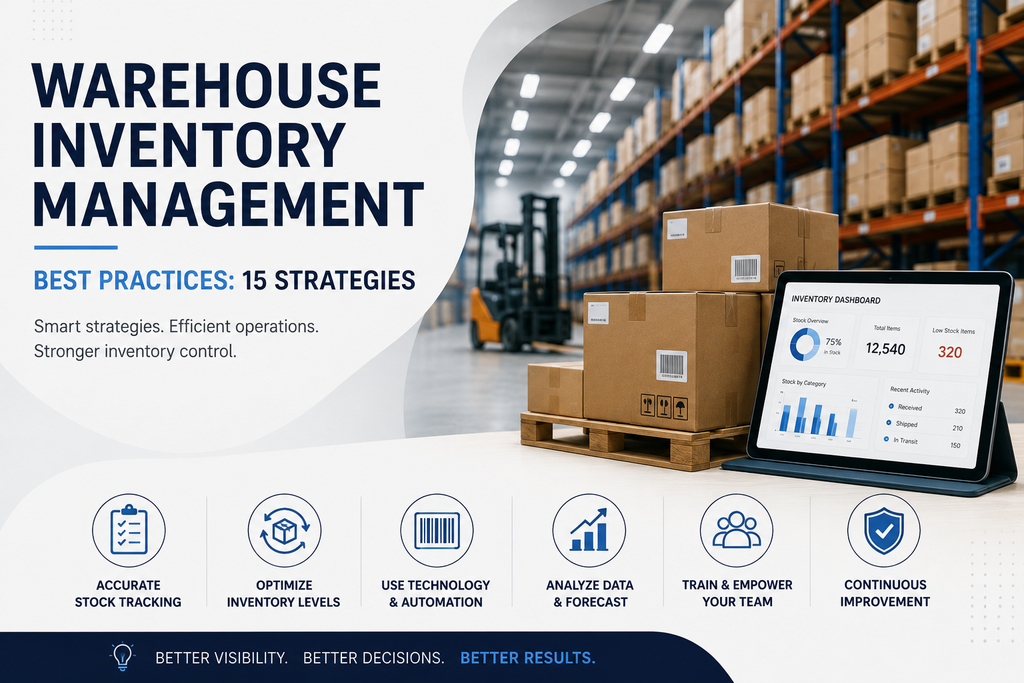
This guide brings together 15 warehouse inventory management best practices — practical strategies you can apply to improve accuracy, cut costs, and run a leaner, faster operation. Some are quick wins; others are longer-term investments. Together, they form a playbook for keeping inventory under control as your business grows.
▶ Watch: Warehouse Management System (WMS)
Why Inventory Best Practices Matter
Poor inventory management is expensive in ways that are easy to miss. Cash gets tied up in excess stock, sales are lost to stockouts, and labour is wasted on manual counts and searches. Strong practices reverse all of this — freeing capital, protecting sales, and letting the same team handle far more volume. Beyond the direct costs, poor inventory data erodes trust: sales teams stop believing the system, customers receive late or wrong orders, and planning becomes guesswork. Strong practices rebuild that trust with data everyone can rely on. In short, disciplined inventory management is one of the highest-return areas a warehouse manager can focus on.
The 15 Strategies at a Glance
Here is a quick overview before we explore each strategy in detail:
| # | Strategy | Focus |
| 1 | Use a Warehouse Management System | The single highest-impact move |
| 2 | Adopt Barcode or RFID Tracking | Automate data capture |
| 3 | Optimise Your Warehouse Layout | Cut wasted travel |
| 4 | Implement Cycle Counting | Keep counts accurate |
| 5 | Use ABC Analysis | Focus effort where it matters |
| 6 | Set Accurate Reorder Points | Avoid stockouts and overstock |
| 7 | Improve Demand Forecasting | Stock the right amount |
| 8 | Maximise Space Utilisation | Use every cubic metre |
| 9 | Standardise Receiving and Put-Away | Stop errors at the dock |
| 10 | Optimise Pick, Pack, and Ship | Speed up fulfilment |
| 11 | Keep Real-Time Inventory Visibility | Work from current numbers |
| 12 | Reduce Dead and Excess Stock | Free up cash and space |
| 13 | Train and Empower Your Team | People make it work |
| 14 | Use Data and KPIs to Improve | Measure to manage |
| 15 | Automate Where It Pays | Amplify every practice |
15 Warehouse Inventory Management Best Practices
Now let’s look at each strategy and how to apply it.
1. Use a Warehouse Management System
A WMS is the foundation of good inventory management. It tracks every item’s location and quantity in real time, directs put-away and picking, and replaces guesswork with accurate data. Rather than managing inventory on spreadsheets, warehouse managers get a single source of truth that keeps stock levels current and coordinates the whole operation. For most warehouses, adopting inventory management software is the highest-impact strategy of all.
2. Adopt Barcode or RFID Tracking
Manual data entry is slow and error-prone. Barcode scanners and RFID let staff capture stock movements automatically and accurately, keeping inventory records in step with reality. RFID goes further, reading many items at once without line of sight for real-time visibility. Automated data capture is what makes every other inventory practice reliable, because decisions are only as good as the data behind them.
3. Optimise Your Warehouse Layout
A smart warehouse layout cuts wasted travel and speeds up work. Place fast-moving items near packing and dispatch, group related products, and keep clear, logical aisles. Good slotting reduces the time staff spend walking and searching, improving both accuracy and order fulfilment. Reviewing and refining the layout as your product mix changes keeps the warehouse efficient over the long term.
4. Implement Cycle Counting
Instead of shutting down for a huge annual stocktake, count small portions of inventory regularly. Cycle counting spreads the effort across the year, catches discrepancies early, and keeps inventory counts accurate without disrupting operations. Focusing counts on high-value or fast-moving items first delivers the most benefit, and frequent counts keep accuracy consistently high rather than letting it drift.
5. Use ABC Analysis
Not all stock deserves equal attention. ABC analysis ranks items by value or sales velocity — A items are the vital few, C items the trivial many. Focusing tighter controls, more frequent counts, and better forecasting on your A items concentrates effort where it matters most. This simple prioritisation helps warehouse managers manage inventory efficiently without spreading resources too thin.
6. Set Accurate Reorder Points
A reorder point is the stock level that triggers a new order. Setting it correctly, based on demand and lead time, prevents both stockouts and overstocking. Too low and you run out; too high and cash sits idle on the shelf. Reviewing reorder points regularly, especially for seasonal items, keeps stock levels lean and reliable throughout the year.
7. Improve Demand Forecasting
Good inventory control starts with anticipating demand. Using historical data, seasonality, and market trends, demand forecasting helps you stock the right amount at the right time. Better forecasts mean fewer emergency orders, less dead stock, and smoother order fulfilment. Modern inventory management software can automate much of this, turning past patterns into forward-looking plans.
8. Maximise Space Utilisation
Warehouse space is expensive, so use it well. Going vertical with taller racking, narrowing aisles where safe, and using dense storage such as an automated storage and retrieval system all improve space utilisation. Better use of space can delay or avoid a costly move to a larger building, and it keeps goods organised and easy to find.
9. Standardise Receiving and Put-Away
Inventory accuracy begins at the dock. Standardised receiving — checking goods against the purchase order and recording them immediately — stops errors entering the system. Directed put-away then ensures each item goes to the right location. Consistent, well-documented processes here prevent the small mistakes that snowball into big discrepancies later on.
10. Optimise Pick, Pack, and Ship
The pick, pack, and ship process is where inventory turns into fulfilled orders. Optimised pick paths, batch picking, and scan verification speed up fulfilment while cutting errors. The faster and more accurately goods move out, the happier customers are — and the more clearly your inventory reflects what has actually shipped.
11. Keep Real-Time Inventory Visibility
Stock data that is a day old is a liability. Real-time visibility — powered by a WMS and automated data capture — lets everyone work from current numbers. Managers can spot low stock before it becomes a stockout, locate goods instantly, and make confident decisions. Live inventory tracking is the difference between reacting to problems and preventing them.
12. Reduce Dead and Excess Stock
Slow-moving and obsolete stock ties up cash and space. Regularly review inventory to identify items that are not selling, then discount, return, or repurpose them. Tackling excess stock frees capital and room for products that actually move. Preventing it in the first place, through better forecasting and reorder points, is even better.
13. Train and Empower Your Team
Even the best systems fail without a capable team. Train staff thoroughly on processes and technology, and give them clear responsibilities. When people understand why accuracy matters and how to use the tools, errors fall and productivity rises. A well-trained team is one of the most cost-effective inventory investments a warehouse can make.
14. Use Data and KPIs to Improve
What gets measured gets managed. Track key metrics — inventory accuracy, order accuracy, stock turnover, and fulfilment speed — and review them regularly. KPIs reveal where the operation is slipping and where it is improving, turning gut feel into evidence. Continuous, data-driven refinement is how good warehouses become great ones over the long term.
15. Automate Where It Pays
Automation amplifies every other best practice. Conveyors, automated storage and retrieval systems, and robotics handle repetitive work faster and more accurately than people can. The key is to automate where the return is clear — usually the biggest bottleneck first — then expand. Done well, automation lifts accuracy, throughput, and space utilisation all at once.
Bringing the Strategies Together
These 15 strategies reinforce one another. A warehouse management system and automated data capture provide the accurate, real-time data; smart layout, forecasting, and reorder points keep stock lean; and automation and a well-trained team turn that into speed and reliability. You do not need to adopt all 15 at once — start with the ones that address your biggest pain point, prove the results, and build from there.
Common Inventory Management Mistakes to Avoid
Applying these strategies also means avoiding the traps that undo them. The most common is relying on manual counts and spreadsheets long after volumes have outgrown them — accuracy simply cannot keep up. Others include counting stock only once a year, so errors accumulate unseen; ignoring dead stock until it clogs valuable space; and setting reorder points once and never revisiting them as demand shifts. Perhaps the biggest mistake is treating inventory management as a one-time project rather than an ongoing discipline. The warehouses that stay accurate are the ones that keep measuring, reviewing, and refining.
Conclusion
Great warehouse inventory management is not about a single silver bullet — it is the compound effect of many good practices working together. Accurate data, smart processes, lean stock levels, a capable team, and well-chosen automation combine to create an operation that is faster, cheaper, and far less stressful to run.
Start where the pain is greatest, measure the improvement, and keep refining. Applied consistently, these 15 strategies will keep your inventory under control and your warehouse ready to scale.
Optimise Your Inventory Management with Brilliant Info Systems
Brilliant Info Systems helps warehouses put these best practices into action — with warehouse management systems, RFID inventory solutions, and warehouse automation. Talk to our team to build a smarter, more accurate inventory operation.
Frequently Asked Questions
What is the most important warehouse inventory best practice?
Adopting a warehouse management system is usually the highest-impact step, because it gives you accurate, real-time inventory data that every other practice depends on. Without reliable data, other improvements are built on shaky ground.
How can I improve inventory accuracy in my warehouse?
Combine automated data capture (barcode or RFID), regular cycle counting, and standardised receiving and put-away. Together these keep records in step with reality and catch discrepancies early, before they grow.
What is ABC analysis in inventory management?
ABC analysis ranks stock by value or sales velocity, so you can focus tighter controls and more frequent counts on the most important items. It concentrates effort where it delivers the greatest return.
How does a WMS help with inventory management?
A WMS tracks every item’s location and quantity in real time, directs put-away and picking, and provides a single source of truth. It replaces spreadsheets and guesswork with accurate, live inventory data.
How do I reduce excess and dead stock?
Review inventory regularly to identify slow-moving items, then discount, return, or repurpose them. Better demand forecasting and accurate reorder points prevent excess stock from building up in the first place.
When should a warehouse invest in automation?
When a clear bottleneck justifies it — usually high-volume, repetitive work. Start with the process that hurts most, prove the return, then expand. Automation amplifies good inventory practices rather than replacing them.