
RFID Inventory Management System: A Guide to Real-Time Visibility
Most inventory problems come down to one thing: not knowing what you have and where it is, right now. With manual counts and barcode scans, your stock data is only truly accurate at the moment of counting — and drifts out of date the moment work resumes. For fast-moving warehouses and supply chains, that lag is expensive.
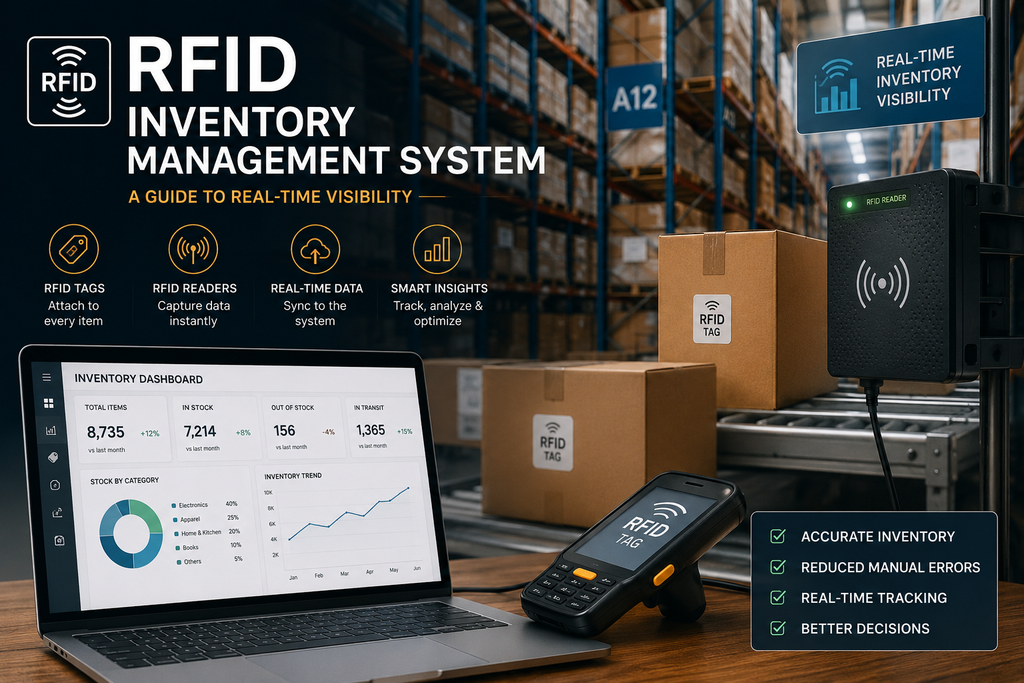
An RFID inventory management system removes the lag. By tagging items and reading them automatically as they move, it gives you continuous, real-time visibility of every unit in your operation. This guide explains what an RFID inventory system is, how it works, its components and benefits, and how to implement one. For a closer look at one key benefit, see our guide on how RFID improves inventory accuracy.
▶ Watch: RFID Inventory Management
Table of Contents
- What is an RFID inventory management system?
- How it works
- Key components
- How it delivers real-time visibility
- Benefits
- RFID vs traditional inventory
- Applications
- Implementation and integration
- Challenges and the future
- FAQs and conclusion
What Is an RFID Inventory Management System?
An RFID inventory management system uses radio frequency identification to track stock automatically and continuously. Each item, carton, or pallet carries an RFID tag, and fixed or handheld readers capture those tags as goods move — no manual scanning, no line of sight required.
The result is a live, always-current picture of your inventory: what you have, how much, and exactly where it is. Instead of counting stock periodically and hoping the numbers hold, an RFID inventory system keeps your records in step with reality, minute by minute. That real-time visibility is the whole point.
How an RFID Inventory System Works
The system follows a clear chain from the tag on a box to the dashboard on a manager’s screen. Each stage passes clean data to the next:
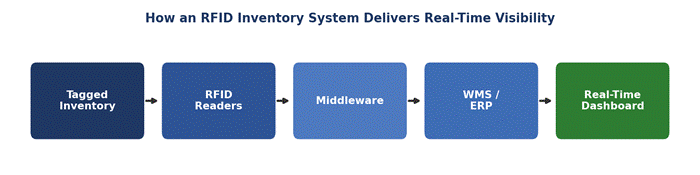
Tagged inventory moves through the facility, and RFID readers capture each tag automatically. Middleware filters those raw reads — removing duplicates and noise — and passes clean data to the warehouse management system, which updates stock levels and locations. Managers then see the current picture on a real-time dashboard, and the same data flows to the ERP and other systems that need it. Because this happens continuously, the inventory record is never out of date.
Key Components of an RFID Inventory System
An RFID inventory system is built from five parts working together:
| Component | Role in the system |
| RFID tags | Carry each item’s unique ID, attached to stock |
| RFID readers & antennas | Detect tags and capture their signals |
| Middleware | Filters and cleans raw reads into usable data |
| Software / WMS | Stores inventory and shows live dashboards |
| Integrations | Connect to ERP and other business systems |
The tags and readers capture what is happening physically; the middleware, software, and integrations turn those signals into the live inventory data your team actually uses to make decisions.
How RFID Delivers Real-Time Visibility
Real-time visibility is what sets RFID apart from periodic counting. Because readers capture tags automatically as stock arrives, moves, and ships, every movement updates the system instantly — no waiting for the next stocktake.
That live data powers dashboards and alerts: managers can see stock levels across the warehouse at a glance, spot low inventory before it becomes a stockout, and locate goods without walking the floor. Feeding this into your inventory visibility and RFID tracking tools turns raw reads into decisions you can trust in the moment.
The Benefits of an RFID Inventory System
Continuous, accurate inventory data improves almost every part of the operation:
- Real-time visibility: always know what stock you have and where it is.
- Higher accuracy: automated reads remove the errors of manual counting.
- Lower labour costs: staff are freed from slow, repetitive stocktakes.
- Faster receiving and picking: whole pallets are read at once instead of item by item.
- Fewer stockouts and less dead stock: live data drives smarter reordering.
- Better decisions: reliable, real-time data improves planning across the supply chain.
RFID vs Traditional Inventory Management
It helps to see the difference against the barcode and manual methods most warehouses start with. Both have their place, and many operations use them together, but for real-time visibility the contrast is clear. For a full comparison, see our guide on RFID vs barcode.
| Aspect | Traditional / barcode | RFID inventory system |
| Visibility | Point-in-time, when scanned | Continuous, real-time |
| Counting | One item at a time | Many items at once |
| Line of sight | Required | Not required |
| Labour | Higher | Lower, automated |
| Data freshness | Drifts between counts | Always current |
Barcodes remain cheap and simple for low-volume identification. An RFID inventory system wins where speed, scale, and always-current data matter most.
Applications of RFID Inventory Systems
RFID inventory management adds value wherever stock moves quickly and accuracy matters. Warehouses and distribution centres use it for real-time stock control across thousands of SKUs. Retailers use it to keep shelves accurate and speed up replenishment. Manufacturers track raw materials and finished goods, while 3PL providers keep separate, accurate inventory for multiple clients. In pharmaceuticals and other regulated sectors, it also supports full traceability of every item.
Implementation and Integration
A successful rollout follows a clear path — the same approach in our guide to implementing RFID . Define your goals, tag the right stock, and place readers at the points where goods move: receiving, put-away, and dispatch. Test tags and readers around metal and liquids, then pilot in one area before scaling.
Crucially, integrate the RFID system with your warehouse management system and ERP, so the live inventory data flows into the workflows your team already uses. Without that integration, the reads never become decisions.
How to Choose the Right RFID Inventory System
The best RFID inventory system is the one matched to your operation, so start from your requirements. Consider how many items you track and how fast they move, the size and layout of your facility, and whether metal or liquids are present. Think about the tag type and read range you need, and how the system will connect to your existing WMS and ERP. Finally, weigh the total cost — tags, readers, software, and integration — against the value of always-current inventory. Piloting in one area before scaling is the surest way to confirm the right fit.
Challenges to Plan For
RFID inventory systems deliver strong results, but a few realities need managing. Metal and liquids can interfere with radio waves, so tag choice and reader placement should be tested against your products. Tags cost more than barcode labels, which matters for very high volumes of low-value items. And the system must be integrated with your software to be useful. None of these is a barrier — each is simply a factor to plan for, ideally with an experienced partner.
The Future of RFID Inventory Management
As warehouses connect more of their operations, RFID inventory data increasingly feeds AI and Industrial IoT systems that forecast demand and flag issues automatically. Combined with automation, real-time inventory becomes the backbone of the self-correcting warehouse — where stock records are always current and reordering, replenishment, and planning happen on live data rather than estimates.
Conclusion
An RFID inventory management system solves the oldest problem in the warehouse — not knowing exactly what you have and where — by keeping your stock data live and accurate at all times. That real-time visibility flows into fewer stockouts, lower labour costs, faster fulfilment, and decisions you can finally trust.
Barcodes still have their place, but for operations that depend on always-current inventory, an RFID system is one of the most valuable investments available. The key is choosing the right setup for your goods and integrating it properly with the systems that run your business.
Get Real-Time Inventory Visibility with Brilliant Info Systems
Brilliant Info Systems designs and integrates RFID inventory management solutions connected to your warehouse management system — so your stock stays accurate and visible in real time. Talk to our team to design the right RFID inventory system for your operation.
Frequently Asked Questions
What is an RFID inventory management system?
It is a system that uses RFID tags and readers to track stock automatically and continuously, giving real-time visibility of what you have and where it is — without manual scanning or line of sight.
How does RFID give real-time inventory visibility?
RFID readers capture tags automatically as goods move, and the data updates your system instantly. This keeps inventory records current at all times, rather than accurate only on counting day.
Is an RFID inventory system better than barcodes?
For real-time visibility and high volumes, generally yes, because RFID automates data capture and reads many items at once. Barcodes remain cheaper for low-volume identification, and many operations use both.
Does an RFID inventory system integrate with a WMS?
Yes. RFID reads flow through middleware into your warehouse management system and ERP, so inventory updates automatically and stays accurate across your whole operation in real time.
What does an RFID inventory system cost?
Cost depends on the number of tags and readers and the size of the operation. Tags cost more than barcodes, but labour savings and accuracy gains typically justify the investment for higher-volume warehouses.
Which industries use RFID inventory management?
Warehousing, retail, manufacturing, 3PL logistics, and pharmaceuticals all use RFID inventory systems for real-time stock control, accuracy, and, where required, full traceability.