
Conveyor Automation Systems: A Complete Guide to Smart Material Handling
In any busy warehouse or distribution centre, goods are in constant motion — and how efficiently they move often decides whether the operation runs smoothly or grinds to a halt. Moving products by hand, on trolleys and forklifts, is slow, costly, and tiring. This is exactly the problem conveyor automation systems solve.
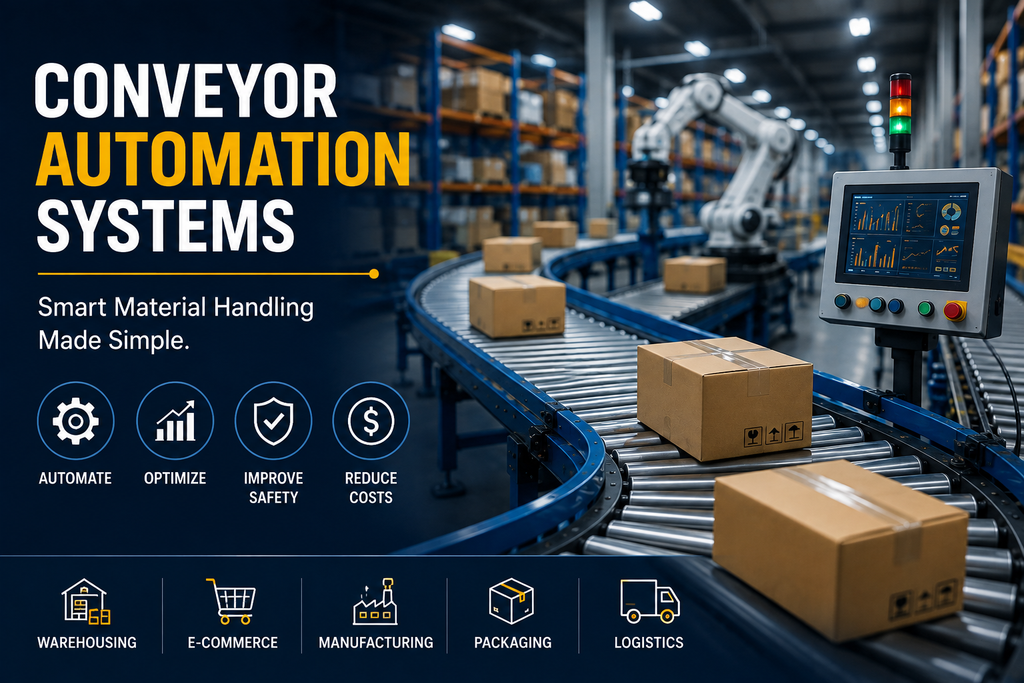
Conveyors are the backbone of smart material handling, transporting goods quickly and reliably across a facility with minimal manual effort. This guide explains what conveyor automation systems are, how they work, the main types, their benefits, and how they fit into a modern automated warehouse.
▶ Watch: Conveyor Automation
Table of Contents
- What are conveyor automation systems?
- How conveyor systems work
- Types of conveyors
- Benefits
- Conveyors in the automated warehouse
- Applications
- How to choose
- Challenges and the future
- FAQs and conclusion
What Are Conveyor Automation Systems?
A conveyor automation system is a network of powered conveyors, controls, and software that moves goods automatically through a facility. Rather than staff carrying items from one area to another, conveyor systems transport materials continuously — from receiving to storage, picking, packing, and dispatch.
Modern conveyors are not just dumb belts. Connected to control systems and sensors, they route, track, and sort goods intelligently, forming a key part of automated material handling systems. The result is faster, more accurate movement of goods with far less manual labour.
How Conveyor Systems Work
At their core, conveyors use motors, belts, or rollers to move goods along a fixed path. What makes them “smart” is the layer of control on top. Sensors detect items as they travel, and a control system — often tied to a warehouse control system — decides where each item should go, diverting it to the right lane, station, or dock.
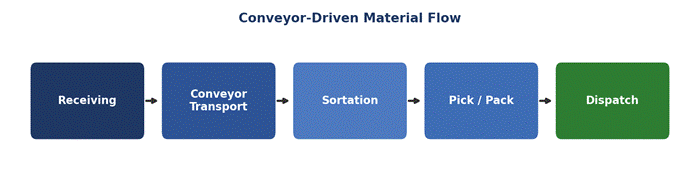
This lets goods flow through the warehouse in a coordinated sequence — received, transported, sorted, picked or packed, and dispatched — with real-time tracking at each step. Because the system knows where every item is, it keeps inventory data accurate while moving product at high speed.
Types of Conveyor Systems
Conveyors come in several forms, each suited to different goods and tasks. Most automated facilities combine more than one:
| Conveyor type | How it works | Best for |
| Belt conveyor | A continuous moving belt carries items | General transport of cartons and loose items |
| Roller conveyor | Goods roll over powered or gravity rollers | Cartons, totes, and pallets |
| Chain conveyor | Heavy-duty chains move large loads | Pallets and heavy items |
| Overhead conveyor | Carriers hang from an overhead track | Garments and saving floor space |
| Sortation conveyor | Diverters route items to the right lane | High-speed order sortation |
Sortation systems deserve special mention: these high-speed conveyors use diverters to route items automatically to the correct destination, and are essential for fast order fulfilment in high-volume distribution centres.
Key Components of a Conveyor System
Whatever the type, an automated conveyor system is built from a few core parts working together:
- Drive and motors: power the belt or rollers that move the goods.
- Belts, rollers, or chains: the surface that carries items along the path.
- Sensors and scanners: detect items and read barcodes or RFID for real-time tracking.
- Diverters and sortation gates: route items to the correct lane or destination.
- Control system: the software and controls that coordinate everything and connect to your WMS.
The mechanical parts move the goods; the sensors and control system make the movement intelligent, turning a simple conveyor into a smart, trackable material-handling line.
The Benefits of Conveyor Automation
Conveyor systems deliver value across the whole operation:
- Higher throughput: goods move continuously and at high speed, increasing throughput without extra staff.
- Improved efficiency: automating transport removes slow, manual movement between areas.
- Better accuracy: controlled routing and tracking reduce misplaced items and improve accuracy.
- Lower labour costs: conveyors handle repetitive movement, freeing human workers for higher-value tasks.
- Improved safety: less manual lifting and forklift traffic means fewer injuries.
- Consistent flow: goods move at a steady, predictable pace, smoothing warehouse operations.
Conveyors in the Automated Warehouse
Conveyors rarely work alone. They are the connective tissue of an automated warehouse, linking other systems together. A conveyor might carry goods from receiving to an automated storage and retrieval system (ASRS), feed picking stations, or move finished orders to sortation and dispatch.
Tied into a warehouse management system and coordinated with AGVs and robotics, conveyors help create a seamless flow where goods move from dock to dock with minimal manual handling. This integration is what turns individual machines into a truly smart material-handling operation.
Applications of Conveyor Systems
Conveyor automation is used wherever goods need to move quickly and reliably. E-commerce and retail distribution centres rely on them for high-speed order fulfilment and sortation. Manufacturers use conveyors to move materials between production stages and feed assembly lines. Food and beverage, pharmaceuticals, and parcel logistics all depend on conveyors to transport materials at scale, accurately and hygienically. Anywhere high volumes of goods move through a facility, conveyors are usually at the heart of it.
How to Choose the Right Conveyor System
There is no single conveyor that suits every operation, so start from your needs. Consider what you are moving — cartons, totes, pallets, or loose items — and the weight and size involved. Think about the throughput and speed you require, the available floor space and layout, and whether you need sortation. Crucially, plan how the conveyor will integrate with your existing systems and other automation. Matching the system to your real goods and volumes is what delivers the operational efficiency you are after.
Challenges to Plan For
Conveyor automation is powerful, but a few factors need planning. The up-front investment and installation are significant, so a clear business case matters. Fixed conveyors are less flexible than mobile robots if your layout changes often. And, like any equipment, conveyors need maintenance to avoid downtime. Designing the system well from the start — with room to grow and easy access for servicing — keeps these challenges manageable.
The Future of Conveyor Automation
Conveyor systems are getting smarter. Combined with Industrial IoT sensors and AI, they now support predictive maintenance, flagging a failing motor before it causes downtime, and adjust flow dynamically to match demand. As warehouses pursue full automation, conveyors will keep working alongside ASRS, AGVs, and robotics as the high-speed backbone that ties the whole operation together.
Conclusion
Conveyor automation systems are the backbone of smart material handling — moving goods faster, more accurately, and with far less manual effort than any manual method. From belt and roller conveyors to high-speed sortation, they keep product flowing smoothly through the modern warehouse.
Their real power shows when they are integrated with the wider operation, linking receiving, storage, picking, and dispatch into one seamless flow. For any high-volume facility, conveyor automation is one of the most effective ways to lift throughput and efficiency.
Automate Your Material Handling with Brilliant Info Systems
Brilliant Info Systems designs and integrates conveyor automation and sortation systems — connected to your WMS, WCS, ASRS, and robotics for seamless material handling. Talk to our team to design the right conveyor solution for your operation.
Frequently Asked Questions
What is a conveyor automation system?
It is a network of powered conveyors, controls, and software that moves goods automatically through a facility — transporting, tracking, and sorting items with minimal manual effort.
What are the main types of conveyors?
Common types include belt, roller, chain, and overhead conveyors, plus sortation conveyors that divert items to the right destination. Most automated warehouses combine several.
How do conveyors improve warehouse efficiency?
They move goods continuously and at high speed, remove slow manual transport, and route items accurately — increasing throughput and improving accuracy while lowering labour costs.
Do conveyors integrate with a WMS?
Yes. Conveyors connect to warehouse management and control systems, so movements are tracked in real time and coordinated with the rest of the operation.
What is a sortation conveyor?
A sortation conveyor uses diverters to automatically route items to the correct lane, chute, or dock — essential for high-speed order fulfilment in busy distribution centres.
Are conveyors worth the investment?
For operations moving high volumes of goods, usually yes. The gains in throughput, accuracy, and labour savings typically justify the investment, especially when integrated with other automation.