
Digital Twin in Warehousing: How Virtual Warehouses Transform Operations
Imagine being able to test a new warehouse layout, reroute your pickers, or simulate a peak-season surge — without touching the real building or risking a day’s output. That is exactly what a digital twin makes possible. It creates a living, virtual copy of your warehouse that you can watch, test, and optimise in ways the physical site never allows.
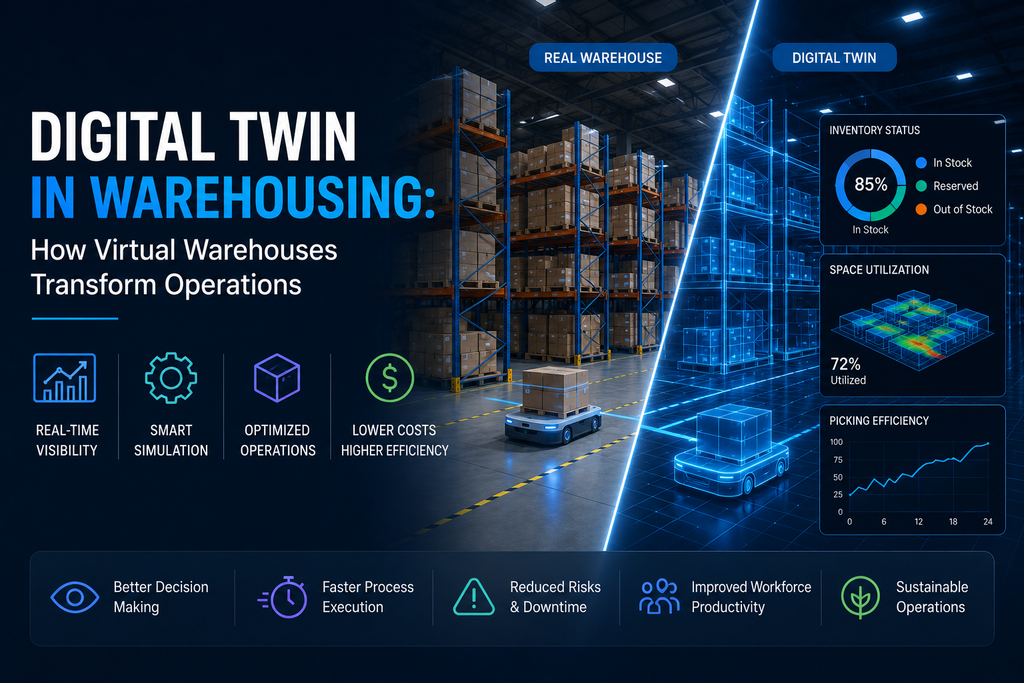
A warehouse digital twin is transforming how modern operations are run, planned, and improved. This guide explains what a digital twin is, how it works in warehousing, the types available, and the benefits of digital twins for warehouse operations and the wider supply chain.
▶ Watch: Digital Twins Explained
Table of Contents
- What is a digital twin?
- How a warehouse digital twin works
- Types of digital twin
- Key benefits
- Use cases in warehousing
- How to implement one
- Challenges and the future
- FAQs and conclusion
What Is a Digital Twin?
A digital twin is a virtual representation of a physical thing — an asset, a process, or an entire facility — kept in sync with reality using live data. In warehousing, a digital twin is a virtual model of your warehouse and its physical assets that updates in real time as goods, people, and equipment move around the real site.
Unlike a static 3D drawing, a digital replica is dynamic. Fed by IoT sensors and systems data, it mirrors the current state of the warehouse and lets you run simulations against it. Digital twin technology, often combined with machine learning, turns that virtual warehouse into a powerful tool for making informed decisions before acting in the real world.
How a Warehouse Digital Twin Works
A digital twin works by continuously connecting the physical warehouse to its virtual counterpart. The process forms a loop that keeps the model accurate and useful:
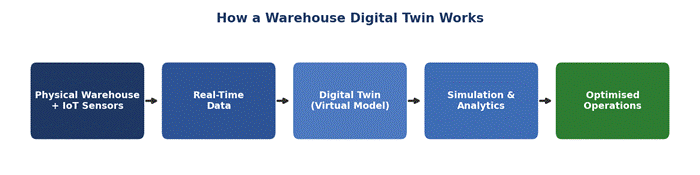
Sensors and systems in the physical warehouse stream real-time data — locations, stock, equipment status — to the digital twin. The virtual model updates to match, and simulation and analytics run scenarios against it. The insights then feed back into real warehouse operations, closing the loop. Because the twin reflects the live warehouse, the decisions it informs are grounded in what is actually happening, not guesswork.
Types of Digital Twin
Digital twins come at different scales, and warehouses often use several together. The main types of digital twin are:
| Type of digital twin | What it models |
| Asset twin | A single machine or piece of equipment |
| Process twin | A workflow such as picking or receiving |
| System twin | A full warehouse and how its parts interact |
| Supply chain twin | The wider network of sites and flows |
An operation might run an asset twin of a critical conveyor, a process twin of its picking flow, and a system twin of the whole building — each answering different questions, from equipment health to overall throughput.
The Key Benefits of Digital Twins in Warehousing
The benefits of digital twins reach across planning, daily operations, and long-term strategy:
- Risk-free testing: try new layouts, processes, and what-if scenarios virtually before committing.
- Higher operational efficiency: spot bottlenecks and optimise flows using real data.
- Better decisions: the digital twin enables informed decisions backed by simulation, not hunches.
- Improved planning: model peak seasons and growth to prepare capacity in advance.
- Predictive insight: combined with analytics, anticipate problems before they occur.
- Real-time visibility: see the whole warehouse and its inventory management at a glance.
Use Cases in Warehousing
Warehouse digital twins earn their keep in many ways. They optimise layout and slotting by simulating different arrangements; they plan and de-risk automation projects such as ASRS and robotics before installation; and they model labour and equipment needs for peak demand across busy supply chains. They also support predictive maintenance by mirroring equipment condition, and extend into supply chain management, where a digital twin of the network helps balance stock and flows across multiple sites.
How to Implement a Digital Twin
Building a digital twin is a staged journey. Start with a clear question you want it to answer — a layout change, an automation decision, or peak planning. Connect the right data sources, from IoT sensors to your warehouse management and ERP systems, and build a virtual model at the scale you need. Validate it against the real warehouse so you trust its results, then use it to simulate and optimise. As with any such project, start focused and expand once it proves its value.
A digital twin is a natural next step for operations already investing in IIoT and smart warehousing, since it builds on the same connected data foundation.
Challenges to Plan For
Digital twins are powerful but need planning. They depend on good, connected data — an accurate twin requires reliable feeds from sensors and systems. Building and validating the model takes effort and expertise, and the up-front investment must be justified by clear use cases. The most successful projects start with one well-defined question, prove the value, and scale from there rather than trying to model everything at once.
The Future of Digital Twins in Warehousing
Digital twin technology is advancing quickly. As AI and machine learning mature, twins are moving from mirroring the present to predicting and prescribing — recommending the best action, not just showing the current state. Combined with wider automation, virtual warehousing is set to become a standard planning and optimisation tool, giving operations a safe space to test every decision before it touches the real world.
Conclusion
A digital twin turns your warehouse into something you can experiment with safely — a virtual warehouse where every layout, process, and investment can be tested before it becomes real. By keeping a live digital replica in sync with the physical site, it replaces guesswork with evidence and helps you run leaner, smarter operations.
As part of the connected, data-driven warehouse, digital twin technology is fast moving from cutting-edge to competitive necessity. The best way to start is with a single clear question and the data to answer it — then let the virtual warehouse show you the way forward.
Build Your Warehouse Digital Twin with Brilliant Info Systems
Brilliant Info Systems designs and integrates digital twin solutions — powered by IoT sensors, real-time data, and analytics — connected to your warehouse and manufacturing systems. Contact our team to create a virtual warehouse that transforms how you plan and operate.
Frequently Asked Questions
What is a digital twin in warehousing?
A warehouse digital twin is a virtual representation of a physical warehouse, kept in sync with reality using real-time data. It lets you monitor, simulate, and optimise operations without disrupting the real site.
How does a warehouse digital twin work?
Sensors and systems stream real-time data from the physical warehouse to a virtual model, which stays in sync. Simulation and analytics run scenarios against it, and the insights feed back into real operations.
What are the benefits of a digital twin?
Benefits include risk-free testing of changes, higher operational efficiency, better and more informed decisions, improved capacity planning, predictive insight, and real-time visibility of the whole warehouse.
What are the types of digital twin?
Common types are asset twins (a single machine), process twins (a workflow), system twins (a whole warehouse), and supply chain twins (the wider network) — often used together.
Is a digital twin the same as a 3D model?
No. A 3D model is static, while a digital twin is a live virtual representation kept in sync with the real warehouse using real-time data, allowing dynamic simulation and analysis.
How do I start with a warehouse digital twin?
Begin with one clear question, connect reliable data from sensors and your warehouse systems, build and validate a focused model, then use it to simulate and optimise before scaling to more of the operation.