
Real-Time Air Quality Monitoring in Mining: Protecting Workers, Equipment and the Environment
The air on a mine site carries more than dust. Engines, blasting, and the rock itself release a mix of airborne particles and gases — from respirable dust to carbon monoxide — that workers breathe every shift. Over time, that exposure causes serious health problems, and in confined or underground spaces it can turn dangerous fast. Protecting people means knowing exactly what is in the air, moment to moment. That is what real-time air quality monitoring delivers.
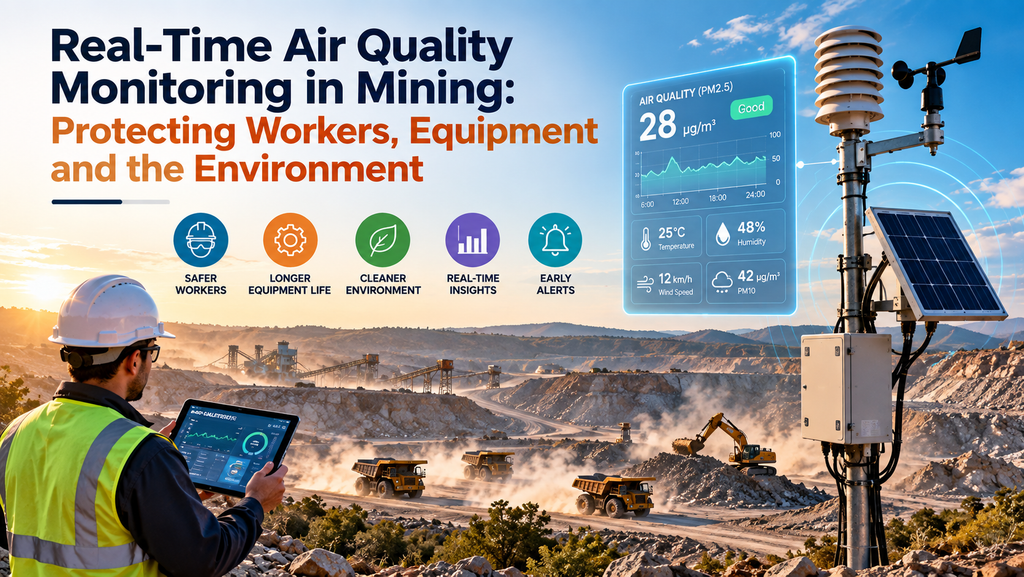
This guide explains how real-time air quality monitoring protects workers, equipment, and the environment in mining — what it measures, how it works, and why continuous data beats occasional checks. It pairs closely with our guide to dust monitoring in mining.
▶ Watch: Real-Time IoT Monitoring in Action
Table of Contents
- Why air quality monitoring matters
- What it measures
- How it works
- The benefits
- Personal and area monitoring
- Air quality and control measures
- FAQs and conclusion
Why Air Quality Monitoring Matters in Mining
Poor air quality is one of the most serious and least visible hazards in mining. Fine airborne dust and toxic gases cannot always be seen or smelled, yet repeated dust exposure is a leading cause of lung diseases among miners, and gases like carbon monoxide can be fatal in minutes at high levels. Mining activity such as drilling, blasting, and hauling causes constant dust generation, and rising dust levels and other dust hazards must be tracked so dust particles never build to harmful concentrations. Beyond health, air pollution corrodes equipment and drifts off-site to affect nearby communities.
Because these hazards are invisible, workers can be exposed long before anyone notices. Real-time monitoring removes that blind spot, giving teams the data to keep exposure within safe limits and act the instant conditions worsen — protecting workers, equipment, and the environment together.
What Air Quality Monitoring Measures
A modern air quality monitoring system tracks the full range of pollutants in a mine’s air, not just one. Connected IoT sensors and smart sensors measure both particulate matter and gases continuously:
| Air quality hazard | Why it matters in mining |
| Dust (PM10 / PM2.5) | Airborne particles that cause lung diseases with long exposure |
| Respirable dust | The finest dust, reaching deep into the lungs |
| Carbon monoxide | A toxic, odourless gas from engines and blasting |
| Other gases | NOx, SO2, and methane that pose health and explosion risks |
| Overall air pollution | Combined pollutants affecting the whole work environment |
For the dust side specifically — PM10, PM2.5, and respirable dust — see our detailed guide to dust monitoring in mining. Together, particle and gas sensing gives a complete picture of the air workers are breathing.
How Real-Time Air Quality Monitoring Works
The system runs as a continuous loop from the air to a protective action:
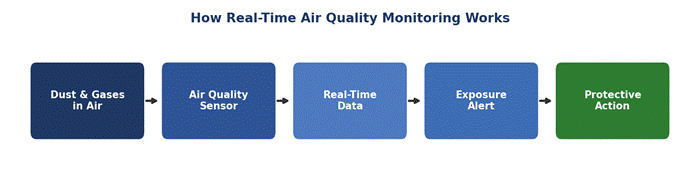
Sensors detect dust and gases in the air; readings are captured and sent as real-time data to a central platform; the system compares them against exposure limits; and if a threshold is crossed, it alerts the team instantly so they can take protective action — ventilation, evacuation, or dust suppression. Because monitoring never stops, dangerous conditions are caught the moment they arise.
The Benefits of Real-Time Air Quality Monitoring
Continuous air quality monitoring protects a mine on several fronts at once:
- Protecting worker health: real-time alerts keep exposure below safe limits, reducing the risk of lung diseases and gas poisoning.
- Regulatory compliance: continuous data collection proves air quality stays within legal exposure limits.
- Protecting equipment: managing dust and corrosive gases reduces wear and maintenance costs.
- Environmental protection: catching air pollution early limits its impact beyond the site.
- Faster response: instant alerts allow immediate action, from ventilation to evacuation.
Personal and Area Monitoring
Air quality monitoring works at two levels. Area monitors are fixed at key points across the site to track conditions in each zone. Personal dust monitors, worn by workers, measure the air each person actually breathes — capturing individual dust exposure that a fixed sensor might miss.
Used together, area and personal monitoring give both the big picture and the individual detail. This is especially important underground, where indoor air quality can vary sharply from one working face to another and where gases can accumulate in confined spaces.
Air Quality Monitoring and Control Measures
Monitoring is most valuable when it drives action. Real-time air quality data shows exactly when and where to apply control measures — increasing ventilation, triggering dust suppression, or pausing work until conditions improve. Instead of reacting after workers have been exposed, teams act on live data before harm is done.
This fits within the wider environmental and blast monitoring solutions a modern mine relies on. For the full site view, see our guides on environmental sensors in mining and continuous environmental monitoring.
Conclusion
The air quality in a mine is a matter of life and health, not just compliance. Real-time monitoring turns the invisible threat of dust and gases into clear, actionable data — protecting workers from lung diseases and gas exposure, reducing wear on equipment, and limiting air pollution beyond the site.
Combined with dust suppression, ventilation, and wider monitoring solutions, real-time air quality monitoring is a cornerstone of a safe, responsible modern mine. Explore our related guides on dust monitoring and continuous environmental monitoring for the complete picture.
Protect Your Workers with Brilliant Info Systems
Brilliant Info Systems delivers IoT-powered air quality and environmental monitoring — from real-time IoT and smart sensors to blast vibration monitoring and predictive maintenance. Contact our team to protect your workers, equipment, and environment with real-time air quality monitoring.
Frequently Asked Questions
What is real-time air quality monitoring in mining?
It is the use of connected sensors to continuously measure dust and gases in a mine’s air, reporting the data instantly so teams can keep worker exposure within safe limits and act the moment conditions worsen.
What air quality hazards does it monitor?
It monitors dust (PM10, PM2.5, and respirable dust), toxic gases such as carbon monoxide, and other pollutants — the airborne particles and gases that harm worker health and the environment.
How does air quality monitoring protect workers?
By measuring air pollutants in real time and alerting teams the instant exposure limits are approached, it lets them take protective action — ventilation, suppression, or evacuation — before workers are harmed.
What are personal dust monitors?
Personal dust monitors are worn by workers to measure the dust in the air each person actually breathes, capturing individual exposure that fixed area monitors might miss.
Why is air quality monitoring important underground?
Underground, indoor air quality varies between working areas and gases can build up in confined spaces. Continuous monitoring is essential to catch dangerous conditions quickly and protect workers.
Does air quality monitoring help with compliance?
Yes. Continuous data collection provides an unbroken record proving air quality stays within legal exposure limits, making regulatory compliance straightforward to demonstrate.