
Dust Monitoring in Mining: Protecting Workers, Equipment and the Environment
Dust is an unavoidable by-product of mining. Drilling, blasting, crushing, and hauling all throw fine particles into the air — and those particles are far more than a nuisance. They damage worker health, wear down equipment, and drift beyond the site to affect nearby communities. Managing dust is therefore a core safety, operational, and environmental responsibility, and it starts with knowing exactly how much is in the air. That is the job of dust monitoring.
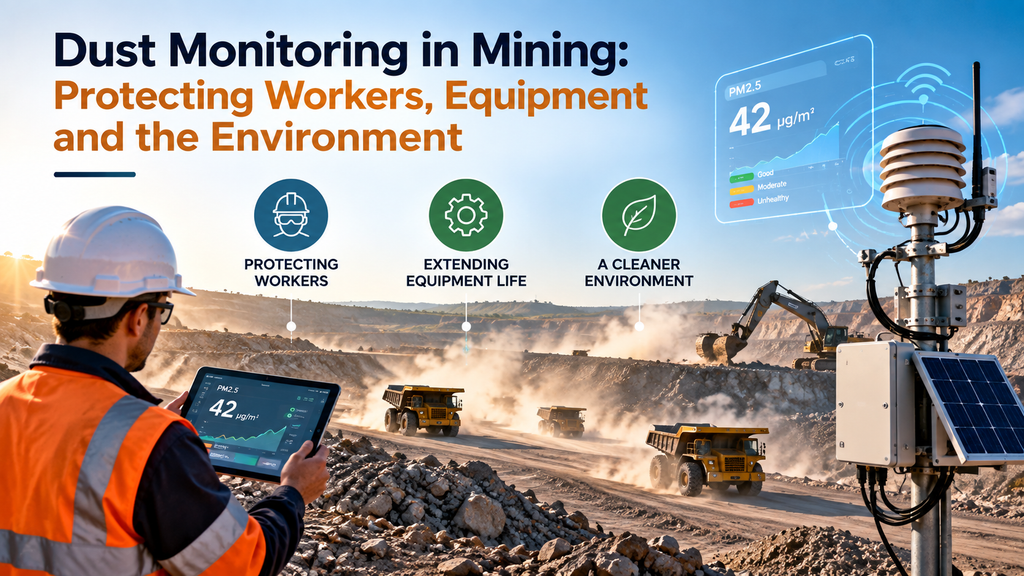
This guide explains why dust monitoring matters in mining, what a modern dust monitoring system measures, and real time monitoring of dust that protects people, machinery, and the environment. It builds on our wider guides to environmental sensors in mining and continuous environmental monitoring.
▶ Watch: Real-Time IoT Monitoring in Action
Table of Contents
- Why dust monitoring matters
- Types of mining dust
- What a dust monitoring system measures
- How dust monitoring works
- The benefits
- Dust control and suppression
- FAQs and conclusion
Why Dust Monitoring Matters in Mining
Uncontrolled dust creates problems on three fronts. For people, fine airborne particles cause serious health risks — from irritation to long-term lung disease among workers repeatedly exposed. For equipment, dust accelerates wear on engines, filters, and moving parts, driving up maintenance costs and downtime. And for the environment, dust drifting off-site harms air quality and triggers community complaints and regulatory action.
You cannot control what you cannot measure. Dust monitoring gives operators the timely data they need to see when dust levels are rising and act on dust hazards before they harm anyone — protecting worker health, machinery, and the surrounding work environment all at once.
Types of Mining Dust: PM10, PM2.5 and Respirable Dust
Not all dust is equal. What matters most is particle size, because smaller particles travel deeper into the lungs and pose greater health risks. Dust monitoring focuses on a few key categories:
| Dust type | Particle size | Why it matters |
| PM10 | 10 micrometres or less | Inhalable; irritates airways and reduces visibility |
| PM2.5 | 2.5 micrometres or less | Reaches deep into the lungs; a serious health risk |
| Respirable dust | Very fine fraction | Linked to long-term lung disease in miners |
PM10 and PM2.5 monitoring are the standard measures used worldwide, because they capture the airborne particles most closely linked to health effects. The finer the dust particle, the more dangerous it tends to be.
What a Dust Monitoring System Measures
A modern dust monitoring system uses a dust sensor to measure dust concentrations in the air continuously, in real time. Rather than collecting occasional dust samples to send to a lab, connected IoT sensors and smart sensors report dust levels instantly, so teams see conditions as they change.
A good dust monitor tracks PM10 and PM2.5 concentrations, often alongside weather data such as wind, which affects how dust spreads. This advanced monitoring turns dust from an invisible, uncertain hazard into a clear, measurable number the team can act on.
How Dust Monitoring Works
The process is a simple, continuous loop from the dust source to a control action:
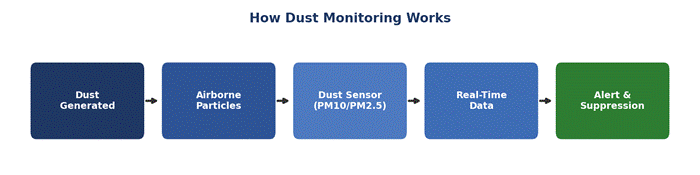
Mining activity generates dust; the particles become airborne; a dust sensor measures their concentration; the reading is sent as real time data to a platform; and if dust levels cross a limit, the system alerts the team to trigger control measures such as suppression. Because it runs constantly, dust is caught the moment it rises, not hours later.
The Benefits of Dust Monitoring
Continuous dust monitoring delivers benefits across health, operations, and compliance:
- Protecting worker health: real-time alerts let teams reduce exposure before it harms anyone.
- Regulatory compliance: continuous records prove dust levels stay within legal limits.
- Lower equipment wear: managing dust reduces damage to machinery and cuts maintenance costs.
- Environmental protection: catching dust drift early limits impact on nearby communities.
- Smarter suppression: data shows exactly when and where dust control is needed, saving water and effort.
Dust Monitoring and Dust Suppression
Monitoring and control work hand in hand. Dust monitoring tells you when and where dust is a problem; dust suppression — spraying water or applying dust control measures — does something about it. Linking the two means suppression is triggered by real data rather than guesswork, so it happens exactly when needed.
This data-driven approach is more effective and more efficient, and it fits within the wider blast and environmental monitoring solutions a modern mine relies on to stay safe and compliant.
Conclusion
Dust is one of mining’s most persistent hazards, but it is also one of the most manageable — once you can measure it. Real-time dust monitoring turns an invisible risk into clear, actionable data, protecting worker health, extending equipment life, and shielding the surrounding environment from harm.
Paired with dust suppression and wider monitoring solutions, a modern dust monitoring system helps mines stay safe, compliant, and responsible. For the full site picture, explore our guides on blast monitoring sensors and continuous environmental monitoring.
Control Mining Dust with Brilliant Info Systems
Brilliant Info Systems delivers IoT-powered dust and environmental monitoring — from real-time IoT and smart sensors to blast vibration monitoring and predictive maintenance. Contact our team to protect your workers, equipment, and environment with real-time dust monitoring.
Frequently Asked Questions
What is dust monitoring in mining?
Dust monitoring uses sensors to measure the concentration of airborne particles — such as PM10 and PM2.5 — in real time, so mines can protect worker health, reduce equipment wear, and meet regulatory limits.
What is the difference between PM10 and PM2.5?
PM10 refers to particles 10 micrometres or smaller, which irritate the airways. PM2.5 refers to finer particles 2.5 micrometres or smaller, which reach deep into the lungs and pose a greater health risk.
What is respirable dust in mining?
Respirable dust is the very fine fraction of dust small enough to reach the deepest parts of the lungs. Long-term exposure is linked to serious lung disease, making it a key focus of dust monitoring.
How does a dust monitoring system work?
A dust sensor measures airborne particle concentrations continuously and sends the data to a platform in real time. When dust levels exceed a limit, the system alerts the team to trigger control measures.
Why is dust monitoring important?
Because uncontrolled dust harms worker health, damages equipment, and affects nearby communities. Monitoring provides the timely data needed to control dust before it becomes a hazard and to prove compliance.
How does dust monitoring support dust suppression?
It shows exactly when and where dust levels are rising, so suppression such as water spraying is triggered by real data at the right moment — making dust control more effective and efficient.