
Air Quality Monitoring Solutions for Mining: Protecting Workers and Communities
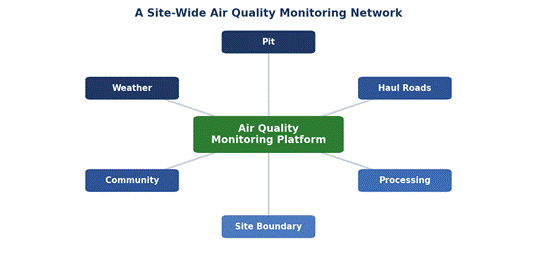
A mine is not a single point — it is a sprawling site where dust and gases rise from the pit, the haul roads, the processing plant, and beyond the boundary into local communities. Checking the air at one spot, once in a while, cannot capture that. Modern air quality monitoring solutions can, connecting sensors across the whole site into one continuous, real-time network. This shift to continuous monitoring means the air is watched everywhere, all the time, with real time data flowing to a single air quality monitoring system.
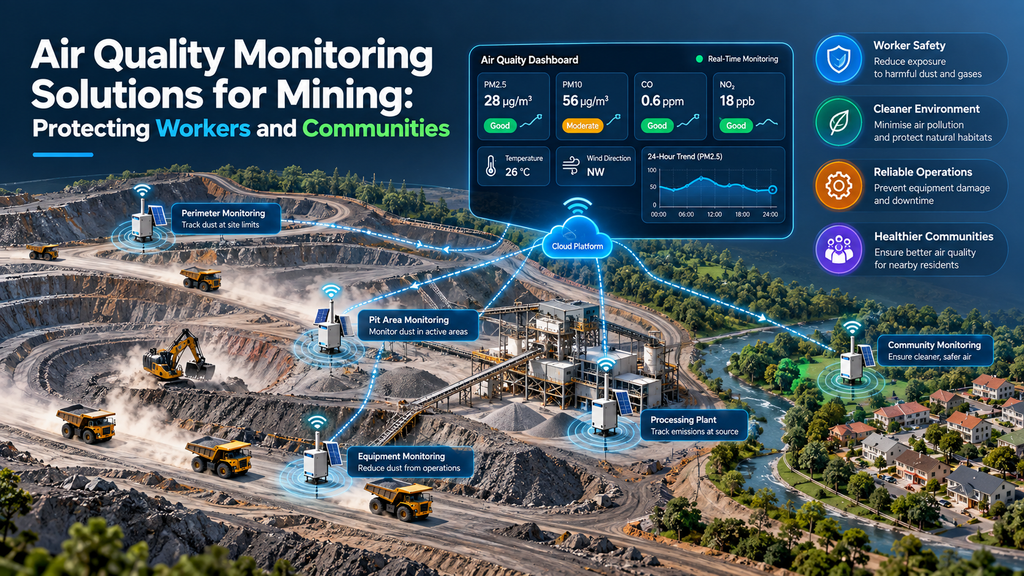
This guide looks at how a modern air quality monitoring solution works at scale — protecting workers and local communities, ensuring compliance, and reducing environmental impact. Done well, it helps protect workers and neighbours from the health risks of dust and gases across a large scale operation. For how monitoring protects workers specifically, see our guide on real-time air quality monitoring in mining.
▶ Watch: Real-Time IoT Monitoring in Action
What Is an Air Quality Monitoring Solution?
A real time air quality monitoring solution is a connected system of sensors, networks, and software that measures air pollutants across a site continuously. Rather than a single environmental monitor, it links many IoT and smart sensors into a monitoring network, feeding real time data to one platform that turns readings into alerts and reports.
It typically measures particulate matter at several sizes — PM1, PM2.5, and PM10 — along with gases, so operators see the full air quality picture. The result is site-wide awareness rather than isolated readings.
Traditional vs Modern Air Quality Monitoring
The move from traditional monitoring to a modern solution is a big step up, especially at scale:
| Aspect | Traditional monitoring | Modern monitoring solution |
| Data | Occasional lab samples | Continuous, real-time |
| Coverage | A few points | A site-wide sensor network |
| Response | Days later | Instant alerts |
| Scale | Hard to scale | Built for large-scale sites |
| Compliance | Gaps in the record | Unbroken, verifiable data |
Protecting Workers and Local Communities
A key advantage of a site-wide monitoring network is that it protects everyone affected — not just workers on the floor, but the local communities around the mine. Sensors at the site boundary track whether dust and air pollution are drifting off-site, giving early warning before they reach homes.
This dual focus matters for a mine’s social licence to operate. Transparent, real-time air quality data reassures communities and resolves complaints on facts — the same principle behind wider continuous environmental monitoring.
Ensuring Compliance at Scale
Large-scale operations face constant regulatory scrutiny, and a monitoring solution makes compliance far easier. Because the network records air quality continuously across every zone, it produces an unbroken, verifiable dataset. When regulators ask for evidence, the data is already there — no gaps, no guesswork. This is a decisive advantage over traditional sampling, which leaves long periods unmonitored.
The Benefits of an Air Quality Monitoring Solution
Deploying a connected solution delivers benefits across health, compliance, and reputation:
- Protects workers and communities: from dust and gases, on-site and beyond the boundary.
- Site-wide coverage: a sensor network watches every zone, not just one point.
- Ensures compliance: continuous, verifiable data across large-scale operations.
- Reduces environmental impact: early warning limits air pollution before it spreads.
- Scales easily: sensors are added as the site grows, with no loss of coverage.
Conclusion
An air quality monitoring solution turns a scatter of readings into a single, continuous view of a mine’s air — from the pit to the boundary and the communities beyond. That site-wide awareness protects worker health and safety, reassures local communities, reduces environmental impact, and makes compliance effortless.
For modern mines, a connected monitoring solution is fast replacing traditional sampling. Explore our related guides on dust monitoring in mining and environmental sensors in mining for the complete picture.
Deploy an Air Quality Monitoring Solution with Brilliant Info Systems
Brilliant Info Systems builds IoT-powered, site-wide air quality and environmental monitoring networks — from real-time IoT and smart sensors to blast vibration monitoring and predictive maintenance. Contact our team to protect your workers, communities, and environment at scale.
Frequently Asked Questions
What is an air quality monitoring solution?
It is a connected system of sensors, networks, and software that continuously measures air pollutants — such as PM1, PM2.5, PM10, and gases — across a mine site, feeding real-time data to one platform for alerts and reporting.
How is it different from traditional monitoring?
Traditional monitoring relies on occasional samples from a few points. A modern solution uses a site-wide sensor network to capture continuous, real-time data, with instant alerts and an unbroken compliance record.
What does it measure?
It measures particulate matter at several sizes — PM1, PM2.5, and PM10 — along with gases, giving a complete view of air quality across the whole site.
How does it protect local communities?
Sensors at the site boundary detect whether dust and air pollution are drifting off-site, giving early warning before they reach nearby homes and helping resolve community concerns with real data.
How does it help with compliance?
By recording air quality continuously across every zone, the network produces a verifiable dataset that makes demonstrating regulatory compliance straightforward, even for large-scale operations.