
Estimating RTLS Project Costs: Anchors, Tags, Software and Installation
“How much does an RTLS cost?” is one of the first questions every buyer asks — and the honest answer is: it depends. A real time location system is not a single product off a shelf; it is a combination of hardware, software, and services sized to your building and your goals. But while the final figure varies, the things that go into an RTLS project budget are always the same four: anchors, tags, software, and installation.
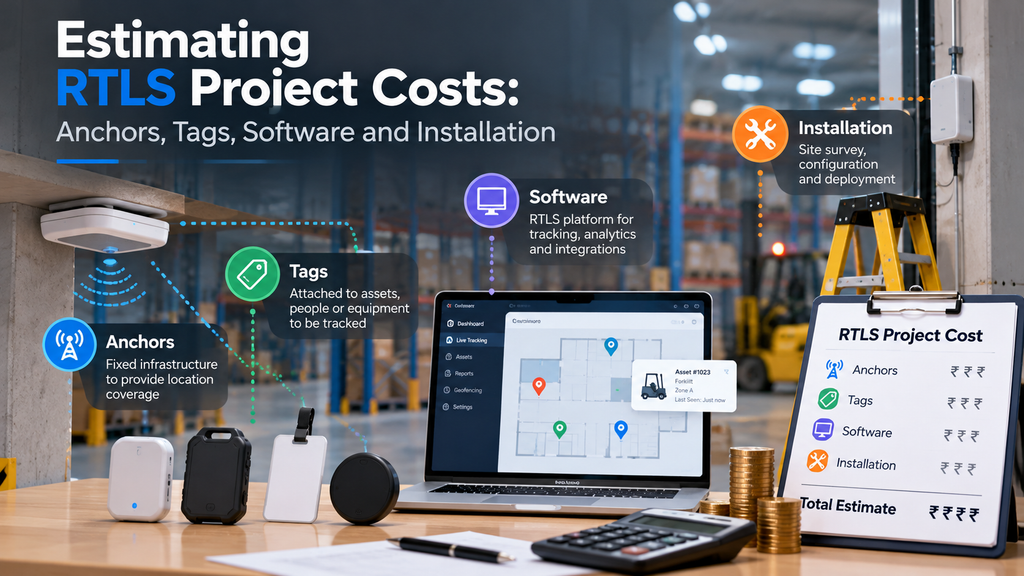
This guide breaks down what goes into each part, so you can estimate RTLS project costs with confidence and understand where your money actually goes.
▶ Watch: Brilliant Info Systems on YouTube
The Four Main Cost Components
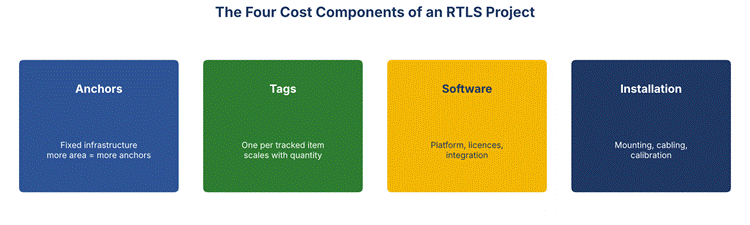
Almost every line in an RTLS budget falls into one of four buckets. Understanding how each one scales is the key to a realistic estimate.
1. Anchors (Fixed Infrastructure)
Anchors are the fixed receivers mounted around your building that pick up signals from tags. They are the backbone of the system, and their number is driven by two things: the size of the area you want to cover and the location accuracy you need. A larger space, or one that needs precision location down to the centimetre, needs more anchors.
Different rtls technologies change the count, too. UWB RTLS delivers the tightest accuracy but may need denser placement and clear line of sight, while a wi fi or BLE setup can cover more ground per unit at lower precision. Because anchors are infrastructure, this is usually the largest single hardware line in an rtls project. Our UWB tracking and BLE tracking pages explain the trade-offs.
2. Tags (Scales with Quantity)
Tags are the small devices attached to the assets, vehicles, or people you want to track. Unlike anchors, tag cost scales directly with quantity — one per tracked item. Track 200 items and you need 200 rtls tags; track 2,000 and the tag line grows with it.
Tag price varies by type and capability. A simple asset tag is inexpensive; a rugged tag for medical equipment, or a wearable with extra features, costs more. The technology matters as well — UWB tags typically cost more than BLE tags. For most asset tracking projects, tags are a moderate but ongoing cost, since they have batteries and are occasionally replaced.
3. Software (The Platform)
Hardware produces raw location data; application software turns it into something useful — live maps, alerts, reports, and dashboards. Software costs usually include the core location platform, user licences, and any integration with the systems you already run.
Two factors drive this line. First, licensing model: some platforms charge a one-time fee, others a recurring subscription. Second, integration: connecting the rtls system to your ERP, WMS, or other operating systems takes configuration work. A well-integrated platform is what links location tracking to real business value, feeding data into inventory visibility and other tools you depend on.
4. Installation and Services
The final bucket is getting everything mounted, connected, and working. Installation costs cover a site survey, mounting the anchors (often high on walls or ceilings), running power and network cabling, and calibrating the system so readings are accurate. Most rtls deployments also include commissioning, testing, and staff training.
This is the part buyers most often underestimate. Good installation is what makes the difference between a system that performs and one that disappoints — proper anchor placement and calibration directly determine your real-world accuracy.
Cost Factors at a Glance
The table below summarises what pushes each component up or down:
| Component | What Increases the Cost |
| Anchors | Larger area, higher accuracy, UWB vs BLE, obstructions. |
| Tags | Number of items tracked, rugged or wearable types, technology. |
| Software | Subscription vs licence, number of users, integration depth. |
| Installation | Site complexity, cabling, calibration, training. |
How to Keep Your RTLS Budget Realistic
A few habits lead to an accurate estimate and avoid surprises later:
- Start with the use case: Define what you need to track and how accurately before pricing hardware. Over-specifying accuracy is the fastest way to inflate a budget.
- Count your tags honestly: List every item, vehicle, and person to be tracked — this number drives a big part of the cost.
- Phase the rollout: Many systems require only one zone to prove value first; you can expand anchors and tags later.
- Include running costs: Budget for software subscriptions, tag batteries, and support, not just the up-front build.
A good partner will help you right-size an RTLS solution rather than overselling hardware, and will base the design on reliable IoT sensors matched to your site.
Conclusion
Estimating RTLS project costs comes down to understanding four building blocks: anchors sized to your area and accuracy, tags that scale with the number of items tracked, application software that turns data into decisions, and the installation that makes it all work. Get clear on each one and the total stops being a mystery — you can plan an rtls project budget that matches your real needs.
Brilliant Info Systems designs right-sized RTLS deployments and gives transparent, itemised estimates. Explore our RTLS and RFID solutions or talk to our team for a budget built around your site.
Frequently Asked Questions
What is the biggest cost in an RTLS project?
For most indoor positioning projects, anchors are the largest single hardware cost because they are fixed infrastructure sized to the area and accuracy you need. Tags and software follow, with installation a significant service cost on top.
Why do UWB systems cost more than BLE?
UWB RTLS delivers centimetre-level precision location, which needs more capable anchors and tags and often denser placement with clear line of sight. BLE offers lower accuracy at a lower cost, so the right choice depends on how precise you need to be.
Are there ongoing costs after installation?
Yes. Real time location systems rtls typically have running costs including software subscriptions or support, plus occasional tag battery replacement. These should be part of your total budget, not just the initial build.
Can I start small and expand later?
Absolutely. A phased rollout — starting with one zone or department — lets you prove the value of location tracking before scaling up anchors and tags across the whole site.
How long does an RTLS deployment take?
Timelines vary with site size and complexity. A single-zone pilot can be live in a few weeks, while a full-site deployment covering many areas takes longer, mostly because of the installation work — surveying, mounting anchors, cabling, and calibration. Planning this stage carefully keeps both the schedule and the budget on track.