
Worker Location and SOS Alerts in Industrial Facilities
In a busy industrial facility, every second counts when something goes wrong. A worker who slips in a remote corner, a technician who collapses in a plant room, or a lone operator in a hazardous zone needs help to arrive fast — and that only happens if someone knows where they are. Combining real time worker location with SOS and zone alerts turns a safety policy into a system that actually protects people.
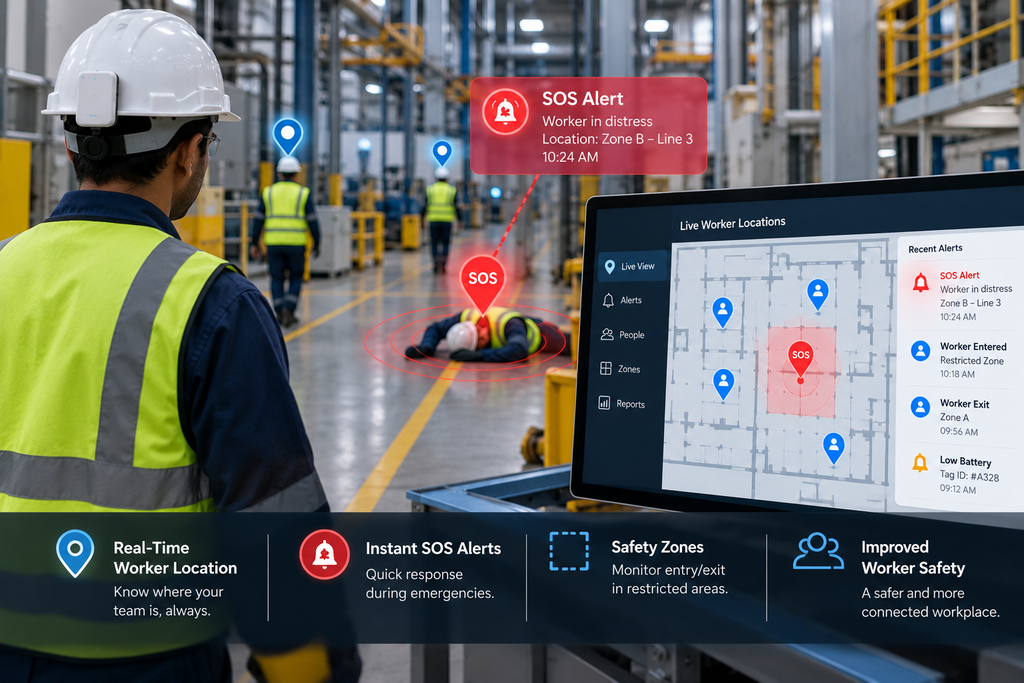
This guide explains how worker location and SOS alerts work in industrial facilities — the SOS button, zone alerts, fall detection, and live location features that make up a modern lone worker safety solution.
▶ Watch: Brilliant Info Systems on YouTube
Why Worker Location Matters for Safety
Industrial sites are large, noisy, and full of hazards. A worker in trouble may be out of sight and earshot of colleagues, unable to call for help the normal way. Without their location, even a fast emergency response wastes precious minutes searching. Knowing worker locations in real time means help goes straight to the right place.
This is especially critical for lone workers — maintenance staff, night-shift operators, or anyone working alone in a plant room or storage area. A proper lone worker safety device keeps them connected even when no one else is around, which is why worker location sits at the heart of labour safety and management on any serious site.
How SOS Alerts Work
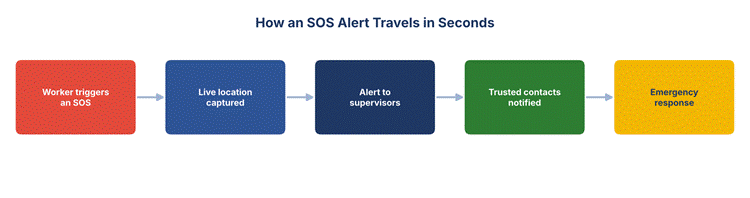
An SOS alert is the fastest way for a worker to call for help. At its simplest, the worker presses an SOS button or panic button on a wearable tag, badge, or mobile device. The moment they send an SOS, the system does the rest in seconds:
- Capture location: The worker’s live location is attached to the alert, so responders know exactly where to go.
- Notify the team: Supervisors and trusted contacts are alerted instantly on dashboards, mobile apps, or by SMS.
- Trigger response: The emergency response begins immediately, with the worker’s exact position already known.
- Log the event: All SOS events are recorded with time and location for review and compliance.
Because the alert carries live location rather than just a name, there is no guesswork — the difference between finding someone in seconds and searching a sprawling site for minutes.
Zone Alerts: Safety Before the Emergency
SOS alerts respond to a crisis; zone alerts help prevent one. By drawing virtual boundaries around hazardous areas — near heavy machinery, chemical stores, or high-voltage equipment — the system can warn a worker (and their supervisor) the instant they enter a restricted zone. This pairs naturally with anti-collision systems and PPE detection to build layered protection across the working environment.
Zone alerts can also confirm that only authorised, properly equipped workers enter a dangerous area, turning safety rules into something the system enforces automatically rather than hoping everyone remembers.
Key Features of a Worker Safety System
A complete lone worker safety solution usually combines several features:
| Feature | What It Does |
| SOS / panic button | Lets a worker trigger an SOS instantly to call for help. |
| Live location | Shows each worker’s real time position on a site map. |
| Zone alerts | Warns when a worker enters a restricted or hazardous area. |
| Fall detection | Automatically raises an alert if a worker falls or stops moving. |
| Trusted contacts | Routes alerts to the right supervisors and responders. |
| Event logging | Records every alert for compliance and review. |
Fall detection deserves special mention: if a worker collapses and cannot press the button themselves, the device detects the fall and raises the alarm automatically. Together these features cover both the moment a worker calls for help and the moment they cannot.
Modern lone worker devices including wearables, badges, and mobile apps can send your location to your trusted contacts the instant you trigger an SOS. Unlike the free trial full protection offers marketed to consumers, an industrial-grade system is built for the scale and hazards of a real working environment — with rugged panic buttons and real time location designed for the plant floor rather than a phone.
Indoor and Outdoor Coverage
Industrial sites are rarely just one building. A worker may move from an office to a warehouse to an outdoor yard in a single shift, so a safety system has to work indoor and outdoor. Outdoors, GPS provides live location across open areas; indoors, where GPS fails, technologies like BLE and UWB take over to give accurate positioning inside buildings.
The best systems hand off seamlessly between the two, so a worker is protected everywhere, backed by one RTLS and RFID platform and reliable IoT sensors throughout the site. Some solutions add time tracking and attendance on the same device, so one wearable serves several purposes.
Conclusion
Worker location and SOS alerts turn industrial safety from a plan on paper into real, active protection. With an SOS button for emergencies, zone alerts to prevent them, fall detection for when a worker cannot react, and live location that works indoor and outdoor, every person on site stays connected to help. For lone workers especially, that connection can be the difference between a close call and a tragedy.
Brilliant Info Systems designs worker safety and location systems for industrial facilities, combining SOS alerts, zone alerts, and real time tracking. Explore our labour management and safety solutions or talk to our team to protect your workforce.
Frequently Asked Questions
What is an SOS alert in a worker safety system?
It is an instant distress signal a worker sends by pressing an SOS or panic button on a wearable or mobile device. The alert carries the worker’s live location to supervisors and trusted contacts, so an emergency response can reach them immediately.
What is the difference between an SOS alert and a zone alert?
An SOS alert is triggered by the worker to call for help in an emergency. A zone alert is triggered automatically by the system when a worker enters a restricted or hazardous area — it helps prevent incidents before they happen.
How does fall detection work?
Fall detection uses motion sensors in the worker’s device to recognise a sudden fall or a long period of no movement. If it detects one, it raises an SOS automatically — vital when a worker is unconscious or unable to press the button themselves.
Does worker location tracking work both indoors and outdoors?
Yes. A good lone worker safety solution uses GPS outdoors and indoor positioning technologies such as BLE or UWB inside buildings, handing off between them so a worker’s live location is always available across the whole facility.