
Smart Warehousing for E-commerce: Handling Peak-Season Order Volumes
For an e-commerce business, peak season is make-or-break. Black Friday, festive sales, and a product going viral on social media can multiply order volumes overnight. A warehouse that copes beautifully in a quiet month can collapse under that surge — orders back up, stock counts drift, and customers get late or wrong parcels. Smart warehousing is how online retailers absorb these spikes without breaking a sweat.
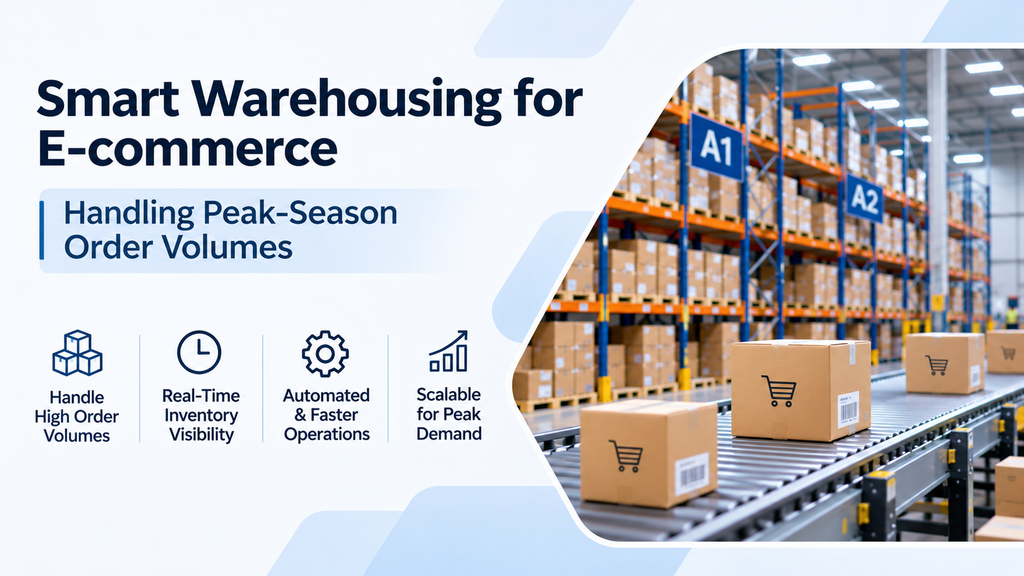
This guide explains how smart warehousing for e-commerce handles peak-season order volumes — why peaks are so hard, the technologies that tame them, and the gains for speed, accuracy, and customer experience.
▶ Watch: Brilliant Info Systems on YouTube
What You’ll Learn
- Why peak season breaks ordinary warehouses
- What “smart warehousing” actually means
- The technologies that handle peak volumes
- The benefits for your business and customers
Why Peak Season Is So Hard
E-commerce demand is spiky by nature. A single marketing push, a holiday, or a trend on social media can send order volumes soaring in hours. Manual warehousing operations that rely on people walking, counting, and keying data simply cannot scale that fast. As volumes climb, so does human error — mispicks, wrong counts, and oversells — exactly when customers are least forgiving.
The classic peak-season failures are familiar: stock levels that no longer match reality, so you sell items you do not have; pickers overwhelmed and making mistakes; and a supply chain that cannot keep pace with the surge. Every one of these damages customer service and the customer experience, and the cost of fixing them — returns, refunds, lost loyalty — lands right when margins are tightest.
What Smart Warehousing Means
Smart warehousing uses connected technology — the internet of things iot, artificial intelligence, automation, and real-time data — to run a warehouse that senses demand and responds automatically. Instead of people reacting late, the system sees the surge coming and adapts: reprioritising orders, directing labour, and keeping stock counts accurate every second.
The growing smart warehousing market reflects how essential this has become for online retail. These smart warehousing technologies turn a warehouse from a fixed-capacity bottleneck into a flexible engine that scales with demand — the difference between thriving at peak and drowning in it. For online sellers, this is the backbone of modern e-commerce fulfilment.
The Technologies That Handle Peak Volumes
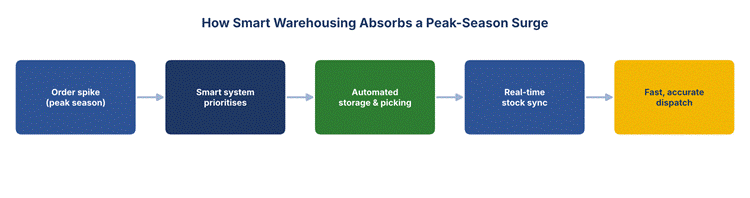
Several technologies work together to absorb a peak-season surge:
Automation & Robotics
Automated storage and retrieval systems (ASRS) and automated guided vehicles move goods without manual forklifts, so throughput is not limited by how fast people can walk. They keep running at full speed through the busiest days.
Real-Time Inventory & Tracking
Accurate inventory management is everything at peak. RFID technology and real-time RTLS solutions keep stock levels correct to the second, feeding inventory visibility that prevents overselling across every channel.
Smart Order Fulfilment
An order management system prioritises and routes every order, while pick-to-light speeds up picking and slashes errors. Built on connected IoT sensors, the whole operation stays coordinated as volumes climb.
The Benefits for Your Business
Smart warehousing turns the stress of peak season into a competitive advantage:
| Benefit | What It Means at Peak |
| Scales with demand | Handle Black Friday volumes without a matching rise in staff. |
| Fewer errors | Automation cuts human error, so customers get the right order. |
| Accurate stock | Real-time counts stop overselling and disappointed buyers. |
| Faster fulfilment | Orders ship quickly even on the busiest days. |
| Happier customers | On-time, correct deliveries protect loyalty and reviews. |
There is a sustainability angle too: by optimising space, routes, and energy, smart, eco friendly warehouse operations cut waste and running costs — good for the planet and the bottom line. And because the technology scales down as well as up, you are not paying for peak capacity all year round.
Preparing Your Warehouse for Peak Season
E-commerce is all about buying or selling online at speed, and peak is when that speed is tested hardest. Smart warehousing works best when you plan ahead rather than scramble in November. A few practical steps make the difference:
- Get inventory accurate first: Real time data on stock levels is the foundation — you cannot fulfil what you cannot see, and overselling is the fastest way to lose a customer.
- Automate the busiest flows: Target the picking and packing lanes that handle the most volume, where automation pays back fastest.
- Forecast and pre-position stock: Use sales and social media signals to predict demand and slot fast-movers close to packing before the rush.
- Stress-test before the peak: Run a trial surge so bottlenecks surface in October, not on Black Friday.
- Connect your channels: Sync the warehouse with every sales channel so stock and orders stay consistent everywhere you sell.
Done well, this turns peak from a yearly panic into a repeatable, profitable routine — and the same smart warehousing operations keep paying off all year, not just at Christmas.
Conclusion
Peak season rewards the prepared. For e-commerce, smart warehousing is how you turn a flood of orders into a smooth, profitable surge rather than a crisis. By combining automation, real-time inventory, and intelligent order fulfillment, online retailers can scale with demand, cut errors, keep stock accurate, and delight customers when it matters most. In a market where one bad peak can cost years of loyalty, smart warehousing is no longer a luxury — it is how you win.
Brilliant Info Systems builds smart warehousing and automation solutions for e-commerce, from real-time inventory to full fulfilment automation. Explore our e-commerce solutions or talk to our team to get peak-season ready.
Frequently Asked Questions
What is smart warehousing for e-commerce?
It is the use of IoT, automation, AI, and real-time data to run an online retailer’s warehouse so it can sense demand and respond automatically — scaling throughput, keeping stock accurate, and shipping orders fast, especially during peak season.
How does it help during peak season?
Automation keeps throughput high when order volumes spike, real-time inventory stops overselling, and smart order routing prioritises fulfilment. Together they let a warehouse absorb a Black Friday surge without the errors and delays manual operations suffer.
Do I need to automate everything at once?
No. Most retailers start with the highest-impact areas — usually real-time inventory and faster picking — and expand over time. Smart warehousing technologies are modular, so you can scale the investment as your order volumes grow.
Does smart warehousing reduce errors?
Yes. By automating picking, counting, and data capture, it removes much of the human error that spikes when people are rushed at peak — protecting accuracy, customer service, and your reputation.