
Cold Storage Monitoring: Temperature, Humidity & Compliance
In cold storage, a few degrees can be the difference between safe product and a costly write-off. Frozen food, fresh produce, vaccines, and chemicals all have strict temperature and humidity windows — and if those windows are breached, stock spoils and regulators take notice. Cold storage monitoring uses connected sensors to watch conditions around the clock, so problems are caught in minutes, not on the next manual round.
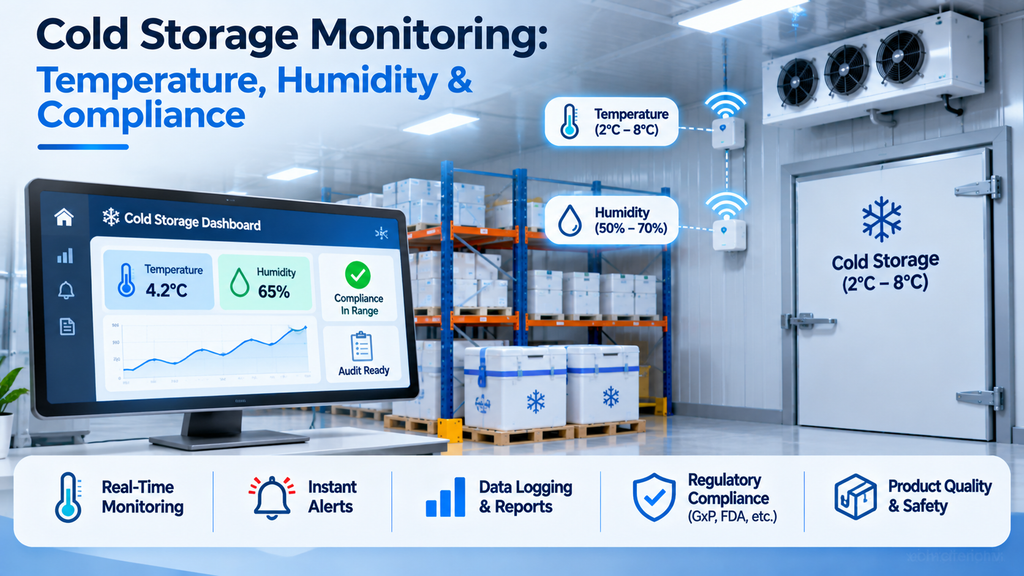
This guide explains cold storage monitoring — how temperature and humidity tracking works, why it matters for compliance, and the benefits for any business running a cold chain.
▶ Watch: Brilliant Info Systems on YouTube
What You’ll Learn
- Why temperature and humidity matter
- How cold storage monitoring works
- How it supports compliance
Why Temperature and Humidity Matter
Cold storage is about holding a stable environment. Temperature monitoring keeps product within its safe band — often within a degree Celsius or two — while humidity levels control moisture that can cause frost, mould, or dehydration. Both must stay in range for food safety and product quality across the cold chain.
Quick refresher: temperature is measured on temperature scales such as the Celsius scale, and most cold stores target low but above-freezing absolute temperatures for chilled goods. Humidity is the amount of water held in the air — absolute humidity is the actual quantity, while relative humidity compares it to the maximum the air temperature can hold. Unlike a one-off body temperature check, cold storage needs these values watched continuously, because even short temperature fluctuations can spoil a whole batch.
How Cold Storage Monitoring Works
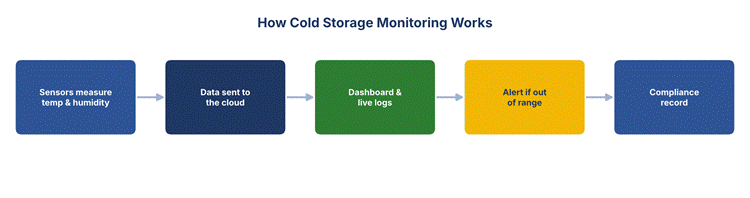
Modern monitoring solutions replace manual clipboard checks with automatic, always-on sensing:
- Sensors measure conditions: Temperature sensors and humidity sensors in each zone read conditions continuously.
- Data goes to the cloud: Readings stream to a central platform in real time, building a complete history.
- Dashboards and alerts: Staff see live conditions, and the system raises an instant alert if a reading drifts out of range.
- Automatic records: Every reading is logged for audits — no manual paperwork.
Built on reliable IoT sensors and smart sensors, these monitoring systems watch every zone at once and send alerts by SMS or email the moment something is wrong — so a failing fridge is caught before the stock is.
The same approach works across every kind of cold storage — chilled and frozen warehouses, pharmaceutical fridges, cold rooms, and refrigerated transport. Because sensors are wireless and battery-powered, they can be added to existing units without rewiring, and the system scales from a single cold room to a multi-site network on one dashboard. That makes it practical to start small and expand as the operation grows.
How It Supports Compliance
For regulated goods, proof is everything. Cold storage monitoring turns compliance from a manual burden into an automatic by-product of daily operations:
| Benefit | What It Means |
| Audit-ready records | A complete, time-stamped log satisfies compliance officers and inspectors instantly. |
| Lower compliance risk | Automatic alerts prevent breaches that could fail an audit or trigger a recall. |
| Less waste | Catching a fault early saves the stock instead of losing a full load. |
| Stronger governance | Reliable data supports food safety standards and corporate governance reporting. |
The same data strengthens the wider supply chain. Paired with RFID traceability, asset tracking, and inventory visibility, condition data proves not just where a product was, but that it stayed safe the whole way — and feeds predictive maintenance that keeps refrigeration running.
Conclusion
In cold storage, conditions change fast and the cost of getting them wrong is high. Continuous temperature and humidity monitoring catches problems in minutes, protects product quality and food safety, and turns compliance into an automatic record rather than a manual chore. For any business running a cold chain, monitoring is the cheapest insurance it can buy.
Brilliant Info Systems builds cold storage and cold chain monitoring solutions with real-time alerts and audit-ready records. Explore our IoT sensor solutions or talk to our team to protect your cold storage.
Frequently Asked Questions
What is cold storage monitoring?
It is the continuous, automatic tracking of temperature and humidity in cold storage using connected sensors, with live dashboards, instant alerts, and automatic record-keeping to protect product quality, food safety, and compliance.
Why monitor humidity as well as temperature?
Temperature keeps product in its safe band, but humidity levels control moisture. Too much or too little causes frost, mould, or dehydration, so both must stay in range to protect stock and meet standards.
How does monitoring help with compliance?
It creates an automatic, time-stamped record of conditions and alerts you to any breach in real time. That reduces compliance risk, gives compliance officers audit-ready proof, and helps meet food safety and governance requirements.