
Pick-to-Light Systems: A Complete Guide to Faster, More Accurate Picking
Order picking is the most labour-intensive job in most warehouses — and the one where errors hurt the most. A single mis-pick means a wrong delivery, a return, and a disappointed customer. As order volumes climb and delivery windows shrink, the old approach of paper lists and manual searching simply cannot keep up. Pick-to-light is one of the most effective answers.
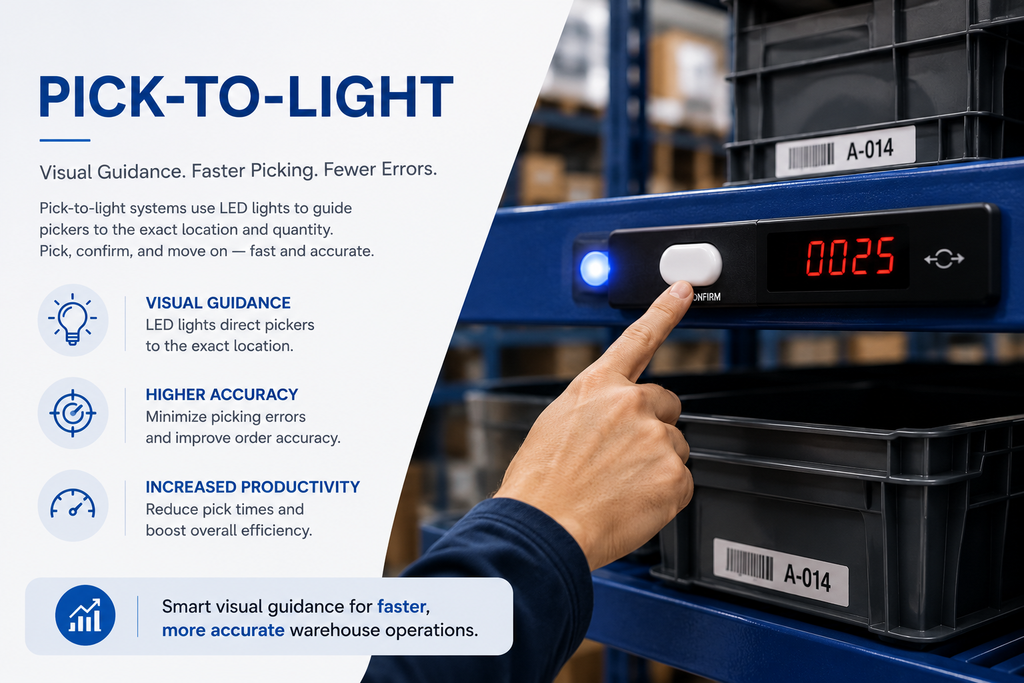
A pick-to-light system guides workers with simple, unmistakable light signals, making picking dramatically faster and more accurate. This guide explains what pick-to-light is, how it works, its components and benefits, how it compares with other methods, and where it fits best.
▶ Watch: Pick to Light
Table of Contents
- What is a pick-to-light system?
- How pick-to-light works
- Key components
- Benefits
- Pick-to-light vs other methods
- Best applications
- Put-to-light
- How to choose and integrate
- Challenges and the future
- FAQs and conclusion
What Is a Pick-to-Light System?
A pick-to-light system is an order-picking method that uses light modules mounted at storage locations to direct workers. When an order is released, the light at each location that needs picking illuminates and shows the quantity required. The worker simply goes to the lit location, picks the shown quantity, and presses a button to confirm.
It replaces reading, searching, and second-guessing with a clear visual cue: pick from the light. That simplicity is exactly why pick-to-light is one of the fastest and most accurate paperless picking methods available, especially in busy, high-volume zones.
How Pick-to-Light Works
The process is refreshingly simple for the worker, even though clever software sits behind it. Here is the typical cycle:
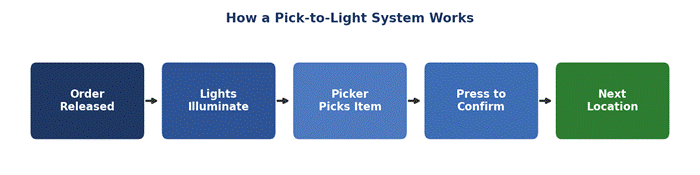
An order is released from the warehouse management system, which lights up every location that needs a pick. The worker moves to a lit location, picks the displayed quantity, and presses the confirm button. That location’s light goes out, the next lights up, and the cycle repeats until the order is complete. Because the system tracks every confirmed pick, it updates inventory in real time and catches missed steps instantly.
Key Components of a Pick-to-Light System
A pick-to-light setup is built from a few core parts working together:
- Light modules and displays: mounted at each location to show which to pick and how many.
- Confirmation buttons: let the worker signal that a pick is complete.
- Controller: coordinates the lights and communicates with the software.
- WMS integration: releases orders to the lights and records every confirmed pick.
The lights guide the worker; the controller and WMS integration turn each pick into accurate, real-time data.
The Benefits of Pick-to-Light
Pick-to-light delivers gains that show up immediately on the warehouse floor:
- Higher picking speed: workers go straight to the lit location with no searching or reading.
- Excellent accuracy: clear visual cues and confirmation sharply reduce mis-picks.
- Faster training: the “pick from the light” logic is intuitive, so new staff are productive quickly.
- Paperless operation: no pick lists to print, carry, or lose.
- Real-time inventory: every confirmed pick updates stock instantly.
- Higher productivity: more orders per hour from the same team and space.
Pick-to-Light vs Other Picking Methods
How does pick-to-light compare with the alternatives? Each method has its place, and many warehouses combine them, but for dense, high-volume zones pick-to-light is hard to beat.
| Method | How it works | Accuracy | Speed |
| Pick-to-Light | Lights show the location and quantity | Very high | Very fast |
| Paper pick list | Printed list, picked manually | Lower | Slow |
| RF scanning | Handheld scanner directs the picker | High | Moderate |
| Pick-by-Voice | Spoken instructions via a headset | Very high | Fast |
Paper lists are cheapest but slow and error-prone. RF scanning is flexible and mobile. Pick-by-voice keeps hands and eyes free for large areas. Pick-to-light wins on raw speed and accuracy in fixed, high-density picking zones.
Best Applications for Pick-to-Light
Pick-to-light shines in specific scenarios. It is ideal for high-volume operations with many picks concentrated in a compact area — such as e-commerce fulfilment, pharmaceutical distribution, and parts picking. It works best where locations are fixed and picking is dense, so the light modules earn their keep. For fast-moving zones with frequent picks from the same shelves, few methods match its throughput and accuracy.
Put-to-Light: The Reverse Approach
A close cousin of pick-to-light is put-to-light, which reverses the logic. Instead of guiding picks from storage, put-to-light guides the placing of items into order slots — lighting up which order each item belongs to. It is widely used to sort batch-picked goods into individual orders, and often works alongside pick-to-light in the same operation.
How to Choose and Integrate Pick-to-Light
Pick-to-light is not right for every zone, so match it to your operation. It suits fixed, high-density, high-volume picking areas rather than sprawling, low-frequency storage. Consider your order profile, pick density, and how the system will integrate with your warehouse management system and wider material handling automation. As with any automation, a pilot in one zone confirms the benefit before you scale.
Challenges to Plan For
Pick-to-light delivers strong results, but a few factors need planning. The hardware is a fixed investment tied to specific locations, so it is less flexible if your slotting changes often. It also needs proper integration with your WMS to work, and, like any equipment, the light modules need occasional maintenance. Designed around the right zones, though, these are minor next to the productivity gains.
The Future of Pick-to-Light
Pick-to-light continues to evolve alongside wider warehouse automation. It increasingly works in tandem with conveyors, robotics, and goods-to-person systems to create highly efficient picking cells. Combined with real-time data and analytics, it helps warehouses squeeze even more speed and accuracy from their picking operations as e-commerce demand keeps rising.
Conclusion
Pick-to-light turns one of the warehouse’s hardest jobs into one of its simplest: pick from the light. By guiding workers with clear visual cues and confirming every pick, it delivers outstanding speed and accuracy while cutting training time and paperwork.
It is not the right tool for every zone, but in dense, high-volume picking areas, few methods come close. Integrated with your WMS and wider automation, pick-to-light is one of the most effective ways to lift picking productivity and keep customers happy.
Speed Up Your Picking with Brilliant Info Systems
Brilliant Info Systems designs and integrates pick-to-light and put-to-light systems — connected to your warehouse management system and wider material handling automation. Talk to our team to design a faster, more accurate picking operation.
Frequently Asked Questions
What is a pick-to-light system?
It is an order-picking method that uses light modules at storage locations to show workers exactly where and how much to pick, then confirms each pick with a button press — making picking fast, accurate, and paperless.
How does pick-to-light improve accuracy?
Clear visual cues remove the guesswork of reading lists and searching shelves, and the confirmation step catches errors immediately. This sharply reduces mis-picks compared with manual methods.
Is pick-to-light better than pick-by-voice?
Neither is universally better. Pick-to-light is faster in dense, fixed zones, while pick-by-voice keeps hands and eyes free for picking across large areas. Many warehouses use both where each fits best.
Pick-to-light turns one of the warehouse’s hardest jobs into one of its simplest: pick from the light. By guiding workers with clear visual cues and confirming every pick, it delivers outstanding speed and accuracy while cutting training time and paperwork.
It is not the right tool for every zone, but in dense, high-volume picking areas, few methods come close. Integrated with your WMS and wider automation, pick-to-light is one of the most effective ways to lift picking productivity and keep customers happy.
What is the difference between pick-to-light and put-to-light?
Pick-to-light guides picking items from storage, while put-to-light guides placing items into order slots. Put-to-light is often used to sort batch-picked goods into individual orders.
Does pick-to-light integrate with a WMS?
Yes. The WMS releases orders to the lights and records every confirmed pick, so inventory updates in real time and picking is coordinated with the rest of the operation.
Where is pick-to-light most useful?
It is most effective in high-volume, high-density picking zones with fixed locations — such as e-commerce fulfilment, pharmaceutical distribution, and parts picking.