
How RFID Improves Inventory Accuracy in Warehouses
Ask any warehouse manager about their biggest headache and inventory accuracy will be near the top. When the system says an item is in stock but the shelf is empty — or the other way round — the consequences ripple everywhere: missed orders, unhappy customers, rushed purchases, and hours lost reconciling the numbers. Most of this comes down to how stock is counted.
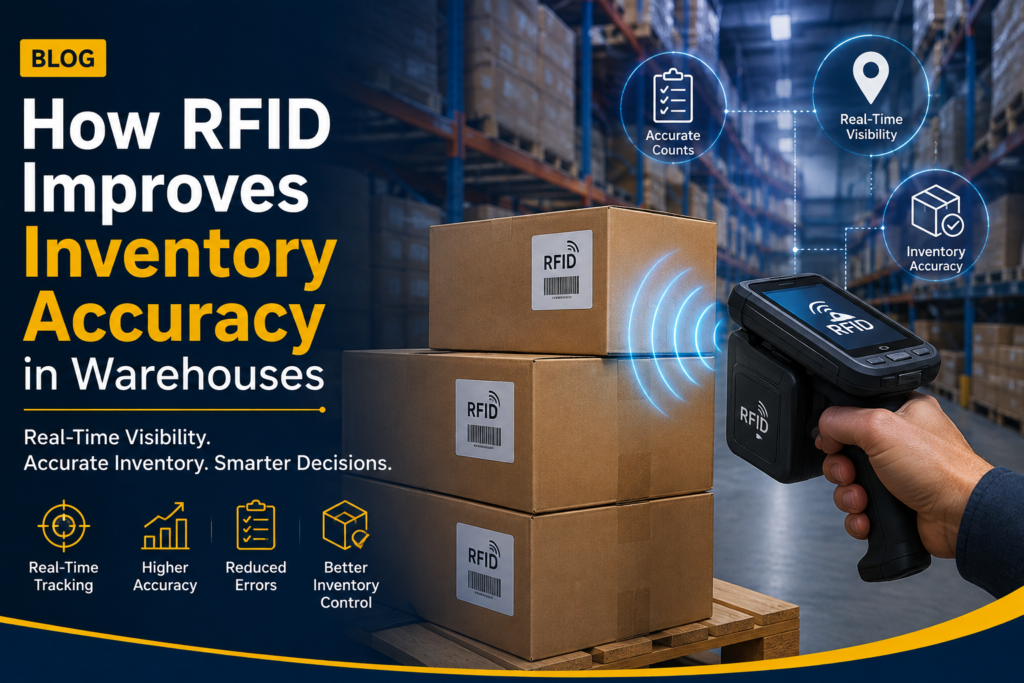
For decades, warehouses have relied on barcode systems and manual counts to track inventory. They work, but they are slow and prone to human error, which lets accuracy drift between counts. Radio frequency identification (RFID) takes a different approach. This guide explains exactly how RFID improves inventory accuracy in warehouses, and why so many distribution centres are making the switch. If you are new to the technology, our guide on what RFID is and how it works covers the basics.
▶ Watch: RFID Inventory Management
Table of Contents
- Why inventory accuracy matters
- Why barcodes and manual counts fall short
- How RFID keeps inventory accurate
- Barcode vs RFID for accuracy
- The wider benefits
- A real-world example
- Implementation and best practices
- FAQs and conclusion
Why Inventory Accuracy Matters
Inventory accuracy is the gap between what your system says you have and what is physically on the shelf. High accuracy keeps warehouse operations running smoothly; low accuracy quietly costs money everywhere.
When stock levels are wrong, you oversell items you do not have, tie up cash in dead stock you forgot about, and send staff hunting for goods that were never there. Across busy supply chains, even a few percentage points of inaccuracy translate into late orders, emergency shipments, and lost trust. It also forces teams to hold extra safety stock as a buffer against uncertainty, tying up cash that could be working elsewhere. Accurate, real-time inventory is the foundation everything else depends on — from reliable customer promises to lean, cost-effective stock levels.
Why Barcodes and Manual Counts Fall Short
Barcode systems were a huge step up from pen and paper, and they remain useful. But for keeping inventory accurate, they have built-in limits. Every barcode must be scanned individually, in the right orientation, with a clear line of sight. That makes counting slow and labour-intensive.
Because full stock checks take so long, they happen infrequently — often only once a quarter. Between counts, accuracy drifts as small errors accumulate: a mis-scan here, a missed item there, a keystroke mistake somewhere else. The result is data that is only truly accurate on counting day, and steadily less reliable after that.
How RFID Keeps Inventory Accurate
RFID tackles accuracy at its root by removing the manual, one-at-a-time bottleneck. RFID tags attached to items respond to radio waves from RFID readers, so many tags can be read at once, without line of sight, and without anyone typing anything.
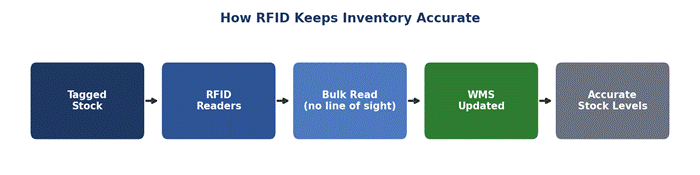
That single change drives several improvements in accuracy:
| How RFID improves accuracy | What it means in the warehouse |
| Automatic, real-time updates | Stock records change the moment goods move |
| Bulk reading | Whole pallets counted in seconds, not item by item |
| No line of sight | Tags read inside cartons and on packed pallets |
| Fewer manual steps | Less typing and scanning means fewer human errors |
| Frequent cycle counts | Fast reads make regular stock checks practical |
Real-Time, Automatic Updates
As tagged goods move through the warehouse — arriving, being put away, picked, or shipped — RFID readers capture each movement automatically and update the system instantly. Stock levels reflect reality in real time, rather than waiting for the next manual count.
Bulk Reading Without Line of Sight
An RFID reader can capture an entire pallet of tagged items in seconds, even when they are boxed or stacked. Because tags can be read through packaging and in bulk, counting that once took hours happens almost instantly — and nothing is missed because it was hidden at the back.
Fewer Human Errors
Manual scanning and data entry are where most inventory errors creep in. By automating data capture, RFID removes those steps, so the miscounts, double-scans, and typos that erode accuracy simply do not happen. The data is captured by the system, not by hand.
Frequent, Effortless Stock Checks
Because RFID makes counting so fast, warehouses can run cycle counts often — even continuously — instead of once a quarter. Frequent stock checks catch discrepancies early, before they grow, keeping accuracy consistently high rather than letting it drift and then correcting it in one painful count.
Where RFID Improves Accuracy, Stage by Stage
RFID keeps inventory accurate at every point goods move through the warehouse, not just at a single count. Here is how it helps at each stage:
- Receiving: entire inbound pallets are read at the dock in seconds and checked against the purchase order, so stock is recorded accurately the moment it arrives — not hours later.
- Put-away: as goods are stored, RFID confirms what went where, so the system always knows the correct location and quantity of every item.
- Picking: reads confirm the right items are picked in the right quantities, catching mistakes before they reach the customer.
- Cycle counting: fast bulk reads make frequent counts painless, so discrepancies are found and fixed continuously.
- Dispatch: outbound loads are verified automatically, ensuring what leaves matches the order and the records.
Because accuracy is maintained at each of these points, errors have far fewer chances to creep in — and any that do are caught quickly rather than surfacing weeks later.
Barcode vs RFID for Inventory Accuracy
Both technologies have their place, and many warehouses use them together. But for keeping inventory accurate, the differences are clear. This comparison sums it up — for a deeper look, see our guide on RFID vs barcode.
| Factor | Barcode systems | RFID systems |
| Scanning | One item at a time | Many tags read at once |
| Line of sight | Required | Not required |
| Stock checks | Slow, so done less often | Fast, so done more often |
| Human error | Higher (manual scans) | Lower (automated reads) |
| Data | Point-in-time | Real-time |
| Typical accuracy | Good, but drifts between counts | Consistently high |
Barcodes remain cheap and simple for low-volume identification. RFID wins where accuracy, speed, and real-time visibility matter most — which is why high-volume distribution centres increasingly rely on it.
The Wider Benefits of Accurate RFID Inventory
Better accuracy is valuable in itself, but it also unlocks a chain of benefits across warehouse operations:
- Lower labour costs: automated counting frees staff from slow manual stocktakes.
- Real-time inventory visibility: everyone works from live, trustworthy stock levels.
- Fewer stockouts and less dead stock: accurate data means smarter reordering.
- Faster fulfilment: staff find and pick the right items without second-guessing the system.
- Better supply chain decisions: reliable real-time data improves planning across the supply chain.
Feeding this accurate data into your inventory visibility and RFID tracking systems turns raw reads into decisions you can trust.
A Real-World Example
Consider a distribution centre that ran on barcodes, with quarterly stock counts. Accuracy sat around 96% just after each count, then slipped over the following weeks as errors accumulated, causing regular stockouts and mis-picks. After tagging inbound stock and installing RFID readers at receiving, put-away, and dispatch, the picture changed.
Inventory updated automatically as goods moved, and quick RFID cycle counts replaced the slow quarterly marathon. Accuracy climbed above 99% and, crucially, stayed there — because discrepancies were caught within days, not months. Fewer stockouts, faster picking, and far less time spent reconciling numbers followed naturally.
Implementation and Best Practices
Getting these results depends on a well-planned rollout — the same approach we cover in our guide to implementing RFID. Start by defining your accuracy goals and tagging the right stock. Place RFID readers at the key points where goods move — receiving, put-away, and dispatch — so movements are captured automatically.
Test tags and readers around metal and liquids, which can affect radio waves, and run a pilot in one area before scaling. Above all, integrate RFID with your warehouse management system so the accurate data flows straight into the workflows your team already uses. Train staff, measure the improvement, and expand from there.
Challenges to Plan For
RFID delivers strong accuracy gains, but a few practical points need managing. Metal and liquids can interfere with radio waves, so tags and reader positions should be tested around your actual products. Tag cost is higher than barcode labels, which matters for very high volumes of low-value items. And the system must be integrated properly with your WMS, or the accurate reads never turn into accurate records. None of these is a barrier — each is simply a factor to plan for, ideally with an experienced partner.
The Future of RFID and Inventory Accuracy
As warehouses connect more of their operations, RFID data increasingly feeds AI and Industrial IoT systems that predict demand and flag issues before they happen. Combined with automation, accurate real-time inventory becomes the backbone of the self-correcting, data-driven warehouse — where stock records are always current and decisions are made on facts, not estimates.
Conclusion
Inventory accuracy is the foundation of a well-run warehouse, and RFID improves it at the source. By reading many items at once, automatically and in real time, RFID removes the manual bottlenecks and infrequent counts that let accuracy slip — keeping stock records consistently reliable instead of accurate only on counting day.
Barcodes still have their place, but for high-volume warehouses that live and die by accurate stock, RFID is one of the most effective investments available. The result is fewer stockouts, lower labour costs, and data your whole operation can finally trust.
Improve Your Inventory Accuracy with Brilliant Info Systems
Brilliant Info Systems designs and integrates RFID inventory and tracking solutions connected to your warehouse management system — so your stock levels stay accurate in real time. Talk to our team to see how RFID can lift inventory accuracy across your warehouse.
Frequently Asked Questions
How does RFID improve inventory accuracy?
RFID reads many tagged items at once, automatically and without line of sight, and updates stock in real time. This removes the manual scanning and infrequent counts that cause barcode-based accuracy to drift.
Is RFID more accurate than barcodes?
For inventory accuracy at scale, generally yes — because RFID automates data capture and enables frequent counts. Barcodes remain accurate for low-volume identification but rely on manual, one-at-a-time scanning.
How much can RFID improve inventory accuracy?
Results vary by warehouse, but many operations move from mid-90s barcode accuracy to consistently above 99% with RFID, largely because discrepancies are caught quickly through frequent cycle counts.
Does RFID replace barcodes completely?
Not necessarily. Many warehouses use both — barcodes for simple, low-cost identification and RFID for fast, accurate, real-time inventory. A hybrid approach is common during the transition.
How does RFID reduce human error?
By capturing stock data automatically as items move, RFID removes the manual scanning and typing where most errors occur, so miscounts and data-entry mistakes are largely eliminated.
Can RFID inventory data connect to my WMS?
Yes. RFID reads flow through middleware into your warehouse management system, so inventory records update automatically and stay accurate across your operation in real time.