
RFID vs BLE vs LoRaWAN: Complete Comparison Guide for Asset Tracking & Inventory Visibility
Losing track of assets is expensive — whether it is a misplaced tool, a container that never came back, or stock nobody can find. To fix it, businesses reach for a tracking technology, and three names dominate the conversation: RFID, BLE, and LoRaWAN. Each promises better asset visibility, yet they work in very different ways and suit very different jobs.
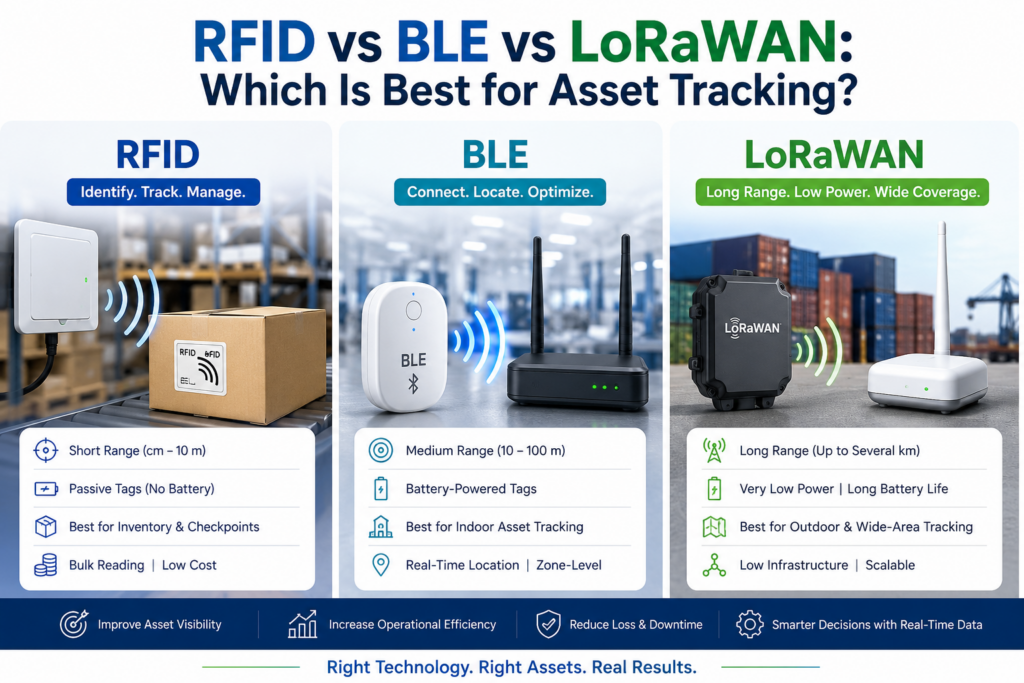
So which is best? The honest answer is that it depends on what you need to track, how far, and how precisely. This guide compares RFID vs BLE vs LoRaWAN across range, power, cost, and accuracy, then helps you match the right one to your use case. For the fundamentals of one of them, see our guide on what RFID is and how it works.
▶ Watch: RTLS Asset Tracking
Table of Contents
- The quick answer
- What is RFID?
- What is BLE?
- What is LoRaWAN?
- Side-by-side comparison
- How to choose
- Real-world examples & hybrids
- FAQs and conclusion
The Quick Answer
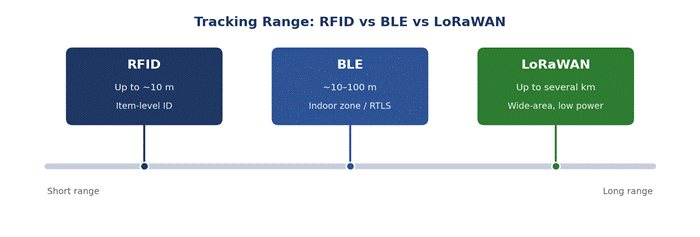
At a glance, the three technologies sit at different points on the tracking-range spectrum. RFID is short-range and ideal for item-level identification. BLE is medium-range and excels at continuous indoor asset tracking. LoRaWAN is long-range and low-power, built for wide-area and outdoor visibility.
What Is RFID?
Radio frequency identification uses radio waves to identify tagged items. Passive RFID tags need no battery — they are powered by RFID readers — which makes them cheap and long-lasting. RFID shines at checkpoints: reading whole pallets at a dock door or confirming stock as it moves, all without line of sight.
Its strength is item-level identification and inventory accuracy at low unit cost. Its limit is range: RFID tells you an item passed a reader, rather than continuously tracking exactly where it is across a large space. For high-volume inventory and controlled checkpoints, though, that trade-off is well worth it, and passive tags can last the life of the asset they are attached to.
What Is BLE (Bluetooth Low Energy)?
Bluetooth Low Energy uses small, battery-powered BLE tags that broadcast a signal to fixed receivers. It is the workhorse of indoor real-time location systems (RTLS), giving continuous, zone-level visibility of where assets are inside a building.
BLE offers a good balance of range, accuracy, and cost, and techniques like angle of arrival can sharpen its location accuracy further. Because most modern devices already speak Bluetooth, the supporting infrastructure is relatively inexpensive to deploy. The trade-off is that BLE tags contain batteries that eventually need replacing, and it is best suited to indoor or campus environments rather than wide outdoor areas.
What Is LoRaWAN?
LoRaWAN (Long Range Wide Area Network) is built for exactly what its name suggests: tracking assets across long distances on very low power. A single gateway can cover a large yard, campus, or even several kilometres, and LoRaWAN tags are famous for their long battery life.
It does not offer the pinpoint accuracy of BLE or the item-level detail of RFID — location tends to be coarser, area-level. But for wide-area, outdoor asset visibility where power and infrastructure are limited, nothing matches its reach and efficiency. Because so few gateways are needed to blanket a large area, LoRaWAN is often the most practical choice for sprawling sites where running cables or installing dense receivers would be impractical.
RFID vs BLE vs LoRaWAN: Side-by-Side
Here is how the three compare across the factors that matter most for asset tracking:
| Typical range | RFID | BLE | LoRaWAN |
| Read range | Short range | Medium range | Long range |
| Power | Passive tags need no battery | Battery-powered tags | Very low power, long battery life |
| Best environment | Item-level, dock doors | Indoor zone / RTLS | Wide-area, outdoor |
| Real-time location | Checkpoint reads | Continuous, zone-level | Periodic, wide-area |
| Accuracy | High at the reader | Good (angle of arrival improves it) | Coarse, area-level |
| Unit cost | Lowest per tag | Medium | Higher tag, low network cost |
| Line of sight | Not required | Not required | Not required |
| Typical use | Inventory & asset ID | Indoor asset tracking | Yard, fleet, construction site |
The pattern is clear: RFID for identification, BLE for indoor real-time location, and LoRaWAN for long-range, low-power coverage. None is universally best — each wins in its own zone.
How to Choose the Right Technology
Start from the job, not the technology. Ask what you need to track, over what distance, how precisely, and in what environment. This table maps common needs to the best fit:
| If you need to… | Best fit | Why |
| Identify items at receiving or dispatch | RFID | Best for inventory & checkpoints |
| Track assets live inside a building | BLE | Best for indoor real-time tracking |
| Track assets across a large outdoor site | LoRaWAN | Long range on very low power |
| Monitor a fleet or construction site | LoRaWAN | Wide-area coverage without heavy infrastructure |
| Get item-level stock accuracy | Hybrid | Best for complex operations using multiple environments |
Budget and infrastructure matter too. RFID has the lowest tag cost but needs readers at every checkpoint. BLE needs receivers throughout a building. LoRaWAN needs few gateways but costlier tags. Weigh unit cost against coverage for your specific site.
Real-World Examples
Each technology has its natural home. A warehouse uses RFID to read inventory at receiving and dispatch, keeping stock accurate. A hospital or factory uses BLE to see, in real time, where mobile equipment is inside the building. A logistics yard or construction site uses LoRaWAN to track vehicles, containers, and heavy equipment spread across a wide outdoor area — all on batteries that last for years. A retailer, meanwhile, might combine RFID for stockroom accuracy with BLE beacons on the shop floor, showing how the same business can use different technologies for different jobs.
Can They Work Together?
Yes — and often they should. Many mature asset-tracking deployments combine technologies: RFID for item-level identification at key points, BLE for indoor real-time location, and LoRaWAN for the wide-area gaps in between. Tied together through a central platform and Industrial IoT, they deliver end-to-end visibility that no single technology achieves alone.
Best Practices
Define your tracking goal and the accuracy you truly need before choosing hardware — over-specifying wastes money. Pilot in your real environment, because metal, walls, and outdoor conditions all affect performance. Consider battery life and maintenance for BLE and LoRaWAN tags. And make sure whatever you choose integrates with your existing systems, so the location data actually drives decisions rather than sitting in a separate app.
The Future of Asset Tracking
Asset tracking is converging with the wider connected enterprise. As Industrial IoT and AI mature, location data from RFID, BLE, and LoRaWAN increasingly feeds real-time analytics and automated workflows. Expect more hybrid deployments, smarter tags, and tighter integration with the systems that run the business — turning raw location data into genuine operational intelligence.
Conclusion
There is no single winner in the RFID vs BLE vs LoRaWAN debate — and that is the point. RFID owns item-level identification, BLE owns indoor real-time location, and LoRaWAN owns long-range, low-power coverage. The best tracking technology for asset visibility is simply the one that matches what you need to track, where, and how precisely.
For many operations, the smartest answer is a combination — using each technology where it excels. Start by defining your goals, pilot in your real environment, and build from there.
Find the Right Asset Tracking Solution with Brilliant Info Systems
Brilliant Info Systems designs and integrates RFID and RTLS asset-tracking solutions — spanning RFID, BLE, and LoRaWAN — connected to your WMS and wider operations. Talk to our team and we will help you choose the right tracking technology for your assets and environment.
Frequently Asked Questions
What is the main difference between RFID, BLE, and LoRaWAN?
RFID identifies items at short range, BLE tracks assets in real time indoors at medium range, and LoRaWAN covers long-range, wide-area tracking on very low power. They suit different distances and use cases.
Which is best for indoor asset tracking?
BLE is usually best for continuous indoor real-time location, offering a good balance of accuracy, range, and cost. RFID also works well for identification at fixed indoor checkpoints.
Which is best for outdoor or wide-area tracking?
LoRaWAN, thanks to its long range and low power. A single gateway can cover a large yard or site, making it ideal for fleets, containers, and construction equipment.
Does RFID need a battery?
Passive RFID tags do not — they are powered by the reader, which keeps them cheap and long-lasting. BLE and LoRaWAN tags are battery-powered, though LoRaWAN tags offer very long battery life.
Can I use more than one of these technologies together?
Yes. Many deployments combine RFID, BLE, and LoRaWAN — each covering the range and use case it does best — tied together through one platform for full asset visibility.
Which technology is the cheapest?
RFID has the lowest per-tag cost, especially with passive tags, but needs readers at checkpoints. The overall cost depends on how much coverage and real-time tracking you need.