
The Benefits of Continuous Environmental Monitoring in Mining Operations
A dust reading taken once a week tells you what the air was like for a few minutes on one day. It says nothing about the other six days — or the night shift, or the sudden spike during a big blast. For mining operations under growing pressure to protect workers, communities, and the environment, those gaps are a real liability. Continuous environmental monitoring closes them, replacing occasional snapshots with unbroken, real time environmental monitoring of site conditions.
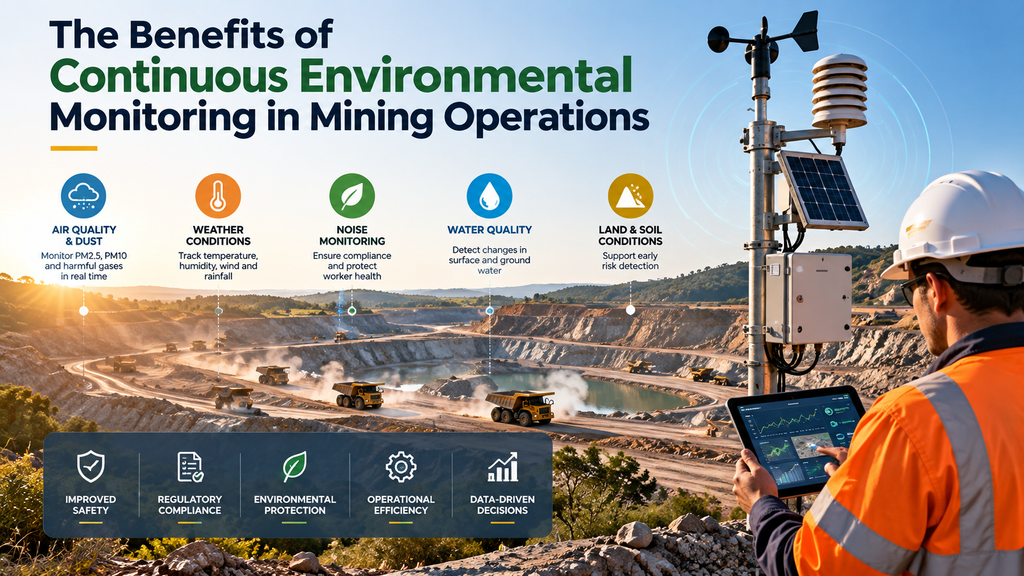
Building on our guide to environmental sensors in mining, this article focuses on why continuous monitoring specifically matters — the concrete benefits of watching environmental conditions around the clock rather than checking them now and then.
▶ Watch: Real-Time IoT Monitoring in Action
Table of Contents
- What is continuous environmental monitoring?
- Continuous vs periodic monitoring
- The key benefits
- What it monitors
- Implementing continuous monitoring
- FAQs and conclusion
What Is Continuous Environmental Monitoring?
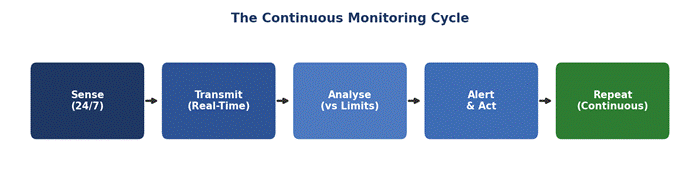
Continuous environmental monitoring is the use of connected sensors to measure environmental conditions non-stop, feeding a constant stream of environmental data to a central platform. Instead of a technician taking a reading and leaving, a continuous monitoring system watches the site 24/7, capturing every change as it happens. It is powered by IoT sensors and smart sensors spread across the operation.
The difference is not just more data — it is timely data. A problem that a weekly check might miss entirely is caught the moment it appears, which is what makes real time monitoring so much more powerful than periodic sampling. Modern monitoring systems make this constant oversight practical even across a large, remote site.
Continuous vs Periodic Monitoring
The contrast between the old and new approach is stark, and it explains why continuous monitoring has become the standard for responsible mining:
| Aspect | Periodic monitoring | Continuous monitoring |
| Data | Occasional snapshots | Always current, real time |
| Problem detection | After the fact | Immediately, as it happens |
| Coverage | Sampled points in time | 24/7, unbroken |
| Effort | Manual sampling | Automatic data collection |
| Risk management | Reactive | Proactive, with early warning |
The Key Benefits of Continuous Environmental Monitoring
Watching the environment continuously delivers benefits that occasional checks simply cannot match:
- Real-time early warning: problems such as a dust spike or a water quality change are flagged instantly, not days later.
- Stronger risk management: continuous data turns environmental risk from reactive to proactive, preventing incidents before they escalate.
- Easier compliance: an unbroken record makes proving compliance straightforward, with no gaps in the environmental monitoring data for regulators to question.
- Lower environmental impact: spotting issues early means smaller problems, faster fixes, and less lasting harm.
- Improving operations: live environmental data informs decisions on blasting, haulage, and dust control across the site.
- Reduced cost: preventing incidents avoids the fines, downtime, and remediation that periodic monitoring lets slip through.
This is the same real-time principle behind a blast vibration monitoring solution, applied to the whole environment rather than a single blast.
What Continuous Monitoring Measures
A continuous system keeps watch on the environmental conditions that matter most at a mine, all at once:
- Air quality: dust, gases, and particulate matter that affect worker health and nearby communities.
- Temperature and humidity: conditions that influence dust spread, equipment, and worker safety.
- Water quality: contamination and changes in the water around and downstream of the site.
- Noise and vibration: levels that impact health, structures, and community relations.
Modern air quality monitors and other sensors capture all of this simultaneously, building a complete, continuous picture rather than a handful of isolated readings.
Implementing Continuous Environmental Monitoring
Implementing continuous monitoring is more achievable than many operators expect. The key is to place sensors where risks and impacts are greatest, connect them to a single platform for automatic data collection, and set clear alert thresholds tied to regulations. Integrating the data with wider systems — including predictive maintenance and a digital twin of the site — multiplies its value.
For a deeper look at the sensors and full site setup, see our guides on environmental sensors in mining and blast monitoring sensors.
Conclusion
Continuous environmental monitoring turns environmental management from a series of snapshots into a live, always-current picture of a mine’s impact. That shift delivers real benefits — early warning, proactive risk management, effortless compliance, and lower environmental and financial cost.
For modern mining operations, monitoring around the clock is fast becoming the standard rather than the exception. Combined with focused monitoring solutions like a blast vibration monitoring solution, continuous environmental monitoring gives teams the complete, real-time insight they need to operate safely and responsibly.
Start Continuous Monitoring with Brilliant Info Systems
Brilliant Info Systems delivers IoT-powered continuous environmental and site monitoring — from IoT and smart sensors to blast vibration monitoring and predictive maintenance. Contact our team to set up continuous monitoring across your operation.
Frequently Asked Questions
What is continuous environmental monitoring?
It is the use of connected sensors to measure environmental conditions — air, water, dust, noise — non-stop, feeding real-time data to a central platform, rather than taking occasional manual readings.
What are the benefits of continuous monitoring in mining?
Key benefits include real-time early warning, stronger risk management, easier compliance, lower environmental impact, better operational decisions, and reduced cost from preventing incidents.
How is continuous monitoring different from periodic monitoring?
Periodic monitoring captures occasional snapshots and finds problems after the fact. Continuous monitoring watches conditions 24/7 and flags issues immediately, enabling a proactive rather than reactive response.
What does a continuous monitoring system measure?
It typically measures air quality and particulate matter, temperature and humidity, water quality, and noise and vibration — all simultaneously and in real time.
Does continuous monitoring help with compliance?
Yes. An unbroken, time-stamped record of environmental data makes demonstrating regulatory compliance straightforward, with no gaps that could raise questions.
Is continuous environmental monitoring expensive?
The investment is usually modest against the cost of a single incident it prevents. By avoiding fines, downtime, and remediation, continuous monitoring typically pays for itself over time.