
Order Management Systems (OMS): The Hub Between Sales and the Warehouse
A customer clicks “buy” — and a chain of events has to fire perfectly: the right stock must be found, the right warehouse told, the order picked, packed, shipped, and tracked, all while the customer watches their order status. Sitting in the middle of it all is the Order Management System (OMS). It is the hub that connects your sales channels to your warehouse, turning a flood of orders into smooth, accurate fulfilment.
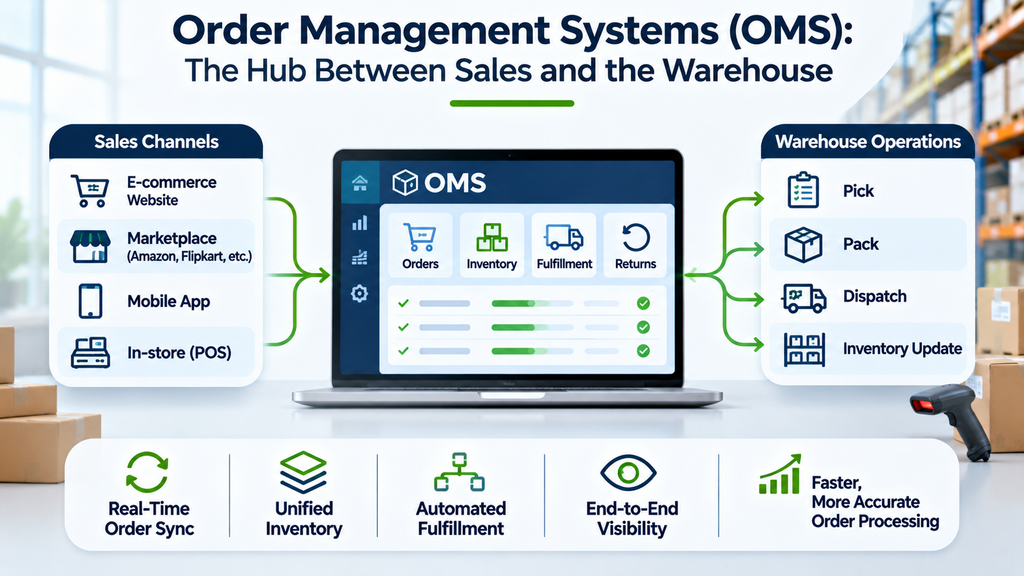
This guide explains what an order management system (OMS) does, why it is the hub between sales and the warehouse, its key features, and the benefits it brings to any business managing orders at scale.
▶ Watch: Brilliant Info Systems on YouTube
What You’ll Learn
- What an OMS is and why it matters
- How it connects sales and the warehouse
- The key features of an OMS
- The benefits for your business and customers
What Is an Order Management System?
An order management system (OMS) is software that captures, tracks, and manages customer orders from the moment they are placed to final delivery. Whether an order comes from a website, a marketplace, or a store, the OMS brings it into one place, checks stock, and routes it for fulfilment — keeping a single, accurate view of every customer order.
Think of it as the brain that sits between the front end, where sales happen, and the back end, where orders are fulfilled. Without an OMS, those two worlds drift apart: the website sells stock the warehouse does not have, orders fall through cracks, and customers are left guessing. With one, everything flows through a single, coordinated system across the whole supply chain.
The Hub Between Sales and the Warehouse
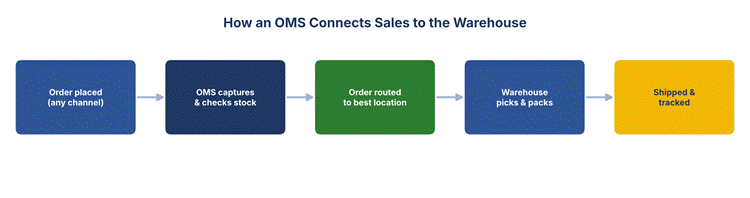
The OMS earns its “hub” name by connecting two sides that must stay in sync:
- On the sales side: It pulls orders from every channel — online store, marketplaces, retail, phone — into one queue, so no order is missed no matter where it came from.
- On the warehouse side: It checks real time inventory, decides the best place to fulfil from, and sends the order to the warehouse to pick, pack, and ship.
This order routing is the heart of an OMS. By matching each order to the right stock and location automatically, it keeps inventory visibility accurate and stops the classic failure of selling items you cannot actually ship. On the floor, it feeds systems like pick-to-light and put-to-wall so fulfilment stays fast as order volume grows.
Key Features of an OMS
A capable order management system brings together several key features:
| Feature | What It Does |
| Multi-channel capture | Brings orders from all sales channels into one system. |
| Real-time inventory | Shows live stock so you never oversell across channels. |
| Order routing | Automatically assigns each order to the best location to fulfil it. |
| Order tracking | Gives live order status to staff and customers from order to delivery. |
| Automation | Automating order steps removes manual work and errors. |
| Reporting | Turns order data into insight on demand, returns, and performance. |
Good order management software also integrates with your ERP, shipping carriers, and warehouse tools, so order data flows cleanly end to end rather than being re-keyed between systems.
The Benefits
Putting an OMS at the centre pays off across the business:
- No overselling: Real-time inventory keeps stock accurate across every channel.
- Faster fulfilment: Smart order routing and automation get orders out the door quicker.
- Scales with growth: The system absorbs rising order volume without adding chaos.
- Better customer experience: Accurate stock, fast delivery, and clear order tracking improve customer service and loyalty.
Together these turn order management from a source of errors into a competitive advantage. For businesses selling across many channels, a strong OMS and order management system is the difference between growth and gridlock — and it is central to modern e-commerce fulfilment.
How It Fits With Your Other Systems
An OMS does not replace your warehouse or accounting systems — it connects them. It passes fulfilment instructions to the warehouse, stock movements to inventory management, and financial data to the ERP, acting as the coordination layer across management systems. Real-time data from RFID and RTLS keeps its stock view accurate, while a cloud-based deployment lets it scale and connect easily, all built on reliable IoT sensors.
Signs You Need an OMS
How do you know it is time to invest in an order management system oms? A few warning signs point clearly to it:
- You oversell or run out: Stock counts differ between your website and warehouse, leading to cancelled orders.
- Orders get lost or delayed: Orders from different channels are handled in separate places, so some slip through.
- Staff re-key data: People copy order data between systems by hand, which is slow and error-prone.
- Customers ask “where is my order?”: Without live order tracking, your team cannot answer quickly, hurting customer service.
If several of these sound familiar, an OMS will likely pay for itself fast — by removing the manual work and errors that grow with every new channel and every rise in order volume.
Conclusion
An order management system is the hub that holds modern commerce together — connecting every sales channel to the warehouse, keeping inventory accurate, routing orders intelligently, and giving customers the visibility they expect. For any business managing orders at scale, the OMS is not just another tool; it is the coordination layer that lets sales and fulfilment move as one. Get it right, and growth stops being a source of chaos and becomes an advantage.
Brilliant Info Systems builds and integrates order management and fulfilment systems that connect your sales channels to the warehouse. Explore our order management system or talk to our team to unify your orders and inventory.
Frequently Asked Questions
What is an order management system (OMS)?
An OMS is software that captures and manages customer orders from every sales channel, checks real-time inventory, routes each order for fulfilment, and tracks it to delivery — acting as the hub between sales and the warehouse.
How is an OMS different from a WMS?
An OMS manages orders across all sales channels and decides where and how to fulfil them. A WMS manages the physical work inside a warehouse — receiving, storage, picking, packing. They work together, with the OMS feeding orders to the WMS.
Does an OMS prevent overselling?
Yes. By maintaining real-time inventory visibility across every channel, an OMS stops you from selling stock you do not have — one of the most common and damaging e-commerce failures.
Do I need an OMS if I only sell on one channel?
Even single-channel sellers benefit from automated order routing, accurate stock, and order tracking. The value grows as order volume rises or you add channels, when managing orders manually quickly breaks down.