
RFID ROI Calculation: Is RFID Worth the Investment?
Every RFID proposal eventually meets the same question from the finance team: “Is it actually worth it?” RFID promises real-time inventory, fewer errors, and lower labour costs — but it also costs more up front than the barcodes it replaces. The only way to answer honestly is to calculate the return on investment.
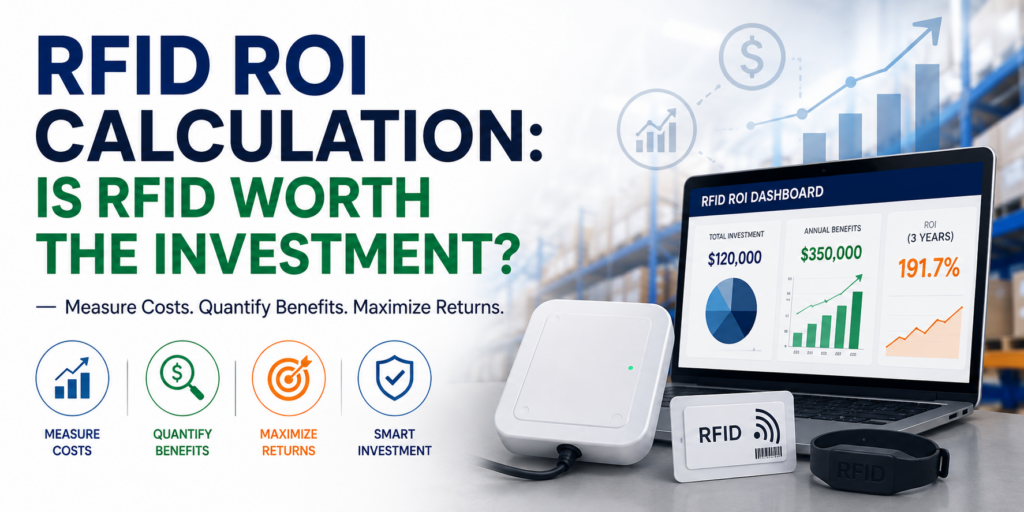
This guide shows you exactly how to work out RFID ROI: the costs to include, the savings that drive the return, the formulas to use, and a full worked example. If you are still comparing options, our guides on RFID vs barcode and how to implement RFID pair well with this one.
▶ Watch: RFID Solutions Overview
Table of Contents
- What is RFID ROI?
- The costs of an RFID system
- The savings that drive ROI
- RFID ROI formulas
- A worked example
- Factors that affect ROI
- Is RFID worth it?
- FAQs and conclusion
What Is RFID ROI?
RFID ROI simply measures what you get back compared to what you spend on an RFID system. It weighs the total cost of investing in RFID against the cost savings and gains it produces over time. A positive, timely return means the technology is paying its way; a weak return means the project needs rethinking.
A good ROI calculation looks beyond the obvious. Some benefits, such as reduced labour, are easy to measure. Others — like improved customer service from better availability — are harder to quantify but still lift the bottom line. Capturing both gives a true picture of whether RFID is worth the investment.
The Savings That Drive RFID ROI
On the other side of the ledger are the returns. An RFID system generates value in several ways, and each should be quantified where possible:
- Reduced labour: bulk reads replace slow manual counts and scans, cutting labour costs.
- Improved inventory accuracy: real-time, accurate stock means less shrinkage, fewer write-offs, and lower safety stock.
- Fewer errors: automated reads reduce the mis-ships and returns that eat into margin.
- Faster processes: quicker receiving and cycle counts lift throughput and efficiency.
- Better asset tracking: less time lost searching for tools, containers, and equipment.
- Increased sales: better product availability from accurate inventory protects revenue.
RFID ROI Formulas
A Worked RFID ROI Example
Let’s put realistic numbers to it. Imagine a mid-sized warehouse deploying RFID across receiving and storage:
| Item | Amount (₹) |
| One-time investment | |
| RFID tags (initial stock) | 6,00,000 |
| RFID readers & antennas | 14,00,000 |
| Software & middleware | 10,00,000 |
| Integration & installation | 7,00,000 |
| Training | 3,00,000 |
| Total investment | 40,00,000 |
| Annual savings | |
| Reduced labour | 18,00,000 |
| Improved inventory accuracy | 8,00,000 |
| Fewer errors & returns | 4,00,000 |
| Faster throughput | 3,00,000 |
| Increased sales (availability) | 2,00,000 |
| Gross annual savings | 35,00,000 |
| Less annual running cost | (7,00,000) |
| Net annual savings | 28,00,000 |
With a total investment of ₹40,00,000 and net annual savings of ₹28,00,000, the payback period is ₹40,00,000 ÷ ₹28,00,000, or about 1.4 years — roughly 17 months. The annual ROI is (₹28,00,000 ÷ ₹40,00,000) × 100, or about 70% a year. Over a multi-year life, the system returns several times its cost, which is a strong case by any standard.
Factors That Affect RFID ROI
Your actual return depends on a few key variables. High inventory volume and high labour costs shorten the payback dramatically, because the savings scale with activity. High-value or easily-lost stock boosts ROI through better asset tracking and less shrinkage. Conversely, very low volumes or difficult environments — lots of metal or liquid — can lengthen the payback. The clearer you are about your own numbers, the more accurate your ROI estimate will be.
So, Is RFID Worth the Investment?
For most operations with meaningful volume, the answer is yes — often with a payback under two years. RFID makes the strongest case when you are fighting high labor costs, accuracy problems, or shrinkage, and when real-time inventory would directly protect sales. It is a weaker fit for very small, low-volume operations, where barcodes may remain the more economical choice for now.
The smartest approach is to run the numbers for your own warehouse before deciding — the same discipline we cover in our warehouse automation ROI guide.
Conclusion
Calculating RFID ROI turns a promising idea into a decision the finance team can approve with confidence. Count every cost honestly, quantify the savings — labour, accuracy, errors, and availability — and use simple payback and ROI formulas to see the picture clearly.
For most warehouses with real volume, RFID pays for itself within a couple of years and keeps delivering long after. Judged over its full life, investing in RFID is one of the surest technology bets a modern warehouse can make.
Calculate Your RFID ROI with Brilliant Info Systems
Brilliant Info Systems helps businesses model, plan, and deploy RFID solutions that deliver real returns — integrated with your WMS and wider warehouse automation. Talk to our team and we will help you calculate the RFID ROI for your specific operation before you invest.
Frequently Asked Questions
How do you calculate RFID ROI?
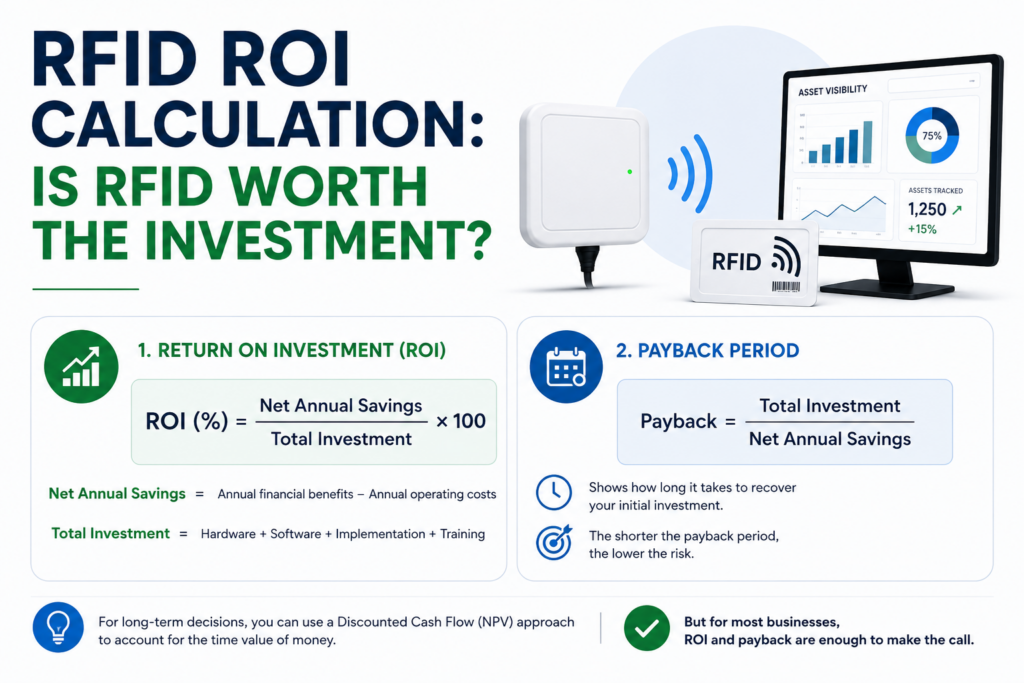
Add up the total investment, calculate the net annual savings it produces, then apply ROI (%) = (Net Annual Savings ÷ Total Investment) × 100 and Payback = Investment ÷ Net Annual Savings.
What is a typical payback period for RFID?
Many warehouses see payback within one to two years, driven mainly by reduced labour and improved inventory accuracy. Higher volumes shorten it further.
What is the biggest source of RFID savings?
Reduced labour is usually the largest saving, as bulk reads replace slow manual counts and scans. Improved inventory accuracy is typically the second biggest driver.
Is RFID worth it for a small business?
It depends on volume. For low-volume operations, barcodes may be more economical; as inventory and labour costs grow, RFID’s ROI improves and becomes worthwhile.
Does RFID increase sales?
Indirectly, yes. Accurate, real-time inventory reduces stockouts and improves availability, which protects and can increase sales — a real but often overlooked part of RFID ROI.
What ongoing costs affect RFID ROI?
Tag replenishment, maintenance, and support are the main recurring costs. Including them gives a realistic net-savings figure rather than an inflated one.