
What Is Material Handling? A Guide to Systems & Automation
Every product that reaches a customer has been moved, stored, and handled many times along the way. That constant movement of goods inside a warehouse or factory is called material handling — and how well you do it shapes your speed, cost, safety, and accuracy. Handle materials poorly and you get bottlenecks, damage, and injuries; handle them well and the whole operation flows.
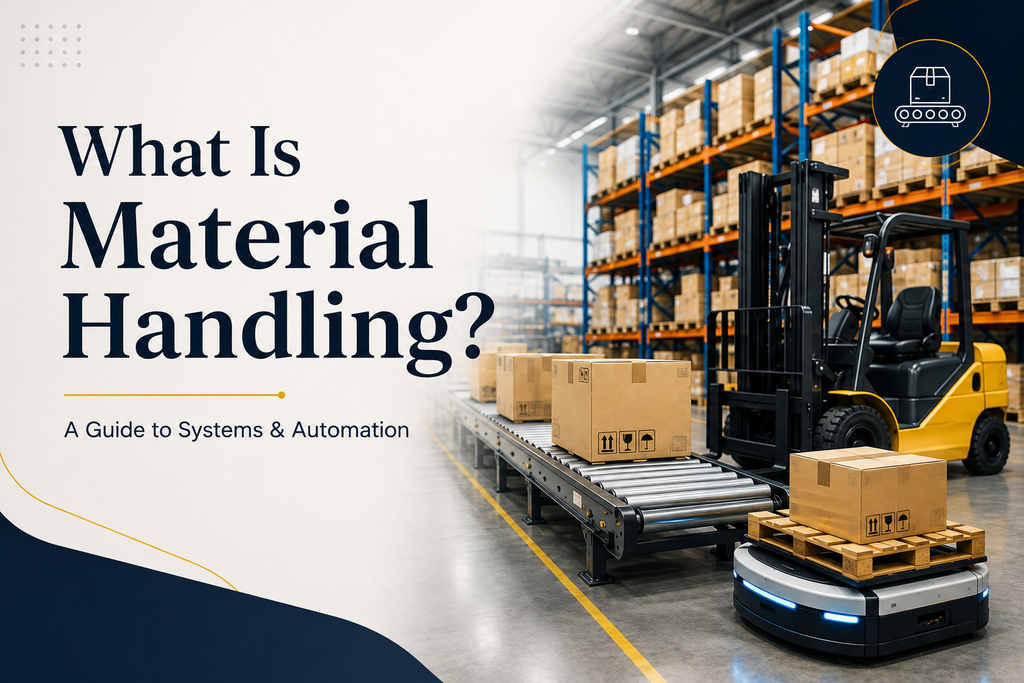
This guide explains what material handling is, the material handling process, the main types of material handling systems, and how automation is transforming the way goods move through the supply chain.
▶ Watch: Warehouse Automation in Action
Table of Contents
- What is material handling?
- The material handling process
- Types of material handling systems
- Material handling equipment and systems
- Manual vs automated
- Benefits of automation
- Material handling in the warehouse
- Industries and how to choose
- FAQs and conclusion
What Is Material Handling?
Material handling is the movement, storage, control, and protection of goods throughout their journey in a facility — from the moment they arrive to the moment they ship. It covers everything from a worker lifting a box to a fully automated crane retrieving a pallet. In short, it is the physical backbone of every warehouse, factory, and distribution centre.
Good material handling is not just about moving things; it is about moving the right things, to the right place, at the right time, safely and efficiently. Done well, it reduces manual labour, protects goods and people, and keeps the supply chain flowing. Done poorly, it becomes the hidden bottleneck behind late orders, damaged stock, and rising costs — which is why warehouse managers treat it as a strategic priority rather than an afterthought.
The Material Handling Process
Whatever the industry, material handling breaks down into four core functions that work together across the operation:
- Movement: transporting goods between receiving, storage, picking, and dispatch.
- Storage: holding materials safely and accessibly until they are needed.
- Control: tracking what you have and where it is, in real time.
- Protection: keeping goods and workers safe from damage and injury.
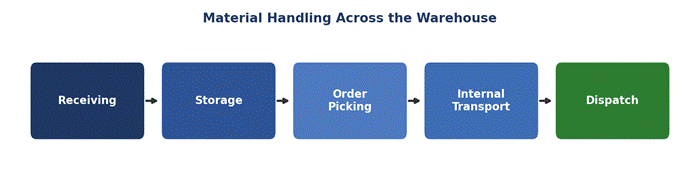
These functions repeat at every stage of the warehouse, from goods-in to dispatch, which is why improving material handling has such a broad impact on performance.
Types of Material Handling Systems
Material handling systems generally fall into three levels, and most operations use a mix of all three:
- Manual handling: people moving goods with trolleys, hand pallet trucks, and muscle — flexible but slow and physically demanding.
- Semi-automated handling: people assisted by powered equipment such as forklifts, powered conveyors, and scanners.
- Automated material handling systems: machines and software that move and store goods with minimal human effort — the direction most modern warehouses are heading.
Material Handling Equipment and Systems
Within those levels sits a wide range of equipment, each solving a different part of the movement-and-storage challenge. The table below groups the main categories:
| Category | What it does | Example systems |
| Storage systems | Hold goods densely and retrieve them | ASRS and inventory visibility |
| Transport systems | Move goods across the facility | AGVs, conveyors and yard management |
| Picking systems | Speed up and verify order picking | pick-to-light, put-to-wall |
| Tracking systems | Identify and locate items in real time | RFID & RTLS, asset tracking |
| Monitoring systems | Watch quality, docks and equipment | quality inspection, dock monitoring |
In practice these systems work together. Goods might be stored in an ASRS, carried by AGVs to a pick-to-light station, verified with RFID tracking, and tracked through inventory visibility — all coordinated as one flow.
Manual vs Automated Material Handling
The biggest decision most warehouse managers face is how far to automate. Manual handling is cheap to start and flexible, but it is slow, labour-intensive, and a major source of workplace injuries from repetitive lifting. Automated material handling systems cost more up front but move goods faster, more accurately, and more safely, while freeing staff from the heaviest, most repetitive tasks.
The hidden costs of manual handling are easy to underestimate: fatigue slows the team as a shift wears on, errors creep in, and every strain or dropped load carries a real cost in downtime and claims. Automation removes much of that variability, delivering a steady, predictable pace hour after hour. For most growing operations, the answer is not all-or-nothing but a sensible mix — automating the highest-volume, most physically demanding tasks first, often starting with storage, transport, or order picking.
The Benefits of Automated Material Handling
Automating how goods move delivers gains across the whole operation:
- Reduced manual labour: machines handle the heavy, repetitive movement.
- Fewer workplace injuries: less manual lifting and forklift traffic improves safety.
- Higher throughput: goods move continuously, speeding up order fulfilment.
- Better space utilisation: dense storage systems use the full height of the building.
- Real-time control: every movement is tracked, keeping inventory accurate.
- Lower long-term cost: efficiency and accuracy gains compound over time.
Material Handling in the Modern Warehouse
Automated material handling delivers its full value only when it is connected. Storage, transport, and picking systems tie into your order management system and ERP integration, while IoT sensors and smart sensors feed real-time data on where goods and equipment are.
That data supports labor management, predictive maintenance, and OEE monitoring, and can even feed a digital twin of the facility. Quality and safety systems such as pick validation and dock monitoring round out a fully connected, modern material-handling operation.
Industries That Rely on Material Handling
Almost every sector depends on good material handling, but some feel it most. Manufacturing plants move raw materials and finished goods around the clock. E-commerce fulfilment centres live or die by fast, accurate movement of parcels. Warehousing, logistics, pharmaceuticals, and automotive all rely on efficient handling to keep goods flowing and costs down.
How to Choose the Right Material Handling System
There is no single right answer — the best system depends on your goods, volumes, and space. Consider what you move and how often, your facility layout and available height, your safety and labour challenges, and how systems will integrate with your existing tools. Location and yard flow matter too, which is where yard management and tracking technologies like UWB tracking and BLE tracking come in. Start with your biggest bottleneck, prove the return, and scale from there.
Challenges to Plan For
Automating material handling is worth it, but a few realities need managing. The up-front investment in equipment and integration is significant, so a clear business case matters. Fixed systems like conveyors are less flexible than mobile robots if your layout changes often, and every system needs maintenance to avoid downtime. Perhaps the biggest challenge is integration: storage, transport, picking, and tracking must talk to each other and to your business systems, or you end up with islands of automation that never deliver their full value. Planning the whole flow from the start, ideally with an experienced partner, keeps these challenges manageable.
Conclusion
Material handling is the invisible engine of every warehouse and factory — the movement, storage, control, and protection of goods that keeps the supply chain running. Whether manual, semi-automated, or fully automated, getting it right lifts efficiency, safety, and accuracy across the board.
As volumes grow and customer expectations rise, automated material handling systems are increasingly the difference between an operation that struggles and one that scales. The key is to match the right systems to your needs and connect them into one seamless flow.
Optimise Your Material Handling with Brilliant Info Systems
Brilliant Info Systems designs and integrates complete material handling solutions — ASRS, AGVs, pick-to-light, RFID tracking, and more — connected through ERP integration and real-time data. Contact our team to design a faster, safer, and more efficient material-handling operation.
Frequently Asked Questions
What is material handling in simple terms?
Material handling is the movement, storage, control, and protection of goods throughout a facility — everything involved in getting materials from where they are to where they need to be, safely and efficiently.
What are the main types of material handling systems?
They range from manual handling with trolleys and pallet trucks, to semi-automated equipment like forklifts and powered conveyors, to fully automated material handling systems such as ASRS, AGVs, and robotics.
What are the benefits of automated material handling?
Automation reduces manual labour and workplace injuries, increases throughput and space utilisation, and provides real-time control of inventory — improving speed, safety, accuracy, and long-term cost.
What equipment is used in material handling?
Common systems include storage (ASRS), transport (AGVs and conveyors), picking (pick-to-light and put-to-wall), and tracking (RFID and asset tracking), usually working together as one connected operation.
How do I choose the right material handling system?
Base it on what you move, your volumes, your space, and your safety and labour challenges, and make sure it integrates with your existing systems. Start with the biggest bottleneck and scale gradually.
Why is material handling important?
Because it directly affects speed, cost, safety, and accuracy. Efficient material handling keeps the supply chain flowing, protects goods and workers, and is fundamental to a well-run warehouse or factory.